Can You Get Enough Vitamin D From Food Alone? Probably Not
Why food alone rarely covers the daily vitamin D target, how skin synthesis works, who is at risk of deficiency, and when supplementation makes sense.
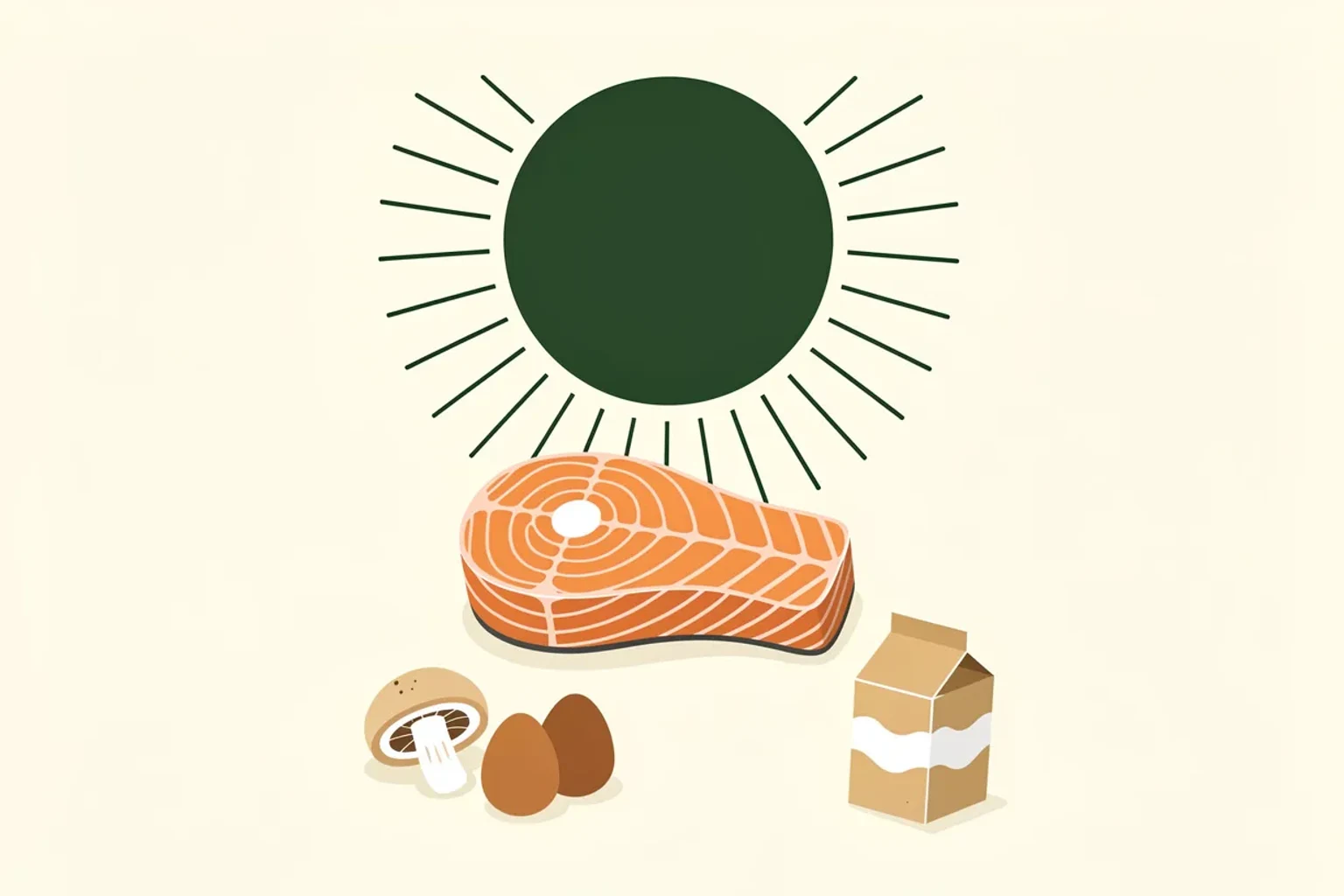
Vitamin D is called "the sunshine vitamin" for a reason: for most of human history, our skin made it from UVB rays. Diet was a side channel. The problem is that above 40° latitude, winter sun is too weak to produce any vitamin D — and most everyday foods carry only modest amounts. Food alone rarely hits the daily target. For half the world, supplementation is the usual answer.
This guide covers daily needs, the actual content of foods, how much sun delivers, who is at high risk, and how to think about supplements.
How much vitamin D you need per day
| Population | Recommendation |
|---|---|
| Adults (US RDA) | 600 IU (15 mcg) |
| Adults over 65 (US RDA) | 800 IU (20 mcg) |
| Adults (EFSA Adequate Intake) | 600 IU (15 mcg) |
| Tolerable Upper Limit (EFSA) | 4000 IU (100 mcg) |
| Vitamin D Council "safe" upper | 4000 IU — disputed by mainstream bodies |
The 4000 IU number that researchers like Holick and the Vitamin D Council push as "safe for healthy adults" sits at the EFSA upper limit, not above it. Some clinical guidelines treat 1000–2000 IU as the practical winter dose, with higher doses reserved for documented deficiency and physician supervision.
Top food sources of vitamin D
Per 100 g, unless noted. Values vary by species, season, and farming method.
| Food | Vitamin D (IU per 100 g) |
|---|---|
| Cod liver oil | 10,000 (≈4500 per 1 tsp) |
| Wild salmon | 1100 |
| Mackerel | 360 |
| Canned tuna | 270 |
| Sardines | 270 |
| Farmed salmon | 250 |
| UV-exposed mushrooms | 400 |
| Egg yolk | 220 (per yolk) |
| Fortified milk | 100 (per cup) |
| Beef liver | 50 |
| Regular mushrooms | 0 |
Notable gaps: regular store mushrooms carry zero D unless they were UV-treated. Farmed salmon has roughly a quarter of the vitamin D in wild salmon — feed composition matters. "Cod liver oil 4500 IU per teaspoon" is an outlier: small portion, huge dose.
The arithmetic problem
A US adult needs 600 IU per day. Look at what that means in practice.
- 100 g wild salmon = 1100 IU — covers the day, with a buffer.
- 100 g farmed salmon = 250 IU — under half the target.
- 1 cup fortified milk + 1 egg = roughly 320 IU — half the target.
- A typical Western diet without fish or fortified products: 100–250 IU per day.
To hit 600 IU on food alone, you would need wild salmon or a similar oily fish every day, or a daily cod liver oil dose, or rely on UV-exposed mushrooms — none of which most people do.
Sun synthesis: the original source
Skin makes vitamin D when UVB rays (290–315 nm) hit cholesterol-derived compounds. The yield depends on three things: latitude, season, and surface area exposed.
- 10–15 minutes of direct midday sun on bare arms and legs in summer: roughly 1000–3000 IU.
- Below 35° latitude (Cairo, Houston, Sydney): synthesis works year-round.
- At 40–50° latitude (Madrid, New York, Beijing): zero synthesis from October to March.
- Above 50° latitude (Berlin, Moscow, London): zero synthesis from September to April.
- Sunscreen SPF 30+ blocks roughly 95 % of UVB and stops synthesis.
The seasonal cutoff is the core point. Even a sunny Berlin winter day delivers no usable UVB — the sun sits too low; the atmosphere filters it out.
Who is at high risk of deficiency
Several groups consistently test low on serum vitamin D.
- Dark skin in northern latitudes. Melanin filters UVB; making the same amount of D needs 3–5× more sun.
- Indoor workers. Most office hours overlap with the only window when synthesis is possible.
- Veiled or modest dress. Less exposed skin, less synthesis.
- Older adults. Skin loses synthesis capacity — by age 70, the same exposure makes about half the D it did at 30.
- Obesity. Vitamin D sequesters in fat tissue and is less available to the bloodstream.
- Malabsorption disorders. Crohn's, celiac, cystic fibrosis, bariatric surgery — fat absorption breaks down, and D goes with it.
Testing: serum 25(OH)D
The blood marker is 25-hydroxyvitamin D — half-life of about three weeks, the standard for status assessment.
| Status | nmol/L | ng/mL |
|---|---|---|
| Deficient | <30 | <12 |
| Insufficient | 30–50 | 12–20 |
| Adequate | 50–125 | 20–50 |
| "Optimal" * | 75–125 | 30–50 |
*The 75–125 nmol/L band is the upper end of "adequate" — favoured by some researchers (Holick, Vitamin D Council), considered unnecessarily high by others (US Institute of Medicine).
Test in late winter (February–March in the northern hemisphere) — that's the seasonal low and the most informative reading.
Supplementation
When food and sun fall short, supplements are the practical answer.
- D3 (cholecalciferol) over D2 (ergocalciferol). D3 raises blood levels more efficiently and lasts longer.
- 1000–2000 IU/day in winter covers most adults without testing — well under the EFSA upper limit.
- Higher doses (4000+ IU) only with documented deficiency and physician oversight.
- Take with a fat-containing meal. Vitamin D is fat-soluble — absorption drops sharply on an empty stomach.
- Vegan D3. Most D3 comes from lanolin (sheep wool). Lichen-derived D3 is available and just as effective.
The magnesium connection
Vitamin D activation needs magnesium. The enzymes that convert dietary or supplemental D into the active hormone (calcitriol) are magnesium-dependent. Roughly half of US adults fall short of the recommended magnesium intake — a quiet reason supplements "don't work" for some people. Nuts, seeds, dark chocolate, leafy greens, and whole grains cover magnesium without effort.
How Vnutri shows vitamin D
The Vnutri catalog lists vitamin D per 100 g for every food where the data exists. The high vitamin D filter ranks foods by density, surfacing salmon, mackerel, sardines, cod liver oil, UV-exposed mushrooms, and fortified products at the top. Combine with dairy-free or other diet filters to fit the food source to the eater.
Frequently asked questions
Can sunbathing replace supplements?
In summer, at low latitudes, with bare skin and no sunscreen — yes, easily. The skin can make several thousand IU in 15–20 minutes. The problem is winter above 40° latitude and any lifestyle that limits sun exposure (office work, dark skin, sunscreen, modest clothing).
Is cod liver oil safe? What about too much vitamin A?
Cod liver oil is high in both D and A. A teaspoon (5 ml) typically gives 4500 IU of D and 4500 mcg of retinol — well above the 3000 mcg vitamin A upper limit for adults. Long-term daily use can cause hypervitaminosis A. Standalone vitamin D3 supplements avoid this problem.
How long does it take to fix a deficiency?
With 2000–4000 IU per day, serum 25(OH)D typically rises 20–40 nmol/L over 8–12 weeks. Severe deficiency may need a higher loading dose (50,000 IU weekly for 8 weeks under medical supervision). Retest after three months.
D2 or D3 — which is better?
D3. It raises serum levels roughly twice as efficiently as D2 and stays in the body longer. D2 (from yeast/fungi) was the standard for decades and still works, but D3 is now the preferred form unless veganism rules out animal-derived ingredients.
Does sunscreen really block vitamin D synthesis?
Lab studies show SPF 30+ blocks roughly 95 % of UVB. In real life, people apply sunscreen unevenly, miss spots, and reapply less often than recommended — so some synthesis still happens. Still, regular high-SPF use plus short exposure times means low D production.
Vegan sources of D3?
Lichen-derived D3 is the practical option — same molecule as animal D3, made by lichens. Cost is higher than D2 but the bioavailability is worth it. UV-exposed mushrooms supply D2 in food form, but doses are modest (one serving rarely gives more than 400 IU).
Related reading
- Macros vs micros — where vitamin D fits in the broader nutrient picture
- Dairy-free calcium sources — calcium pairs with D, and the two go together
- 9 diets explained — vitamin D considerations for vegan, dairy-free, and other patterns
References
- Holick MF. Vitamin D deficiency. N Engl J Med. 2007;357:266–281.
- Bouillon R. Comparative analysis of nutritional guidelines for vitamin D. Nat Rev Endocrinol. 2017;13:466–479.
- European Food Safety Authority. Dietary Reference Values for vitamin D. EFSA Journal. 2016;14(10):4547.
- Heaney RP, et al. Human serum 25-hydroxycholecalciferol response to extended oral dosing with cholecalciferol. Am J Clin Nutr. 2003;77:204–210.
- Wacker M, Holick MF. Sunlight and Vitamin D: A global perspective for health. Dermatoendocrinol. 2013;5(1):51–108.
- Pilz S, et al. Vitamin D testing and treatment: a narrative review of current evidence. Endocr Connect. 2018;8(2):R27–R43.