Vegan vs Vegetarian: What Actually Changes Nutritionally
Vegan vs vegetarian: 7 nutrients that change when you drop dairy and eggs — B12, calcium, iodine, zinc, omega-3 EPA/DHA, vitamin D, choline.
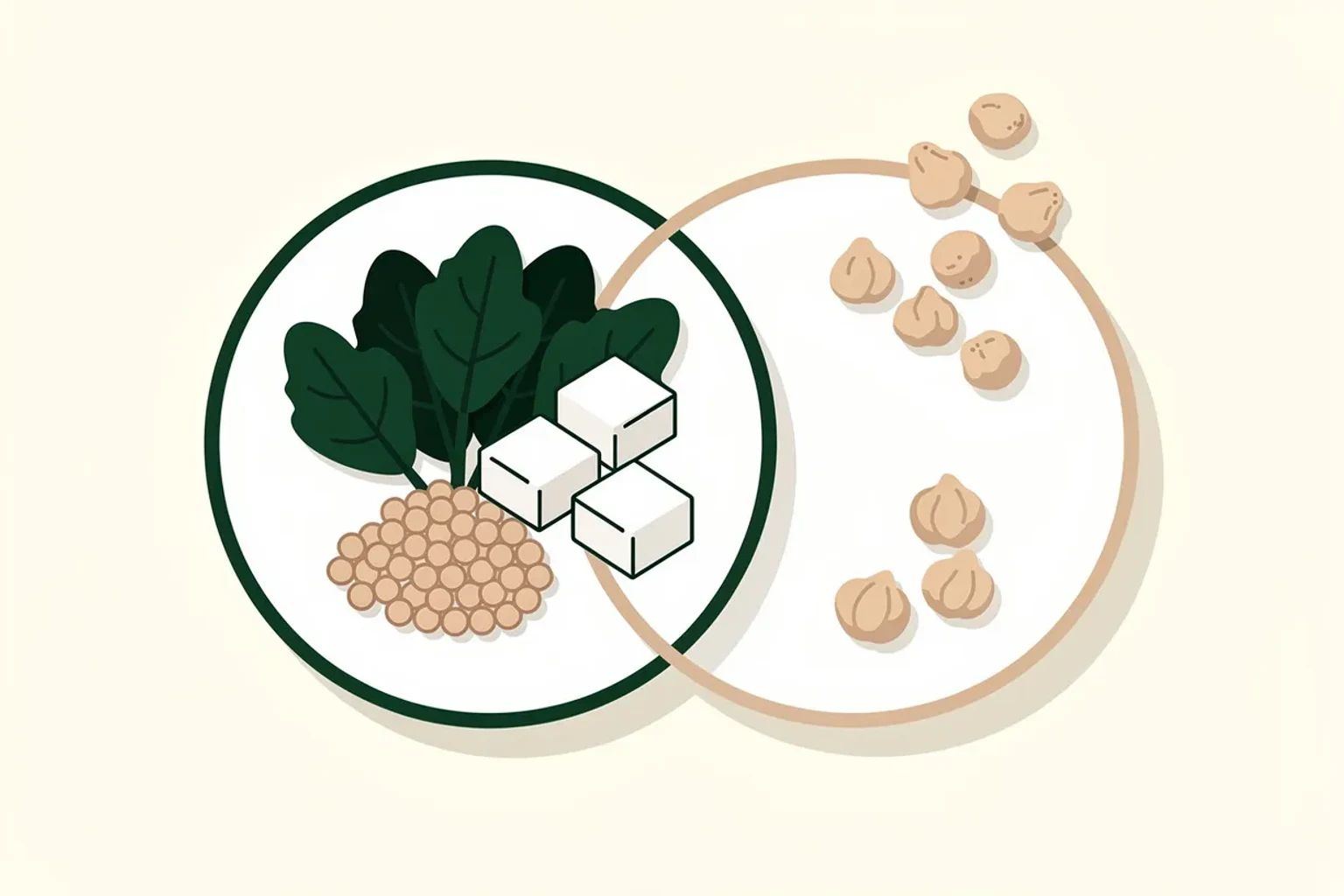
A vegetarian drops meat and fish. A vegan drops those plus dairy, eggs, honey, and gelatin. The gap looks small on a menu — eggs and cheese — but the nutritional gap is wider than it looks. Seven nutrients change measurably when you cross that line.
This article walks through what actually shifts, what plants can replace, and where a supplement is the only honest answer. No moralism — both diets work, and both come with trade-offs.
What each diet excludes
Vegan excludes all animal products: meat, poultry, fish, seafood, dairy (milk, cheese, yogurt, butter, whey), eggs, honey, gelatin, and animal-derived additives like lard, rennet, or carmine.
Lacto-ovo vegetarian excludes meat, poultry, fish, seafood, and gelatin. Dairy and eggs stay. Honey usually stays.
That's it for definitions. The practical difference — eggs and dairy — drives every nutritional change below.
The 7 nutrients that shift
Eggs and dairy concentrate seven nutrients that plants either lack or carry in less absorbable forms. Drop them, and each one needs a deliberate plan.
B12
The cleanest case. B12 is synthesized by bacteria, stored in animal tissues, and present in eggs and dairy in modest but reliable amounts. One egg covers ~25 % of the daily intake; a cup of milk covers ~40 %.
Plants contain no bioavailable B12. Algae and fermented foods carry analogs that don't work in humans. For vegans, B12 comes from a supplement or fortified foods — no exceptions. Pawlak 2014 found B12 deficiency in 52–90 % of unsupplemented vegans depending on subgroup. Vegetarians sit at 5–30 % deficiency (Allen 2009) — softer, but a varied dairy-and-eggs intake usually covers it.
See the B12 dilemma for vegans.
Calcium
Dairy supplies ~50 % of calcium intake in a typical Western diet. A cup of milk has 300 mg; the daily target is 1,000–1,200 mg.
Vegan replacements: calcium-set tofu (350 mg per 100 g), fortified plant milk (matches dairy at ~300 mg per cup), sesame seeds and tahini, kale, bok choy, almonds. Spinach has calcium but oxalates block absorption — count it as low-yield. Most vegans who hit calcium targets do it through fortified plant milk plus at least one dense plant source per day.
Iodine
Mostly invisible until you look for it. Dairy is the leading iodine source in many Western diets — not because milk is iodine-rich naturally, but because dairy cows are supplemented and equipment is sanitized with iodophors. Eggs add a smaller amount.
Vegans without iodized salt or seaweed can run low. Sea vegetables (nori, wakame, kelp) carry iodine, but kelp can deliver multiples of the daily intake in a single serving — over-supplementation is a real risk. The reliable answer: iodized salt or a low-dose supplement (150 mcg/day).
Zinc
Plant zinc is bound to phytate, which cuts absorption by 30–50 %. Dairy and eggs supply zinc in a more available form. Vegans typically need ~50 % more dietary zinc to match absorbed amounts.
Sources: pumpkin seeds, hemp seeds, cashews, lentils, chickpeas, oats. Soaking, sprouting, and fermenting (sourdough, tempeh) reduce phytate and improve absorption.
Omega-3 EPA and DHA
Plants carry ALA (alpha-linolenic acid) — flax, chia, walnuts. The body converts ALA to EPA and DHA, but conversion is poor: ~5 % to EPA, < 0.5 % to DHA. Eggs from hens fed flaxseed carry small amounts of DHA. Dairy carries trace.
For vegans, the practical answer is an algae-oil supplement (200–300 mg combined EPA + DHA per day). Vegetarians who eat eggs regularly cover part of the gap; many still supplement.
See omega-3 without fish.
Vitamin D
Eggs and fortified dairy carry vitamin D. Plants carry almost none. Sun exposure produces D in skin, but latitude, season, skin tone, and sunscreen all cut output.
Both vegans and vegetarians often run low in winter at high latitudes. A supplement (1,000–2,000 IU/day of D3 or vegan-friendly D2/lichen-D3) is the standard fix regardless of diet pattern.
Choline
The least discussed. Choline supports liver function and neurotransmitter synthesis. Egg yolks are the densest source — one yolk has ~150 mg, against a daily target of 425–550 mg. Liver, dairy, and meat supply most of the rest in omnivore diets.
Plant sources: soybeans, peanuts, quinoa, broccoli, shiitake. Vegans tend to fall short of choline more than any other macro-relevant nutrient. A supplement or generous soy intake is the simplest path.
Where they look the same
Both vegan and vegetarian diets can match protein needs — legumes, tofu, tempeh, seitan, dairy or eggs (for vegetarians) get most people to 1.2–1.6 g/kg without effort. Both increase fiber sharply (Marsh 2012 — vegetarian intakes average 41 g/day vs 18 g for omnivores). Both reduce LDL cholesterol and cardiovascular risk relative to a standard Western pattern.
Both struggle with iron in the same way: plant iron is non-heme, with absorption around 5–10 % vs 15–35 % for heme iron in meat. Eggs carry heme iron in small amounts but in a form bound to phosvitin, which actually inhibits absorption. So eggs help less for iron than people assume. Both diets benefit from vitamin C with iron-rich meals.
See iron without meat.
Health outcomes
The largest comparison is the Adventist Health Study 2 (Tonstad 2013, follow-up papers): 96,000 adults, prospective, food-frequency data.
- Vegans had the lowest all-cause mortality and the lowest cardiovascular mortality.
- Vegetarians (lacto-ovo) sat close behind — small absolute differences vs vegans.
- Both groups were well below regular meat-eaters for type 2 diabetes incidence, hypertension, and ischemic heart disease.
The margin between vegan and vegetarian is real but small. The big jump is from omnivore to either plant-leaning pattern.
Who picks which
Pick vegan if: ethics or environmental footprint drive the choice, and you're willing to supplement B12 (non-negotiable) plus likely D, omega-3, iodine, and possibly choline. Vegan rewards planning.
Pick vegetarian if: you want most of the cardiovascular and metabolic benefit with less logistic load. Eggs and dairy carry B12, D, iodine, and choline well enough that for many vegetarians a single B12 source (eggs, milk, or fortified foods) covers the gap. Easier socially and at restaurants.
A common path: omnivore → pescatarian → vegetarian → vegan, or any subset. Each step lowers cardiometabolic risk a bit further; each step adds planning. There's no requirement to finish the ladder.
How Vnutri shows both
The Vnutri catalog tags every food against both diets. Vegan-compatible foods is the stricter list — no animal products. Vegetarian-compatible foods adds dairy and eggs to that set. Cross-filter by nutrient — high-iron foods or high-calcium foods — to see which plants close which gaps.
See also the 9 diets explained for the full diet landscape.
Frequently asked questions
Can you get every nutrient from a vegan diet?
Yes, with two non-negotiable supplements (B12, omega-3 algae oil) and attention to D, iodine, calcium, zinc, and choline. Without supplementation, B12 deficiency is near-inevitable over years.
Is vegan healthier than vegetarian?
By the largest cohort (AHS-2), vegan edges vegetarian on cardiovascular mortality. The gap is small. Both beat omnivorous diets on most cardiometabolic markers.
Are vegan and vegetarian diets safe for children?
Vegetarian — yes, with normal pediatric care. Vegan — yes, but requires more planning (B12, D, omega-3, iron, calcium, choline) and pediatric dietitian support is recommended. Both academies (AAP, Academy of Nutrition and Dietetics) consider well-planned plant-based diets appropriate at all life stages.
Can athletes get enough protein on vegan or vegetarian diets?
Yes. Legumes, tofu, tempeh, seitan, soy isolate, and pea protein cover the 1.6–2.2 g/kg targets athletes use. Vegetarians have the easier path through eggs and dairy. Leucine threshold matters more than total grams — distribute protein across 4–5 meals.
Is vegan more expensive than vegetarian?
Base ingredients (legumes, grains, vegetables, tofu) are cheap. Processed vegan substitutes (cheese, burgers, milks) cost more than dairy and meat equivalents. Cost depends on how much processed food you buy.
What's the easiest single swap from vegetarian to vegan?
Plant milk for dairy milk in coffee and cooking. It's the single biggest dairy lever for most people. Fortified versions match dairy on calcium, D, and B12, which makes the swap nutritionally neutral.
References
- Tonstad S, et al. Vegetarian diets and incidence of diabetes in the Adventist Health Study-2. Nutr Metab Cardiovasc Dis. 2013;23(4):292–299.
- Marsh K, Zeuschner C, Saunders A. Health implications of a vegetarian diet: a review. Am J Lifestyle Med. 2012;6(3):250–267.
- Pawlak R, et al. The prevalence of cobalamin deficiency among vegetarians assessed by serum vitamin B12: a review of literature. Eur J Clin Nutr. 2014;68(5):541–548.
- Allen LH. How common is vitamin B-12 deficiency? Am J Clin Nutr. 2009;89(2):693S–696S.