Selenium: Why Two Brazil Nuts a Day Is Enough
Selenium has a narrow safe range — too little causes Hashimoto's progression, too much causes hair loss and selenosis. Top selenium-rich foods, the Brazil nut variability problem, and how to hit 55 mcg without supplements.
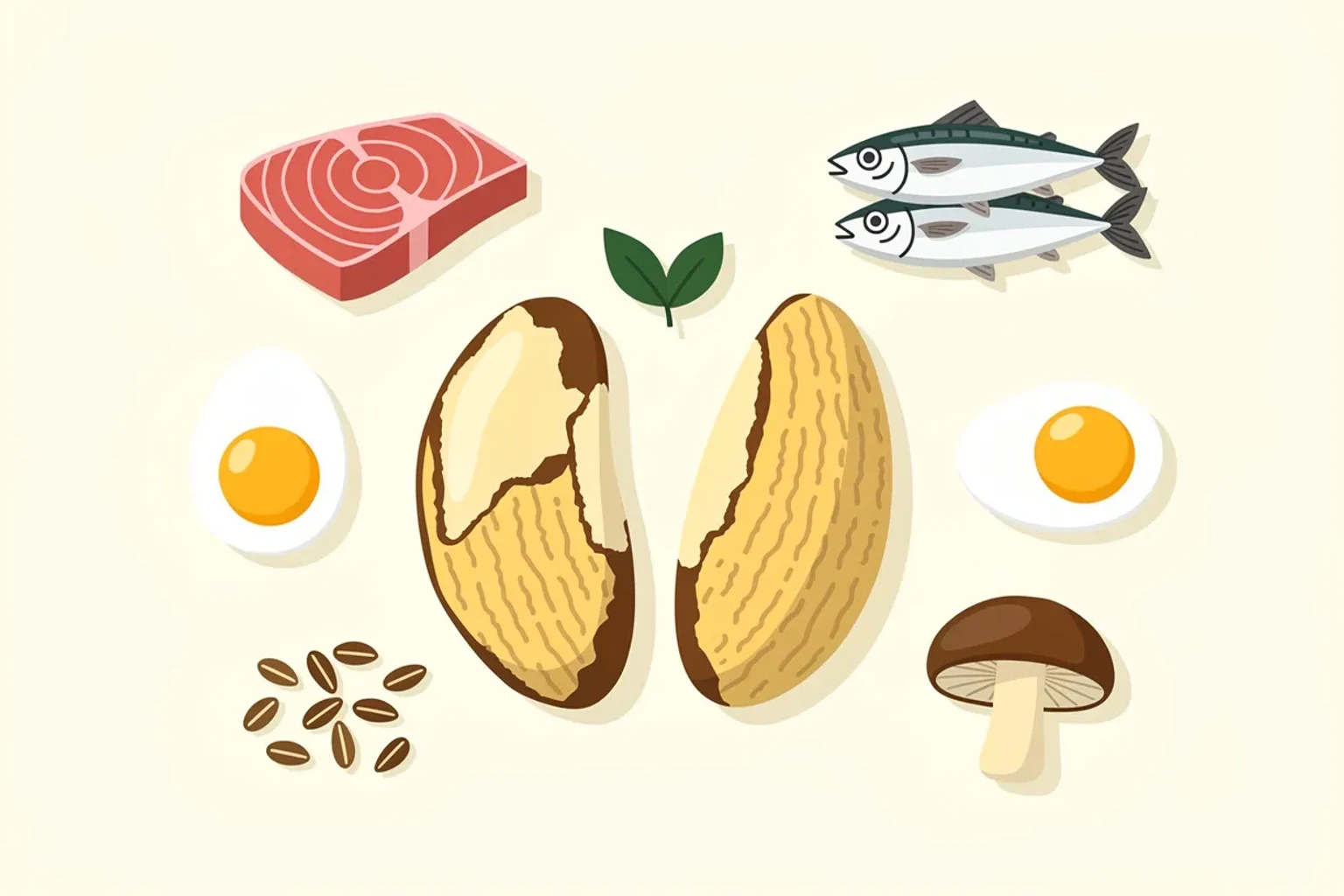
Selenium is the trace mineral with the narrowest safe range in human nutrition. The daily requirement is 55 mcg. The upper limit is 400 mcg. Hit either side of that window for long enough and you have a problem: deficiency drives Hashimoto's progression and, in severe cases, Keshan disease cardiomyopathy. Excess — selenosis — causes hair loss, brittle nails, garlic breath, and neurological symptoms.
Two Brazil nuts a day reliably cover the requirement. One Brazil nut can also over-deliver, depending on which Amazon basin soil grew the tree. That single fact does most of the work in this guide.
What selenium does
Selenium is a cofactor in roughly 25 selenoproteins. Four jobs matter for daily life:
- Glutathione peroxidase — the body's main antioxidant enzyme. Neutralizes hydrogen peroxide and lipid peroxides that would otherwise damage cells.
- Thyroid hormone production — deiodinases convert inactive T4 into active T3. The thyroid stores more selenium per gram than any other organ.
- Immune function — selenium-deficient mice clear viral infections worse and mutate viruses faster (Beck 2003).
- DNA repair and sperm motility — selenoprotein P transports selenium to testes and brain.
Daily target
| Group | RDA (mcg/day) |
|---|---|
| Adult | 55 |
| Pregnant | 60 |
| Breastfeeding | 70 |
| Children 1–8 | 20–30 |
| Upper limit | 400 (adult) |
Most US diets deliver 60–150 mcg/day — North American soils are selenium-rich, especially the Great Plains. European diets sit at 30–90 mcg/day; Scotland, Finland, parts of the Balkans run lower. New Zealand and parts of China are deficient enough that bread is selenium-fortified in some regions.
Top food sources
Per 100 g raw catalog values:
| Food | Selenium (mcg/100 g) | Notes |
|---|---|---|
| Brazil nuts | 1917 | 1–2 nuts often = 100–200 mcg |
| Tuna, canned | 80 | One can ≈ 130 mcg |
| Sunflower seeds | 79 | 30 g handful ≈ 24 mcg |
| Whole wheat | 70 | Soil-dependent |
| Sardines | 53 | One tin ≈ 50 mcg |
| Halibut | 47 | |
| Pork chop | 43 | |
| Beef | 35 | |
| Eggs | 30 | One large egg ≈ 15 mcg |
| Chicken | 27 | |
| Mushrooms | 26 | Among the best plant sources |
| Cottage cheese | 9 |
A can of tuna or sardines covers the daily target on its own. A handful of sunflower seeds gets you halfway. Whole wheat bread carries selenium if the grain grew in selenium-rich soil — much of the US wheat belt qualifies, much of Europe doesn't.
The Brazil nut variability problem
Selenium content varies up to 1000-fold between Brazil nuts from different regions. Two nuts from the same bag can differ by an order of magnitude. The driver is soil.
- Amazon basin (especially Pará state, Brazil). Extremely high. A single nut can deliver 50–250+ mcg.
- Bolivian Amazon. Lower. Same nut variety, less selenium-rich soil.
- Acre and Rondônia states. Mid-range.
The label rarely tells you which. Practical rules:
- 2 nuts daily is the safe ballpark. On the high end, that's ~400 mcg/day from nuts alone — at the upper limit but not over for short periods.
- 4 nuts daily for months is a selenosis-risk zone. Case reports of hair loss exist at this intake.
- Skip Brazil nuts entirely if you take a selenium supplement. Doubling up is the typical overdose pattern.
A handful of Brazil nuts as a one-off snack is fine. Steady daily intake is where the math gets sharp.
Soil selenium varies by region
Soil selenium maps drive dietary selenium more than any food choice. High-soil regions (Great Plains, much of North America, parts of Australia) produce selenium-rich grain, meat, and dairy. Low-soil regions (Scotland, Finland, the Keshan belt in China, New Zealand, parts of the Balkans) produce food with measurably less.
In low-soil regions, supplementation or imported Brazil nuts may be needed. Finland addressed this at the national level — since 1984, agricultural fertilizers in Finland are selenium-enriched, which raised population selenium status to adequate.
Deficiency signs
Selenium deficiency creeps in. Watch for:
- Hashimoto's progression and worsening thyroid antibodies
- Hair loss
- Brittle nails (paradoxically also a sign of excess)
- Muscle weakness and aching
- Cardiomyopathy in extreme deficiency — Keshan disease, named after a Chinese county where selenium-poor soil caused endemic heart failure before fortification
Excess signs (selenosis)
Selenosis shows up at sustained intakes above ~800 mcg/day. Classic signs:
- Garlic breath (dimethyl selenide exhaled through lungs)
- Brittle, ridged nails
- Hair loss in patches
- Skin rashes
- Fatigue and irritability
- Peripheral neuropathy at higher intakes
- Rajpathak 2005 found long-term high serum selenium associated with type 2 diabetes risk in the NHANES III cohort — the U-shaped curve runs both ways
Practical recommendations
- Two Brazil nuts a day, OR
- One can of tuna or sardines weekly plus varied protein (eggs, chicken, beef, whole grains)
- Vegans and vegetarians — sunflower seeds, whole wheat bread, mushrooms, eggs (if vegetarian). Brazil nuts are the simplest fallback.
- Don't supplement separately unless tested deficient. Selenium is in most multivitamins at 55–70 mcg; that's enough as a backstop. Stand-alone 200 mcg selenium supplements are easy to over-stack.
- Skip selenium supplements if you eat Brazil nuts daily. Double-dosing is the typical selenosis path.
How Vnutri helps
The Vnutri catalog stores selenium per 100 g for most foods with ~85–90 % coverage. Selenium data comes from USDA, AFCD, Matvaretabellen, and CoFID — coverage is better than iodine or choline but lower than the core minerals. The high-selenium filter ranks foods by density.
Cross-check related posts: macros vs micros for the broader nutrient context, iodine deficiency for the parallel thyroid trace-mineral story, and 9 diets explained for the diet-level view.
Frequently asked questions
Can I eat 10 Brazil nuts a day?
Not safely as a daily habit. Ten nuts from a high-selenium Pará batch can deliver 2000+ mcg — five times the upper limit. Hair loss, brittle nails, and garlic breath start showing up within weeks at that intake. As a one-off, ten nuts won't hurt. Daily, stop at two.
Should I take selenium for Hashimoto's?
Selenium supplementation (typically 200 mcg/day for 6 months) has shown modest reductions in thyroid antibodies (TPO-Ab) in several trials. Effect size is small and inconsistent. If you already eat Brazil nuts, tuna, or live in a selenium-rich soil region, you don't need a supplement. Talk to your doctor and check serum selenium before supplementing chronically — adding 200 mcg on top of a Brazilian nut habit pushes you toward selenosis.
Why is Brazil nut selenium content so variable?
Brazil nut trees pull selenium from soil far better than most plants. The Amazon basin has patchy selenium content depending on bedrock geology. Trees in Pará state, Brazil, grow on selenium-rich soil; Bolivian Amazon soil is poorer. Bags from suppliers are often mixed, so two nuts from the same bag can differ tenfold. No reliable way to test individual nuts at home.
Where can I get selenium without animal products?
Brazil nuts (1–2 daily), sunflower seeds (30 g daily), whole wheat bread (2 slices), mushrooms, and lentils. A vegan diet built around these sources hits 55 mcg without trying. Mushrooms vary by species and growing medium — shiitake and white button are reliable. Skip kelp for selenium (it's an iodine vehicle, not a selenium one).
References
- Rayman MP. Selenium and human health. Lancet. 2012;379(9822):1256–1268.
- Schomburg L. Selenium, selenoproteins and the thyroid gland: interactions in health and disease. Nat Rev Endocrinol. 2011;8(3):160–171.
- Rajpathak S, Rimm E, Morris JS, Hu F. Toenail selenium and cardiovascular disease in men with diabetes. J Am Coll Nutr. 2005;24(4):250–256.
- Beck MA, Levander OA, Handy J. Selenium deficiency and viral infection. J Nutr. 2003;133(5 Suppl 1):1463S–1467S.
- NIH Office of Dietary Supplements. Selenium — Fact Sheet for Health Professionals. Updated 2024.