Omega-3 Without Fish: Plant Sources, What Works and What Doesn't
Vegan omega-3 sources, the ALA-to-EPA-to-DHA conversion gap, plant ALA table, algae oil dosing, and a practical daily plan.
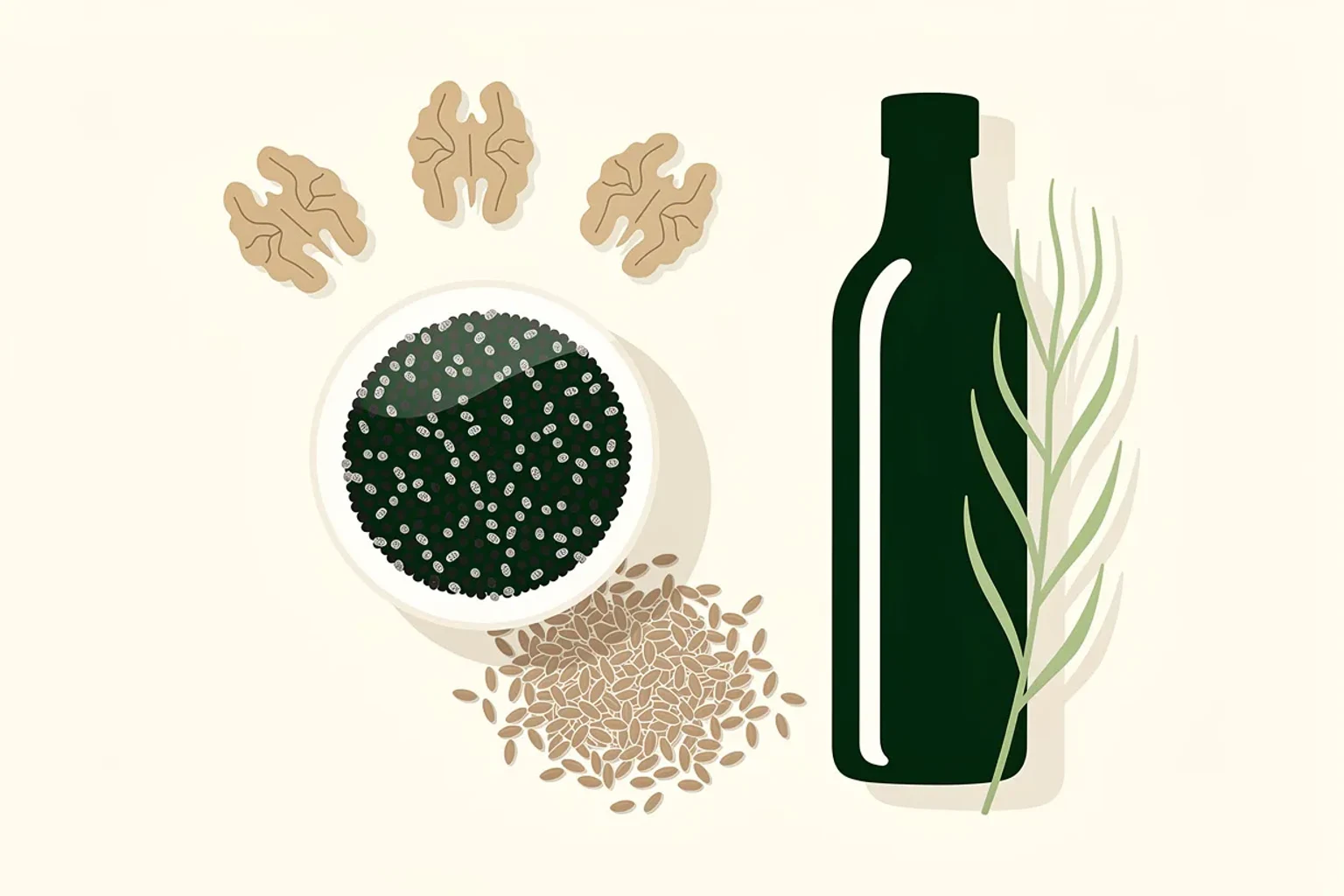
Omega-3 has a fish-shaped reputation: salmon, sardines, anchovies. But the actual molecule the body uses — DHA — was first made by algae. Fish are just intermediaries that ate the algae. So a plant-only plan is biologically workable. The catch is that plants deliver omega-3 in a precursor form (ALA), and the body converts only a tiny fraction of it into the active forms (EPA and DHA) that do most of the work in the brain, eyes, and cell membranes.
This guide ranks the realistic plant sources, explains why ALA isn't a full substitute, and shows what to do about the gap.
The three omega-3s
Three molecules carry the omega-3 label, and they're not interchangeable.
- ALA (alpha-linolenic acid) — 18 carbons. The only essential omega-3 — the body can't make it. Found in flax, chia, walnuts, hemp. Used mainly as fuel or to build longer-chain fats.
- EPA (eicosapentaenoic acid) — 20 carbons. Anti-inflammatory; raw material for resolvins and protectins. Important for cardiovascular and mood research.
- DHA (docosahexaenoic acid) — 22 carbons. Structural fat in the brain, retina, and sperm cells. About 25 % of brain dry weight is DHA. Critical in pregnancy and early childhood.
EPA and DHA do most of the documented physiological work. ALA mostly serves as a substrate — and a poor one for the conversion.
The conversion problem
The body can extend ALA into EPA, and EPA into DHA, using the elongase and desaturase enzymes. The yield is small.
- ALA → EPA: about 5–10 % conversion
- ALA → DHA: about 0.5–4 % conversion (Brenna 2009)
Women convert better than men — about 2.5 times higher rates for DHA in some studies (Burdge 2002). Estrogen upregulates the same enzymes. After menopause the advantage shrinks.
Two things kill conversion further:
- High omega-6 intake. Linoleic acid (omega-6) competes for the same desaturase enzyme. A diet heavy in sunflower, corn, or soybean oil — the typical Western pattern — uses the enzyme on omega-6 first.
- Low total ALA. The enzyme needs substrate. Below ~1 g/day of ALA, conversion drops further.
The practical reading: ALA covers the essential-fat requirement, but a typical plant-eater making 100–200 mg of EPA per day from ALA is well below the 250–500 mg target.
Plant ALA sources
ALA per 100 g of food.
| Food | ALA |
|---|---|
| Flaxseed (whole) | 22,800 mg |
| Chia seeds | 17,800 mg |
| Walnuts | 9,080 mg |
| Hemp seeds | 8,690 mg |
| Soybeans | 600 mg |
| Edamame | 360 mg |
| Spinach | 138 mg |
| Brussels sprouts | 100 mg |
Three foods dominate: flax, chia, walnuts. Everything else is rounding error compared to them.
What works for ALA
Hitting the ALA target is easy on a plant diet.
- 1 tbsp ground flaxseed = ~1.6 g ALA = covers the adequate intake (AI) for women (1.1 g)
- 1 oz (28 g) walnuts = ~2.5 g ALA = covers AI for men (1.6 g)
- 1 tbsp chia = ~1.8 g ALA
A daily tablespoon of ground flax in oats or yogurt, plus a handful of walnuts in a salad, clears the official ALA bar with room to spare. Most plant-eaters already exceed it without trying.
What doesn't fully work
ALA alone struggles to supply EPA, and almost never supplies enough DHA. Pushing ALA intake to 4–5 g/day raises EPA modestly — to the 100–200 mg range — but DHA barely moves. Vegan and vegetarian studies repeatedly show plasma and erythrocyte DHA levels about 30–60 % below omnivores (Sanders 2009). For most adults that gap doesn't cause overt symptoms, but it sits below the population intake associated with cardiovascular and cognitive benefits.
For pregnancy, breastfeeding, and brain development in young children, the gap matters more — DHA demand is high and the conversion ceiling doesn't move.
The algae solution
Fish don't make DHA. They eat phytoplankton that does — specifically marine microalgae of the genus Schizochytrium. Algae oil takes that step out of the food chain.
- Algae oil supplements deliver 200–500 mg DHA (sometimes plus EPA) per soft-gel.
- Bioavailability matches fish oil (Lane 2014).
- No marine sustainability concern, no fishy aftertaste, no microplastic load.
- Vegan-certified versions are widely available.
For a vegan, vegetarian, or fish-averse adult, a daily 250–500 mg algae-oil capsule plugs the EPA/DHA hole that ALA alone leaves open.
Targets
| Nutrient | Daily target |
|---|---|
| ALA | 1.1 g (women), 1.6 g (men) — AI, not RDA |
| EPA + DHA | 250–500 mg (ISSFAL 2004) |
| DHA in pregnancy | +200 mg DHA (Koletzko 2008) |
ALA is an Adequate Intake — a population estimate, not a tightly evidenced individual requirement. EPA/DHA targets come from cardiovascular and developmental outcome studies.
A practical daily plan
A vegan or vegetarian plan that covers all three forms:
- 1 tablespoon ground flaxseed — ~1.6 g ALA
- 1 oz walnuts — ~2.5 g ALA
- Algae oil capsule — 250–500 mg DHA/EPA
- Skip omega-6-heavy oils — sunflower, corn, soybean. Cook with olive, avocado, or a small amount of rapeseed (canola) oil, which has its own ALA.
That covers ALA twice over and closes the EPA/DHA gap without relying on conversion. Total cost: 60 ¢ a day of flax and walnuts plus 10–30 ¢ for the capsule.
Who needs extra attention to DHA
- Pregnant and breastfeeding women. Maternal DHA is pulled into the fetus and into breast milk; deficits show up first in maternal stores.
- Young children. Brain DHA accumulates rapidly in the first two years. Formula now usually contains algae-derived DHA for this reason.
- ApoE4 carriers. This genetic variant impairs DHA transport into the brain and is the strongest known risk factor for late-onset Alzheimer's. Dietary DHA matters more, not less, in this group.
- Older adults. Cognitive aging studies show benefit at the upper end of EPA/DHA intake.
For these groups, plant-only ALA rarely covers DHA needs. Algae oil or a fish-source EPA/DHA (for non-vegan plans) is the realistic route.
How Vnutri helps
The Vnutri catalog shows omega-3 per 100 g for every food. The high-omega-3 filter ranks foods by ALA density (from flaxseed downward). Stack it with the vegan filter to see only vegan, high-omega-3 options on one screen — useful for grocery-day planning.
For the broader picture on which nutrients vegan plans miss most, see B12: the vegan dilemma and the nine diets explained. For why the absorbed amount matters more than the printed number, see macros vs micros.
Frequently asked questions
Why do I specifically need DHA?
DHA is structural fat — it lives in cell membranes, especially in the brain (about 25 % of brain dry weight) and retina. Membranes built with shorter fats are stiffer; signaling and synaptic function slow. The body holds DHA tightly when supply is low, but during pregnancy, breastfeeding, and the first two years of life, demand exceeds what limited stores can release.
Is flaxseed enough on its own?
For ALA — yes, easily. For EPA — possibly, at high intake. For DHA — almost never. Conversion of ALA to DHA averages 1–4 %, which means a daily 4 g of ALA yields 40–160 mg DHA. The standard target is 200–500 mg. Algae oil closes the rest.
What's the right algae-oil dose?
A general adult target is 250–500 mg combined EPA + DHA per day. Pregnant or breastfeeding women add 200 mg DHA on top. Children — follow the product label for age, or 100–200 mg DHA for a school-age child. Doses above 1 g/day require a clinical reason; they raise bleeding risk modestly.
Does cooking destroy omega-3?
ALA is fragile to heat, light, and oxygen. Frying flaxseed oil destroys most of it; baking flaxseed inside bread or muffins is fine — the seed coat protects it. Chia and ground flax stirred into hot porridge after cooking lose little. Keep flax oil refrigerated and out of light.
Whole vs ground flaxseed?
Whole flax passes through the gut undigested — the seed coat is the protection that also blocks absorption. Grinding releases the ALA and the lignans. Pre-ground flax oxidizes within weeks; grind a small batch and refrigerate, or buy small packs. Chia seeds are an exception — the coat breaks down on hydration, so whole chia in liquid works.
References
- Brenna JT, Salem N Jr, Sinclair AJ, Cunnane SC. α-Linolenic acid supplementation and conversion to n-3 long-chain polyunsaturated fatty acids in humans. Prostaglandins Leukot Essent Fatty Acids. 2009;80(2-3):85–91.
- Burdge GC, Wootton SA. Conversion of α-linolenic acid to eicosapentaenoic, docosapentaenoic and docosahexaenoic acids in young women. Br J Nutr. 2002;88(4):411–420.
- International Society for the Study of Fatty Acids and Lipids (ISSFAL). Recommendations for intake of polyunsaturated fatty acids in healthy adults. 2004.
- Sanders TAB. DHA status of vegetarians. Prostaglandins Leukot Essent Fatty Acids. 2009;81(2-3):137–141.
- Lane K, Derbyshire E, Li W, Brennan C. Bioavailability and potential uses of vegetarian sources of omega-3 fatty acids: a review of the literature. Crit Rev Food Sci Nutr. 2014;54(5):572–579.
- Koletzko B, Cetin I, Brenna JT. Dietary fat intakes for pregnant and lactating women. Br J Nutr. 2007;98(5):873–877.