Low-FODMAP Diet for IBS: Phases, Foods, What Nobody Tells You
What FODMAPs are, how the Monash protocol works, what the 3 phases look like, and 5 mistakes that ruin the whole thing. Food list and FAQ.
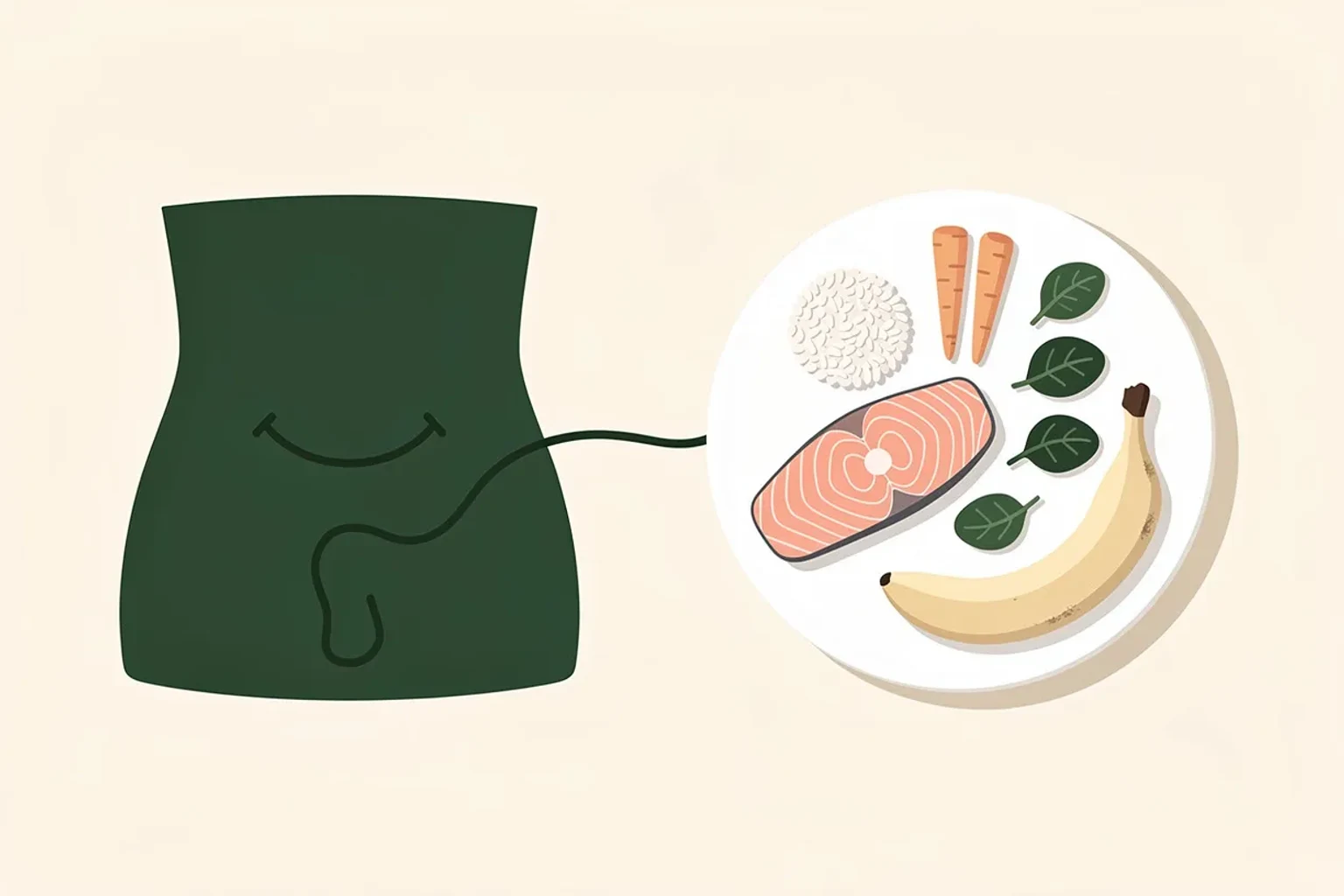
Low-FODMAP isn't a weight-loss diet or a lifestyle. It's a therapeutic protocol for irritable bowel syndrome (IBS), developed at Monash University in Australia. It works: the Halmos 2014 meta-analysis in Gastroenterology showed symptoms drop significantly in 70–80 % of IBS patients.
But low-FODMAP isn't "cut these foods forever". It's a 3-phase protocol with mandatory reintroduction. Skip phases 2 and 3 and you lose the point of the work — and may harm your gut microbiota.
What FODMAPs are
FODMAP is an acronym: Fermentable Oligo-, Di-, Monosaccharides And Polyols. A group of short-chain carbohydrates that are poorly absorbed in the small intestine and actively fermented in the large.
Types:
- Oligosaccharides — fructans (wheat, onion, garlic) and galacto-oligosaccharides (legumes)
- Disaccharides — lactose (milk)
- Monosaccharides — excess fructose relative to glucose (honey, apples, pears)
- Polyols — sorbitol, mannitol (some fruit, artificial sweeteners)
In healthy people, FODMAPs are just food for the microbiota. In IBS patients, they cause gas, bloating, cramps, diarrhea or constipation. The small intestine can't absorb them in time → they reach the large intestine → bacteria ferment them aggressively → gas distends the bowel → pain.
Who it suits
Only with a diagnosis of IBS or chronic functional GI symptoms. Not for healthy people.
Effectiveness is proven for:
- Irritable bowel syndrome (IBS) — all subtypes (diarrhea, constipation, mixed)
- Inflammatory bowel disease in remission — for residual functional symptoms
- Endometriosis with bowel symptoms
It doesn't work for:
- Celiac disease — you need gluten-free; low-FODMAP doesn't help
- Active IBD — needs a low-residue diet, not low-FODMAP
- Healthy people with occasional bloating — investigate the actual cause first
Before starting, get a diagnosis and consult a doctor or dietitian. Self-diagnosing IBS often misses real causes: SIBO, celiac, parasites, colon cancer.
Three phases
Phase 1: elimination (4–6 weeks)
Cut high-FODMAP foods completely. Goal — see if the body responds. If symptoms don't improve in 4–6 weeks, low-FODMAP isn't your answer — stop and look for another cause.
What's allowed (low-FODMAP):
- Meat, fish, seafood, eggs, firm tofu
- Rice, oats, quinoa, buckwheat (in small portions)
- Carrot, tomato, spinach, cucumber, zucchini, eggplant, potato, lettuce, pumpkin
- Banana (moderately ripe), orange, mandarin, kiwi, grapes, strawberry, lemon
- Lactose-free dairy (lactose-free milk, cheddar, parmesan)
- Maple syrup, table sugar (in moderation — the keto crowd won't like this)
- Vegetable oils, olive, coconut
- Dark chocolate up to 30 g portions
- Green parts of leek and green onion — low-FODMAP
What's off-limits (high-FODMAP):
- Wheat, rye, barley — fructans
- Onion, garlic (in any form, including powders) — fructans
- Legumes (beans, lentils, chickpeas) — except canned and rinsed
- Apples, pears, mango, watermelon, ripe peaches
- Honey, agave, inulin syrup
- Milk, soft cheeses (ricotta, mozzarella), yogurt
- Cauliflower, kale (some varieties), mushrooms, asparagus, artichoke
- Sorbitol, mannitol, xylitol, isomalt
Full list of low-FODMAP-compatible foods in the Vnutri catalog.
Phase 2: reintroduction (8–12 weeks)
The most important and most skipped phase. Reintroduce foods one at a time, by FODMAP group. Goal — figure out which groups you actually tolerate badly.
Protocol:
- Days 1–3: small portion of the test food (e.g. a quarter apple)
- Days 4–6: medium portion (half an apple)
- Day 7: large portion (a whole apple)
- Symptoms? — flag the group as a trigger.
- No symptoms? — the group is fine.
- Between tests — washout for 2–3 days on clean low-FODMAP.
Six groups get tested: fructans (wheat), fructans (onion/garlic), lactose, fructose, sorbitol, mannitol.
Most people tolerate 3–5 of the 6 groups. Knowing which is invaluable — it lets you eat much more variety long term.
Phase 3: personalization (long-term)
The real goal of the protocol. Based on phase-2 data, a diet that avoids only your trigger groups. This isn't "a diet"; it's knowledge of your triggers.
Example: after reintroduction you find you don't tolerate fructans (onion, garlic) or lactose, but you're fine with fructose (apples), sorbitol (pears), and galacto-oligosaccharides (legumes). Long-term diet — normal food minus onion, garlic, and milk. Much less restrictive than full low-FODMAP.
What nobody tells you
Five things rarely discussed.
- It's a medical protocol, not a lifestyle. Staying in phase 1 long term (> 12 weeks) depletes the microbiota — Halmos 2015 showed a significant drop in Bifidobacterium after 3 weeks of low-FODMAP. Not scary if phase 2 starts on time; disastrous if you stay "forever".
- Sauces and marinades kill you. Onion and garlic are the base of most sauces and prepared meals. Phase 1 means no ready-made food. Marinades, soy sauce, bouillon cubes, ketchup — almost everything has onion/garlic.
- Garlic oil is a life hack. Garlic releases aromatic oils into fat, but fructans (the symptom drivers) are water-soluble. Fry garlic cloves in olive oil for 5 minutes, remove the cloves — you have garlic oil without fructans. Technically low-FODMAP.
- Portion is critical. Many low-FODMAP foods turn high-FODMAP in large portions. 30 g of almonds is low; 60 g is high. Ripe bananas are higher than green. Check the Monash app for per-portion thresholds.
- Not every "low" label is real. Multi-step FODMAP fractioning is a complex topic. In-store "low-FODMAP" labels don't always match Monash testing. Trust only Monash certification (the green "Low FODMAP Certified" logo).
Common mistakes
- Skipping phase 2. The most common. People stay in phase 1 "because it works". Microbiota suffers.
- Testing multiple foods at once. You can't tell what you reacted to.
- Testing too fast. Day 1 — portion, day 2 — double. You need at least 3 days per dose.
- Ignoring stress. IBS is partly psychosomatic. Stress management has to run in parallel — otherwise the diet doesn't work.
- Self-diagnosis. "I bloat after meals — must be IBS." Could be SIBO, celiac, cancer. Don't start without a doctor.
Who needs support
Low-FODMAP isn't a self-managed diet. Recommended:
- A dietitian-gastroenterologist — for an individual plan and phase 2
- Monash University FODMAP app — mandatory. Full database with per-portion thresholds, green/amber/red coding per food. One of the best food apps in the world.
- Support groups — Reddit r/FODMAPS, Facebook IBS groups — help you through the first week of hell
Outside Australia, dietitians with deep low-FODMAP expertise are limited. The Monash app plus English-language literature is a practical setup.
Long-term outcomes
After phase 3, most patients keep symptoms under control with moderate caution around triggers. Not a strict diet — it's knowledge of your body.
IBS symptoms can shift over time. Retest triggers every 1–2 years.
How Vnutri shows low-FODMAP
The Vnutri catalog tags 845+ foods against low-FODMAP. For the trickier diets (paleo, Mediterranean, low-FODMAP), an LLM classification (Claude Sonnet) is checked against the Monash taxonomy.
The low-FODMAP diet page lists all compatible foods. The catalog doesn't carry per-portion thresholds (see limits below).
Limits: low-FODMAP is a spectrum, not a binary yes/no. 30 g of almonds is okay; 60 g isn't. The Monash app gives exact thresholds; Vnutri gives a binary tag. Use the Monash app for the fine grain.
Frequently asked questions
How long is phase 1?
4–6 weeks as standard. If symptoms don't improve by 6 weeks — stop. The protocol isn't working; look for another cause (SIBO, celiac, infection).
Can you do vegan low-FODMAP?
Yes, but it's tough. Legumes — the main plant protein — are high-FODMAP in their regular form. Workarounds: canned and rinsed legumes (some FODMAPs leach out), tofu (firm is low, silken is high), tempeh. Nuts in moderate portions. Seeds. Quinoa.
What about chocolate?
Dark chocolate (>70 %) up to a 30 g portion — low-FODMAP. Milk chocolate is lactose + sorbitol = high.
Coffee and tea?
Black coffee — low-FODMAP. With milk — depends on the milk. Black and green tea — low. Herbal teas are often high (chamomile, fennel).
Can you drink alcohol?
Dry wine, whiskey, vodka — low-FODMAP. Beer varies (some are high due to malt). Sweet cocktails — high (syrups).
Does low-FODMAP help with bloating without IBS?
Sometimes — yes, but don't use it as a lifestyle. If symptoms persist, see a doctor. If IBS is confirmed — full protocol. If not — you don't need this diet.
How to combine with diabetes?
Tricky. Sugar and maple syrup are low-FODMAP but bad for diabetes. Approach: low-FODMAP plus glycemic control in parallel. Depends on an individual plan.
References
- Halmos EP, et al. A diet low in FODMAPs reduces symptoms of irritable bowel syndrome. Gastroenterology. 2014;146(1):67–75.
- Staudacher HM, et al. A diet low in FODMAPs reduces symptoms in patients with irritable bowel syndrome. Gastroenterology. 2017;153(4):936–947.
- Halmos EP, et al. Diets that differ in their FODMAP content alter the colonic luminal microenvironment. Gut. 2015;64(1):93–100.
- Whelan K, et al. The low FODMAP diet in the management of irritable bowel syndrome. Gastroenterol Hepatol. 2018;15(11):657–664.
- Monash University. FODMAP Diet App. https://www.monashfodmap.com/