Iron in Food: Top 20 Sources for Vegan and Vegetarian Diets
Plant iron is non-heme and absorbs less than meat iron. Top 20 sources per 100 g, absorption hacks, daily targets for vegans, and when to test ferritin.
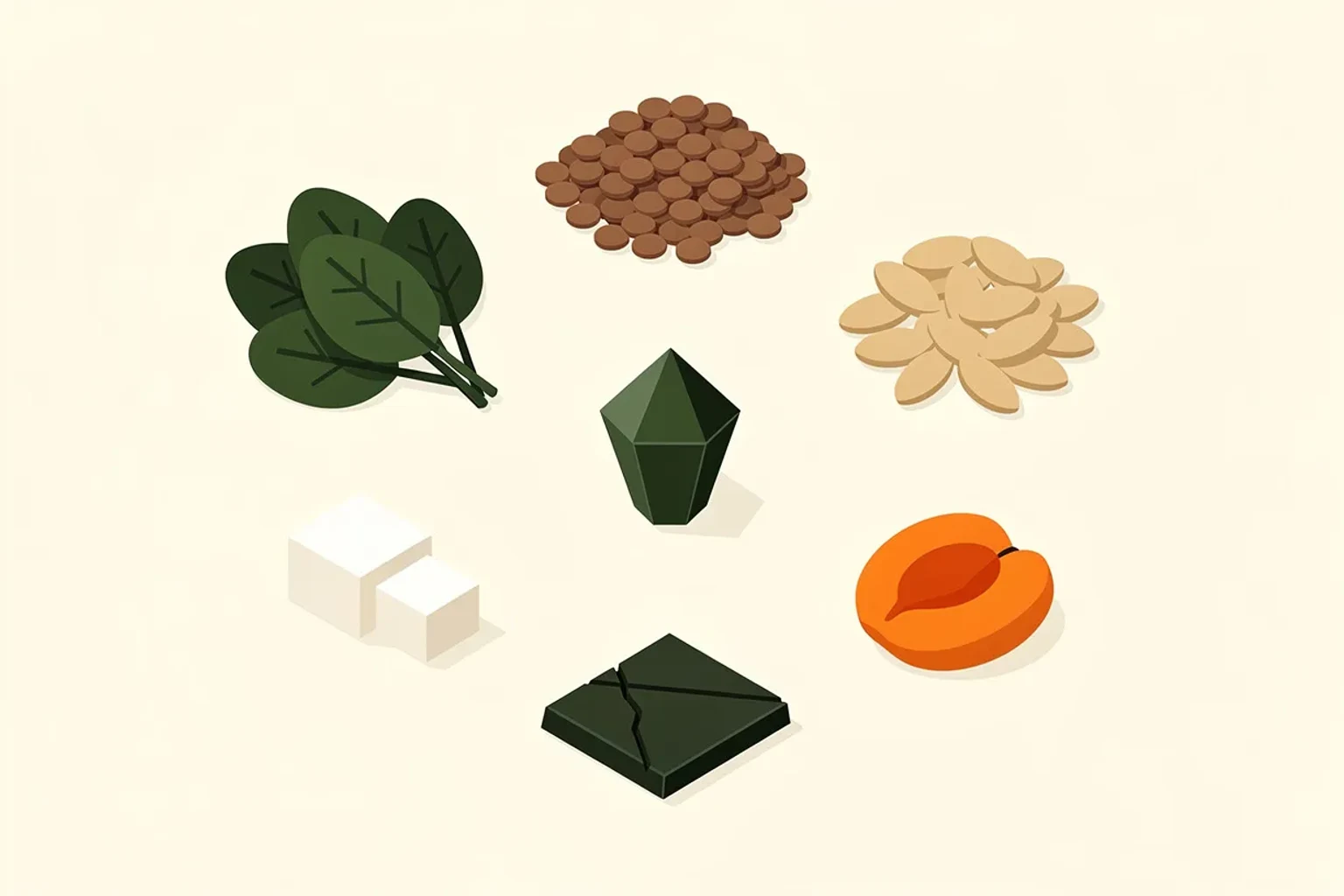
Iron deficiency is the most common nutrient shortfall in the world. The WHO estimates around 30 % of menstruating women in Europe are iron-deficient. Among vegans the share runs higher — not because plants lack iron, but because plant iron is non-heme and absorbs less than the heme iron in meat.
That's the whole problem in one sentence, and it's manageable. With the right foods, the right pairings, and a yearly ferritin test, a vegan diet hits iron targets without supplements for most people.
Heme vs non-heme iron
Two forms, very different bioavailability.
Heme iron lives inside hemoglobin and myoglobin in red meat, poultry, and fish. Absorption: 15–35 %. It doesn't depend much on what else is on the plate.
Non-heme iron is the form in plants and eggs. Absorption: 2–20 %, and the range is wide because it depends on the meal. Vitamin C triples it. Calcium, tea, and coffee cut it in half.
A 100 g portion of beef provides about 2.6 mg of iron at ~25 % absorption — 0.65 mg absorbed. The same 2.7 mg from tofu absorbs at ~7 % — 0.19 mg. Same iron on paper, three times the delivered dose from meat.
This is why dietary surveys consistently show vegans eat more iron than omnivores, yet have lower ferritin stores. The math wins on raw intake; the math loses on absorption. Closing the gap is a matter of choosing the right foods and pairing them right.
Top 20 plant iron sources
Per 100 g, sorted by density.
| Food | Iron |
|---|---|
| Sesame seeds | 14.6 mg |
| Dark chocolate (70%+) | 11.9 mg |
| Pumpkin seeds | 8.8 mg |
| Hemp seeds | 7.9 mg |
| Chia seeds | 7.7 mg |
| Cashews | 6.7 mg |
| Dried apricots | 6.3 mg |
| Sunflower seeds | 5.3 mg |
| Oats, steel-cut | 4.7 mg |
| Almonds | 3.7 mg |
| Lentils, cooked | 3.3 mg |
| Kidney beans, cooked | 2.9 mg |
| Walnuts | 2.9 mg |
| Chickpeas, cooked | 2.9 mg |
| Spinach, raw | 2.7 mg |
| Tofu, firm | 2.7 mg |
| Tempeh | 2.7 mg |
| Edamame | 2.3 mg |
| Black beans, cooked | 2.1 mg |
| Quinoa, cooked | 1.5 mg |
Two patterns stand out.
Seeds top the list. Sesame, pumpkin, hemp, chia — all above 7 mg per 100 g. Portions are small (15–30 g), but a tablespoon of pumpkin seeds adds ~2 mg.
Legumes deliver the volume. Lentils, beans, chickpeas average 2–3 mg per 100 g cooked. One cup (~180 g) covers a third of a man's daily target.
The Vnutri catalog stores iron per 100 g for every food. The high-iron filter sorts by density from 3.5 mg per 100 g.
What boosts absorption
Four practical levers.
Vitamin C with the same meal. A landmark Hallberg 1989 study showed 25 mg of ascorbic acid roughly triples non-heme iron absorption from a meal. Bell pepper, citrus, kiwi, strawberries, parsley, broccoli — any of them works. Lemon juice on lentils, kiwi after oatmeal, bell pepper in a chickpea stew. See the high vitamin C filter.
Cast iron skillet. Cooking acidic foods (tomato sauce, chili) in cast iron transfers measurable iron into the food — about 30 % more per portion. Real effect, well-documented.
Soaking and sprouting legumes and grains. Phytic acid binds iron in seeds and grains. Soaking 8–12 hours and discarding the water cuts phytates by 30–50 %. Sprouting cuts more.
Fermentation. Tempeh, miso, sourdough bread, sauerkraut — fermentation breaks down phytates further. This is one reason tempeh's iron is more bioavailable than equivalent boiled soybeans.
What blocks absorption
Three big inhibitors. All preventable.
Calcium. Milk, cheese, calcium supplements taken with an iron meal block up to 50 % of absorption. Don't pair iron-rich meals with cheese, yogurt, or a calcium pill.
Tea and coffee. Tannins and polyphenols cut iron absorption by up to 60 %. A cup of black tea with a lentil curry is the worst-case combo.
High-bran fiber. Wheat bran is concentrated phytate. Bran cereal with milk = iron blocked twice over.
The simple rule: separate iron-rich meals from calcium-heavy foods, tea, and coffee by at least two hours. Drink tea between meals, not with them.
How much iron you need
EFSA and US Institute of Medicine targets:
| Group | Daily target |
|---|---|
| Men (19+) | 8 mg |
| Menstruating women | 18 mg |
| Postmenopausal women | 8 mg |
| Pregnant | 27 mg |
For vegans the US Institute of Medicine recommends multiplying these targets by 1.8 because of lower bioavailability. That puts a vegan menstruating woman at ~32 mg/day on paper, and a vegan man at ~14 mg/day.
That number looks intimidating until you do the arithmetic: 1 cup of lentils + 30 g pumpkin seeds + 200 g spinach + 50 g dark chocolate already clears 15 mg before counting the rest of the day.
Signs of deficiency
Iron is needed for hemoglobin (oxygen transport), myoglobin (muscle oxygen), and dozens of enzymes. Symptoms in order of appearance:
- Persistent fatigue and exercise intolerance
- Pale skin, especially inner lower eyelid
- Brittle, spoon-shaped nails
- Hair shedding
- Cold hands and feet
- Restless legs at night
- Shortness of breath on stairs
- Pica (craving ice, dirt, chalk)
Fatigue is the most common early sign and the easiest to miss — it gets blamed on stress, sleep, or "just life."
Testing: ferritin, not hemoglobin
The most useful single marker is serum ferritin — the protein that stores iron. Hemoglobin only drops once stores are nearly empty, missing months of slow depletion.
Reference ranges:
- 30–300 ng/mL normal (broad)
- < 30 ng/mL low — symptoms likely
- 50+ ng/mL goal for active people, athletes, women planning pregnancy
- 100+ ng/mL upper goal for endurance training
Ferritin rises with inflammation, so an acute infection or chronic disease can mask a true deficiency. If ferritin reads borderline, check C-reactive protein at the same time.
Test once a year on a vegan or vegetarian diet, every 6 months on heavy menstrual flow, training load, or pregnancy.
Supplementation
If ferritin reads under 30 ng/mL or under 50 with symptoms, supplementation is the practical move while diet changes catch up.
Form. Ferrous sulfate is cheapest, 25–65 mg elemental iron per tablet. Ferrous bisglycinate is gentler on the stomach at similar absorbed doses.
Schedule. Stoffel 2017 (Lancet Haematology) showed alternate-day dosing produces higher cumulative absorption than daily dosing. Daily iron raises hepcidin, which then blocks absorption the next day. Every other day breaks the cycle.
With what. Take with vitamin C (orange juice, 100 mg ascorbate). Avoid calcium, tea, coffee, and dairy in the same window.
Side effects. Constipation and nausea are common with ferrous sulfate. Bisglycinate causes fewer gut complaints at the cost of price.
Don't supplement without a ferritin test. Iron overload (hemochromatosis is the genetic form) is real and damaging. Self-prescribing iron above target levels stresses the liver.
How Vnutri tracks iron
The Vnutri catalog stores iron per 100 g for all 845+ foods. The high-iron filter uses a 3.5 mg per 100 g threshold and sorts by density. One screen, top concentrated sources.
On a food's detail page, iron sits next to other minerals and is paired with vitamin C visibility — useful when planning meals that maximize absorption.
For more on B12, the other vegan deficiency that needs attention, see the B12 vegan dilemma. For a broader view across diets, see 9 diets explained and macros vs micros.
Frequently asked questions
Is plant iron worse than meat iron?
It absorbs less per milligram — 2–20 % vs 15–35 %. But the gap closes when you pair non-heme iron with vitamin C and avoid calcium, tea, and coffee at the same meal. Vegans typically eat 1.5–2× more iron than omnivores, which partially offsets the absorption deficit.
Why do vegans get anemia more often?
Two reasons: lower absorption of non-heme iron, and frequent pairing with tea, coffee, and dairy that blocks what little does absorb. The fix isn't quitting plant iron, it's pairing it correctly and testing ferritin yearly.
Can spinach alone hit iron goals?
No — spinach is famous for iron mostly through a misplaced decimal in a 1937 paper. It has 2.7 mg per 100 g and that iron is bound to oxalates, which lowers absorption further. Treat spinach as a contributor, not a hero. Lentils, tofu, pumpkin seeds, and dark chocolate carry more usable iron.
Are iron supplements necessary on a vegan diet?
Not by default. Most vegans hit targets through food if they include legumes, seeds, and vitamin C with meals. Supplementation is a corrective tool when ferritin reads low or symptoms appear, not a baseline.
Does cooking destroy iron?
No. Iron is a mineral and stable under heat. What cooking can change is bioavailability — cooking in cast iron increases iron content, while boiling and discarding the water reduces it slightly. The mineral itself doesn't break down.
When should I test ferritin?
Once a year on a vegan diet, every six months during pregnancy, heavy menstrual flow, or hard endurance training. The first vegan year is the most useful baseline — measure before you switch and again 12 months in.
References
- Hallberg L, et al. The role of vitamin C in iron absorption. Int J Vitam Nutr Res Suppl. 1989;30:103–108.
- Hurrell R, Egli I. Iron bioavailability and dietary reference values. Am J Clin Nutr. 2010;91(5):1461S–1467S.
- Stoffel NU, et al. Iron absorption from oral iron supplements given on consecutive versus alternate days. Lancet Haematol. 2017;4(11):e524–e533.
- Pawlak R, et al. The prevalence of cobalamin deficiency among vegetarians assessed by serum vitamin B12: a review of literature. Eur J Clin Nutr. 2014;68(5):541–548.
- European Food Safety Authority. Scientific opinion on dietary reference values for iron. EFSA J. 2015;13(10):4254.