Glycemic Index Explained: What It Is and How to Use It
What the glycemic index (GI) measures, how it differs from glycemic load, and which foods are low, medium, or high GI. Full chart, examples, and FAQ.
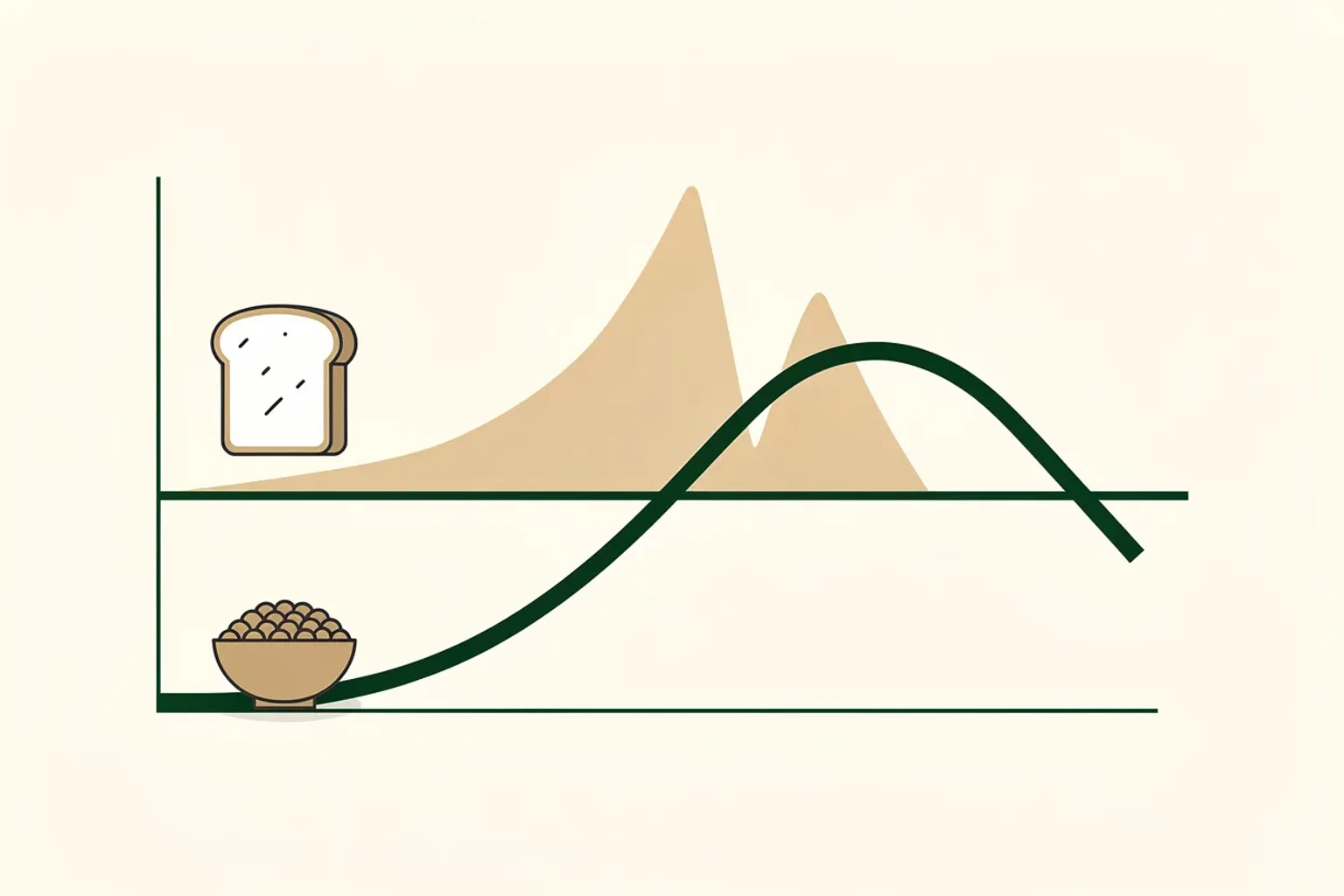
The glycemic index (GI) ranks foods from 0 to 100 by how fast their carbs raise blood sugar. It's one of the most useful tools for thinking about carbohydrates — and one of the most misunderstood, because GI doesn't always match intuition. White bread and watermelon score about the same, though they feel like completely different foods.
This guide covers what GI measures, how it relates to glycemic load (GL), which foods land where, and how to actually use the index without studying tables. Charts and a FAQ at the bottom.
What is the glycemic index?
The glycemic index is a ranking of carbohydrate-containing foods on a 0–100 scale, based on how much they raise blood glucose compared to pure glucose (GI = 100). A food's GI is measured in a lab: subjects eat a portion containing 50 g of available carbohydrates, then have their blood sampled every 15–30 minutes for two hours. The area under the resulting glucose curve, expressed as a percentage of the glucose reference, is the food's GI value.
Foods are usually grouped into three bands:
- Low GI: 55 or below
- Medium GI: 56–69
- High GI: 70 or above
The lower the GI, the slower and steadier the blood sugar rise. Pure protein, pure fat, and most non-starchy vegetables aren't ranked at all — they contain too little carbohydrate to register.
What determines a food's GI
Four factors do most of the work:
- Type of carbohydrate. Pure glucose and refined starches spike blood sugar fast. Fructose (the main sugar in fruit) raises it much more slowly because the liver has to process it first.
- Fiber and fat content. Both slow gastric emptying, which blunts the glucose rise. A bowl of oats with full-fat yogurt sits much lower on the scale than the same oats with water.
- Cooking method and texture. Mashed potato has a higher GI than a whole boiled one. Al dente pasta is lower-GI than overcooked pasta. The more broken-down the starch, the faster it digests.
- Ripeness. A green banana sits around 30. A fully ripe one is closer to 60. As fruit ripens, starch converts to free sugars.
This is why GI sometimes lands far from intuition. White bread (GI ~75) and watermelon (GI ~76) score similarly. But a slice of bread and a portion of watermelon contain very different amounts of carbohydrate per serving — which is the gap glycemic load was invented to close.
Glycemic index vs. glycemic load
Glycemic load (GL) adjusts GI for portion size:
GL = (GI × grams of carbs per serving) ÷ 100
A 120 g serving of watermelon contains only ~7 g of carbohydrate, giving a GL of about 5. A slice of white bread (~15 g carbs) lands at GL ~11. Same GI, different real-world impact.
Thresholds:
- GI: low ≤ 55, medium 56–69, high ≥ 70
- GL: low ≤ 10, medium 11–19, high ≥ 20
For a single meal, GL is the more practical number. GI tells you what kind of carbohydrate the food is; GL tells you how much actually arrives with the portion. A useful mental shortcut: GI is a quality measure, GL is quantity × quality.
Glycemic index chart: 40 common foods
Approximate GI values for everyday foods, grouped by category. Values vary by variety, ripeness, and preparation — these are typical midpoints from peer-reviewed sources.
Breads, grains, cereals
| Food | GI |
|---|---|
| White bread | 75 |
| Whole-wheat bread | 71 |
| Sourdough (wheat) | 54 |
| Rye bread | 50 |
| White rice (boiled) | 73 |
| Basmati rice (boiled) | 58 |
| Brown rice (boiled) | 68 |
| Spaghetti (al dente) | 49 |
| Spaghetti (overcooked) | 58 |
| Quinoa | 53 |
| Rolled oats (porridge) | 55 |
| Steel-cut oats | 52 |
| Cornflakes | 81 |
| Muesli (no added sugar) | 57 |
Fruits
| Food | GI |
|---|---|
| Apple | 36 |
| Banana (ripe) | 51 |
| Orange | 43 |
| Strawberries | 41 |
| Grapes | 53 |
| Watermelon | 76 |
| Pineapple | 66 |
| Mango | 51 |
| Dates (Medjool) | 70 |
Vegetables and legumes
| Food | GI |
|---|---|
| Boiled potato | 78 |
| Mashed potato | 83 |
| Sweet potato | 63 |
| Carrots (boiled) | 39 |
| Lentils | 32 |
| Chickpeas | 28 |
| Kidney beans | 24 |
| Soybeans | 16 |
Dairy and drinks
| Food | GI |
|---|---|
| Whole milk | 39 |
| Plain yogurt | 41 |
| Skim milk | 32 |
| Orange juice | 50 |
| Cola | 63 |
| Sports drink | 78 |
Want to look up a specific item? The Vnutri food catalog shows GI alongside calories, macros, and the full nutrient profile for every entry where a peer-reviewed GI value exists.
Low glycemic index foods
Foods that consistently land at GI ≤ 55:
- Legumes: lentils, chickpeas, kidney beans, black beans, soybeans
- Most whole fruits: apples, oranges, pears, berries, peaches, plums, cherries
- Non-starchy vegetables: broccoli, spinach, cauliflower, peppers, tomatoes (these usually aren't ranked because the carbohydrate per portion is minimal)
- Whole grains: steel-cut oats, barley, quinoa, bulgur, rye
- Pasta cooked al dente: spaghetti, penne, fettuccine
- Dairy: plain yogurt, milk, kefir
- Nuts and seeds
The common pattern: intact structure (whole grain, whole bean) plus fiber, fat, or protein in the same bite. That combination slows digestion and dampens the glucose curve.
High glycemic index foods
Foods that consistently land at GI ≥ 70:
- Refined grains: white bread, white rice (most varieties), instant rice, rice cakes
- Processed cereals: cornflakes, puffed rice, instant oatmeal
- Starchy snacks: pretzels, popcorn, crackers, most chips
- Sweetened beverages: sports drinks, regular soda, fruit punch
- Some root vegetables prepared a certain way: mashed potato, baked russet potato
- Concentrated sugars: dates, dried mango with added sugar, candy
Most of these have one thing in common: starch or sugar without the surrounding fiber, fat, or protein that would slow it down. Processing strips structure; the body digests starch faster than it would in its whole form.
Why the glycemic index matters
A single high-GI meal does little harm if you're metabolically healthy — blood sugar rises and falls, and the body handles it. Four patterns make GI worth paying attention to:
- Sustained energy. Low-GI meals release glucose more steadily. A bowl of steel-cut oats keeps you full longer than a sugary cereal that hits like a wave and crashes.
- Diabetes and prediabetes management. People with type 2 diabetes or insulin resistance see clear glucose-control benefits from low-GI eating patterns. Several meta-analyses link low-GI diets to improved HbA1c and fasting insulin.
- Weight regulation. Large cohort studies link low-GI diets with modestly better long-term weight outcomes, likely because steadier glucose means less reactive hunger between meals.
- Athletic performance. Endurance athletes use high-GI carbs around training for fast fuel, and low-GI carbs at other meals for steady energy.
If you're metabolically healthy and your meals are reasonably balanced, GI is a tiebreaker — not a rule. It matters more for people managing blood sugar, weight, or training load than for the average eater.
How to use the glycemic index in everyday eating
You don't need to memorize tables or check the GI of every food.
- Pick the less-processed version. Steel-cut oats over instant. Whole fruit over juice. Boiled potato over mashed. A whole apple over apple sauce.
- Pair carbohydrates with protein, fat, or fiber. Bread alone spikes blood sugar faster than the same bread with avocado and an egg. The combination shifts the meal's effective GL down significantly.
- Watch portion size on high-GI staples. Half a cup of white rice with protein and vegetables is fine. A full bowl of plain white rice hits much harder.
- Cook starchy foods al dente. Overcooking breaks down starch structure and pushes GI up. Pasta, rice, and potatoes are all affected.
- Eat fruit whole, not blended or juiced. Blending and juicing destroy fiber matrix and convert a low-GL portion into a high-GL one.
Total energy, protein, fiber, and food variety matter more in the long run than the GI of any single food. But for close calls — white rice vs. brown, watermelon vs. apple, instant vs. steel-cut oats — the GI/GL framework is genuinely useful.
How GI fits with low-carb and keto diets
GI and total carbohydrate are different tools. The keto diet targets total net carbs (typically below 20–50 g per day) and largely makes GI irrelevant within that ceiling — at those quantities, even a high-GI food contributes little absolute glucose. The low-FODMAP diet targets specific fermentable carbs, also independent of GI.
If you're following a calorie-controlled but not low-carb diet, GI and GL still apply and are the more useful framework for choosing between similar foods.
How Vnutri shows GI
Every food in the Vnutri food catalog with a known glycemic index displays its GI value on the detail page, alongside calories, macros, and the full nutrient profile. You can filter the catalog to show only low-GI foods. Values come from peer-reviewed sources (primarily Atkinson 2021) and are tracked separately for each cooking state — raw rice and cooked rice, for example, have meaningfully different GI.
Frequently asked questions
What is a good glycemic index number?
Below 55. Foods at GI ≤ 55 are considered low GI; they release glucose slowly and steadily. Foods at GI 56–69 are medium; GI ≥ 70 are high. "Good" depends on context — endurance athletes use high-GI carbs around training, and someone managing type 2 diabetes will lean low-GI most of the time.
Is watermelon high glycemic?
Watermelon has a high GI (~76), but a typical serving (120 g) contains only ~7 g of carbs, giving a low glycemic load of about 5. The high GI describes the carb's quality; the low GL reflects the small portion. For most people, watermelon doesn't cause meaningful blood-sugar spikes.
Are bananas low GI?
A ripe banana sits around GI 51 — medium-low. A green banana is closer to 30. The ripening process converts starch to free sugars, which is why GI rises as the fruit ripens. Pair a banana with nut butter or yogurt to flatten its glucose impact further.
What foods have a glycemic index of 0?
Foods with little or no carbohydrate aren't on the GI scale at all. That includes meats, fish, eggs, cheese, butter, oils, most non-starchy vegetables, and pure protein powders. They don't raise blood sugar meaningfully, so they aren't ranked.
Does cooking change a food's GI?
Yes, often substantially. Cooking gelatinizes starch and makes it easier to digest, which raises GI. Examples: al dente pasta sits around 49, overcooked at 58; boiled potato at 78, mashed at 83. Cooling cooked starches (pasta, rice, potato) and reheating creates resistant starch, which lowers the GI back down.
Glycemic index vs. glycemic load — which matters more?
For day-to-day eating, glycemic load is more practical because it accounts for portion size. GI is a property of the food; GL is the actual carbohydrate impact of what you eat. The two work together: GI tells you the carb's quality, GL tells you the quantity × quality.
Can a low-GI diet help with weight loss?
Several large cohort and intervention studies link low-GI eating patterns with modestly better long-term weight outcomes, mainly because steadier glucose means less reactive hunger. The effect is modest, not dramatic, and total calorie intake still does most of the work. GI is best treated as a tool for choosing between similar foods, not as a weight-loss program on its own.
References
- Atkinson FS, Brand-Miller JC, Foster-Powell K, et al. International tables of glycemic index and glycemic load values 2021: a systematic review. Am J Clin Nutr. 2021;114(5):1625–1632.
- Jenkins DJ, Kendall CW, Augustin LS, et al. Glycemic index: overview of implications in health and disease. Am J Clin Nutr. 2002;76(1):266S–273S.
- Augustin LS, Kendall CW, Jenkins DJ, et al. Glycemic index, glycemic load and glycemic response: An International Scientific Consensus Summit. Nutr Metab Cardiovasc Dis. 2015;25(9):795–815.
- Vega-López S, Venn BJ, Slavin JL. Relevance of the glycemic index and glycemic load for body weight, diabetes, and cardiovascular disease. Nutrients. 2018;10(10):1361.