Fiber: The Complete Guide — How Much, Why, and Where to Get It
Soluble vs insoluble fiber, why 25–35 g per day isn't enough for most, and where to find it without supplements. Tables, targets, and FAQ.
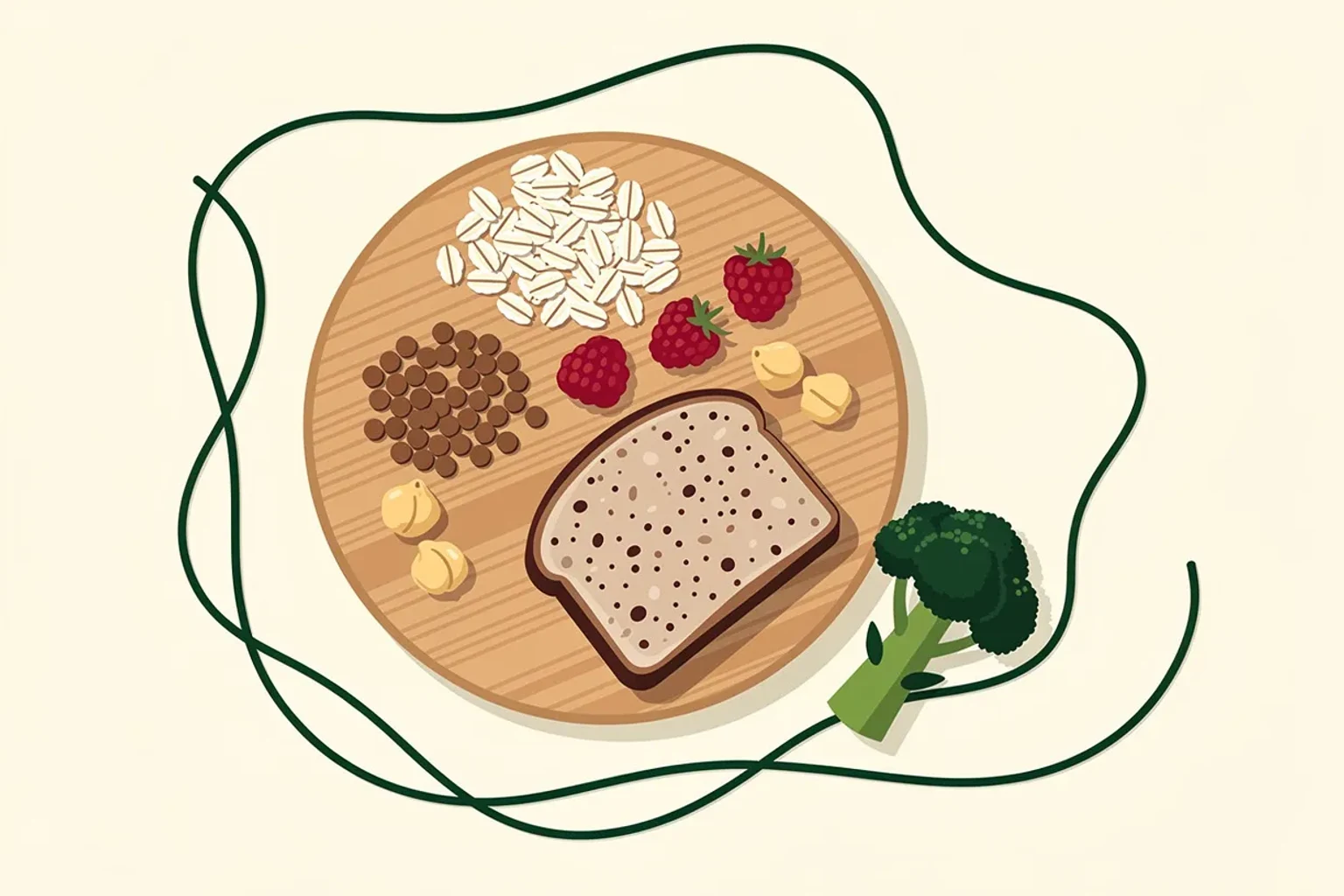
Fiber is the one carbohydrate the body doesn't absorb. It passes through the gut largely intact, feeds the microbiota, slows sugar absorption, and keeps the colon moving. The WHO target is 25–35 g per day; the average European or American eats 15–18 g.
That 10–15 g gap is the largest single hole in modern diets. Closing it isn't hard — but you need to know which foods actually concentrate fiber and which just claim it on the front of the package.
What is fiber?
Fiber (dietary fiber) is the plant carbohydrate the body doesn't digest. It doesn't release glucose, doesn't trigger insulin, and contributes almost no calories: 0–4 kcal/g under US rules, 2 kcal/g under EU rules.
Technically, fibers are polysaccharides with bonds human enzymes can't break: cellulose, hemicelluloses, pectins, beta-glucans, inulin, lignin, resistant starch. Some get fermented by colonic bacteria into short-chain fatty acids — butyrate, propionate, acetate — which feed the intestinal lining.
Soluble and insoluble
Two groups by behavior in water. Every plant contains both, in different ratios.
Soluble — dissolves in water, forms a gel.
- Beta-glucans — oats, barley
- Pectin — apples, citrus, berries
- Inulin — onion, garlic, asparagus, chicory, Jerusalem artichoke
- Psyllium — psyllium husk
- Gums — legumes, seeds
Effect: slows sugar and fat absorption, lowers LDL cholesterol, feeds the microbiota.
Insoluble — doesn't dissolve, adds bulk to stool.
- Cellulose — bran, vegetable and fruit skins
- Lignin — seeds, whole grains
- Some hemicelluloses — root vegetables, wheat bran
Effect: speeds transit, helps prevent constipation and diverticulitis.
Most foods carry both. Oatmeal — soluble beta-glucan + insoluble cellulose. An apple with skin — soluble pectin + insoluble cellulose.
How much fiber you need
Official targets:
| Source | Daily target |
|---|---|
| WHO | 25 g |
| EFSA (Europe) | 25 g |
| US National Academies | 38 g (men), 25 g (women) |
| British Nutrition Foundation | 30 g |
Real median intake: 18 g/day in Europe, 15 g/day in the US. About 90 % of adults fall short.
These targets apply under age 50. Older adults usually need 5–7 g less because total energy intake drops.
There's no hard upper limit, but jumping from 15 to 35 g overnight is a recipe for bloating and gas. Increase gradually — 5 g a week — and drink plenty of water.
Top fiber sources
Per 100 g of food, sorted by density.
Legumes (10–20 g per 100 g cooked)
| Food | Fiber |
|---|---|
| Black beans, cooked | 8.7 g |
| Lentils, cooked | 7.9 g |
| Chickpeas, cooked | 7.6 g |
| Kidney beans, cooked | 7.4 g |
| Green peas, cooked | 5.5 g |
| Edamame | 5.2 g |
Legumes are the most concentrated category. One cooked cup (~180 g) covers a quarter of the daily target.
Whole grains (5–12 g per 100 g dry)
| Food | Fiber |
|---|---|
| Wheat bran | 42 g |
| Oat bran | 15 g |
| Steel-cut oats | 10 g |
| Buckwheat | 10 g |
| Pearl barley | 8 g |
| Bulgur | 7.7 g |
| Whole-wheat flour | 12.2 g |
| Rye bread | 5.8 g |
Refined grains and white bread lose 60–80 % of fiber. Swapping white rice for brown lifts fiber from 0.4 to 1.8 g per 100 g cooked — small but real.
Berries and fruit (2–7 g per 100 g)
| Food | Fiber |
|---|---|
| Raspberries | 6.5 g |
| Blackcurrants | 5.1 g |
| Cranberries | 4.6 g |
| Avocado | 6.7 g |
| Pear with skin | 3.1 g |
| Apple with skin | 2.4 g |
| Banana | 2.6 g |
| Prunes | 7.1 g |
The smaller the berry and the more skin per gram, the higher the density. Peeling removes up to half.
Vegetables (2–6 g per 100 g)
| Food | Fiber |
|---|---|
| Artichoke | 5.4 g |
| Jerusalem artichoke | 4.6 g |
| Brussels sprouts | 3.8 g |
| Broccoli | 2.6 g |
| Carrot | 2.8 g |
| Beetroot | 2.8 g |
| Spinach, raw | 2.2 g |
Nuts and seeds (5–35 g per 100 g)
| Food | Fiber |
|---|---|
| Chia seeds | 34.4 g |
| Flaxseed | 27.3 g |
| Pumpkin seeds | 18.4 g |
| Sunflower seeds | 8.6 g |
| Almonds | 12.5 g |
| Pistachios | 10.3 g |
| Walnuts | 6.7 g |
Seeds top the list but portions are small (15–30 g). One tablespoon of chia ≈ 5 g fiber.
The Vnutri catalog shows fiber per 100 g for every food. The high-fiber filter sorts foods by density (from 6 g per 100 g).
Why fiber matters
The evidence base is stronger than for most nutrients. The Reynolds 2019 meta-analysis (Lancet) summarized 185 prospective studies and 58 randomized trials and found:
- Lower mortality. Every +8 g of fiber per day lowered all-cause mortality by 7 %. The effect is linear up to ~30 g.
- Cardiovascular disease. −19 % risk of coronary heart disease at high vs low intake.
- Type 2 diabetes. −16 % risk. Beta-glucans and pectin blunt the post-meal glucose peak.
- Colorectal cancer. −16 % risk. The effect is stronger for insoluble fiber and butyrate from fermentation.
- Cholesterol. Each +5 g of soluble fiber drops LDL by 5–10 mg/dL.
- Satiety. Fiber slows gastric emptying and cuts intake by 10–20 % under free-choice conditions.
- Microbiota. Fermentable fiber feeds Bifidobacterium and Lactobacillus. Low fiber → less diverse microbiota → higher inflammation.
See the glycemic index guide — fiber partly determines how much a carb raises blood sugar.
Fiber supplements
Psyllium, inulin, acacia gum — they work, but they don't replace whole-food fiber. Whole foods carry fiber bundled with phytochemicals, antioxidants, and minerals. Isolated fiber delivers some effects (lower LDL, faster transit) but not all.
When supplements help:
- Low vegetable tolerance for medical reasons (e.g. active Crohn's)
- Constipation that doesn't respond to diet — psyllium 5–10 g/day
- High LDL — soluble fiber 10 g/day on top of diet
What won't work: adding inulin to a diet that's already short of fiber from food. Cover the base from real food first.
How to add 10 g of fiber to your day
Simple arithmetic. Any of these swaps closes the gap.
- Rye or whole-wheat bread instead of white — +3–4 g per 100 g.
- Half a cup of beans in one meal — +4–5 g.
- Oats instead of cornflakes — +3 g.
- Whole fruit instead of juice — +2.5 g.
- One tablespoon of chia or flax in breakfast — +5 g.
- Brown rice instead of white — +1.5 g per 100 g.
- Potato with skin, unpeeled carrots — +1–2 g.
Any two of those covers a typical gap.
Low-fiber exceptions
Some conditions call for less fiber:
- Active inflammatory bowel disease (Crohn's, ulcerative colitis) — your doctor may prescribe a low-residue diet.
- Colonoscopy prep — low fiber for 2–3 days before.
- IBS with diarrhea — soluble fiber often helps, insoluble can worsen. Sometimes low-FODMAP works. See low-FODMAP for IBS.
- Gastroparesis — delayed gastric emptying makes insoluble fiber a problem.
For a healthy person, there's no fiber ceiling. Gas during a ramp-up is a normal adaptation; it passes in 2–3 weeks.
Fiber and diets
- Keto — fiber subtracts from net carbs, opening room for broccoli, avocado, berries, nuts, and seeds. Achievable target: 20–25 g/day, below the general recommendation.
- Paleo — high by default: vegetables, fruit, nuts. Legumes are excluded, capping the ceiling at 30–40 g.
- Vegan — the highest average intake. Marsh 2012 meta-analysis found a median of 41 g/day, two to three times the omnivore average.
- Mediterranean — high fiber from legumes, whole grains, olive oil, and vegetables.
- Low-FODMAP — usually lower fiber because certain legumes, onions, garlic, and wheat are restricted. Replaced by oats, banana, carrot, potato.
How Vnutri tracks fiber
The Vnutri catalog stores fiber per 100 g for all 845+ foods. The high-fiber filter uses a 6 g per 100 g threshold and sorts by density. One screen, top concentrated sources.
On the detail page, fiber sits next to carbohydrates and sugars — you can see at a glance which part of the carb counts toward calories and which doesn't. For keto, this matters: net carbs = carbs − fiber.
Frequently asked questions
How much fiber do I need per day?
WHO recommends 25 g; the US National Academies recommends 38 g for men and 25 g for women. Average intake in the US and Europe is 15–18 g. A steady ~30 g per day is a reasonable target; more isn't required but isn't harmful.
Soluble or insoluble — which is better?
You need both. Soluble lowers LDL, feeds the microbiota, and smooths glycemia. Insoluble speeds transit and prevents constipation. Whole foods carry both; there's no need to source them separately.
Can I hit my fiber target on white bread?
No. White bread has ~2 g fiber per 100 g, whole-grain ~6–8 g. Hitting 25 g on white bread alone would mean over a kilogram — not realistic.
Fiber makes me bloat — what now?
Jumping from 15 to 30 g of fiber overnight almost always causes gas. The fix is gradual — 5 g per week — and enough water. Also check FODMAP content: onion, garlic, and beans can cause bloating independent of fiber. See low-FODMAP.
Does freezing or cooking destroy fiber?
No. Fiber is a structural polysaccharide and is stable under heat and freezing. Vitamins degrade; fiber doesn't. Frozen vegetables and berries are fine fiber sources.
Should I take fiber supplements?
Cover 25 g from food first. If medical reasons prevent that, or you need extra soluble fiber for LDL, psyllium 5–10 g/day is a reasonable option. Food first, supplements second.
How much fiber is in vegetables vs bread?
One cooked cup of broccoli (~150 g) has 4 g of fiber. Two slices of whole-wheat bread (~60 g) have 4 g. Same total, but the bread delivers ~150 kcal vs ~50 kcal for the broccoli.
References
- Reynolds A, et al. Carbohydrate quality and human health: a series of systematic reviews and meta-analyses. Lancet. 2019;393(10170):434–445.
- US National Academies of Sciences. Dietary Reference Intakes for Energy, Carbohydrate, Fiber, Fat, Fatty Acids, Cholesterol, Protein, and Amino Acids. National Academies Press. 2005.
- European Food Safety Authority. Scientific opinion on dietary reference values for carbohydrates and dietary fibre. EFSA J. 2010;8(3):1462.
- World Health Organization. Healthy diet fact sheet N°394. 2020.
- Marsh K, et al. Health implications of a vegetarian diet: a review. Am J Lifestyle Med. 2012;6(3):250–267.