Calories Explained: What They Are and Why Not All Are Equal
What a calorie is, where it comes from in food, how energy density differs from satiety, and why 'calorie in — calorie out' is only part of the story.
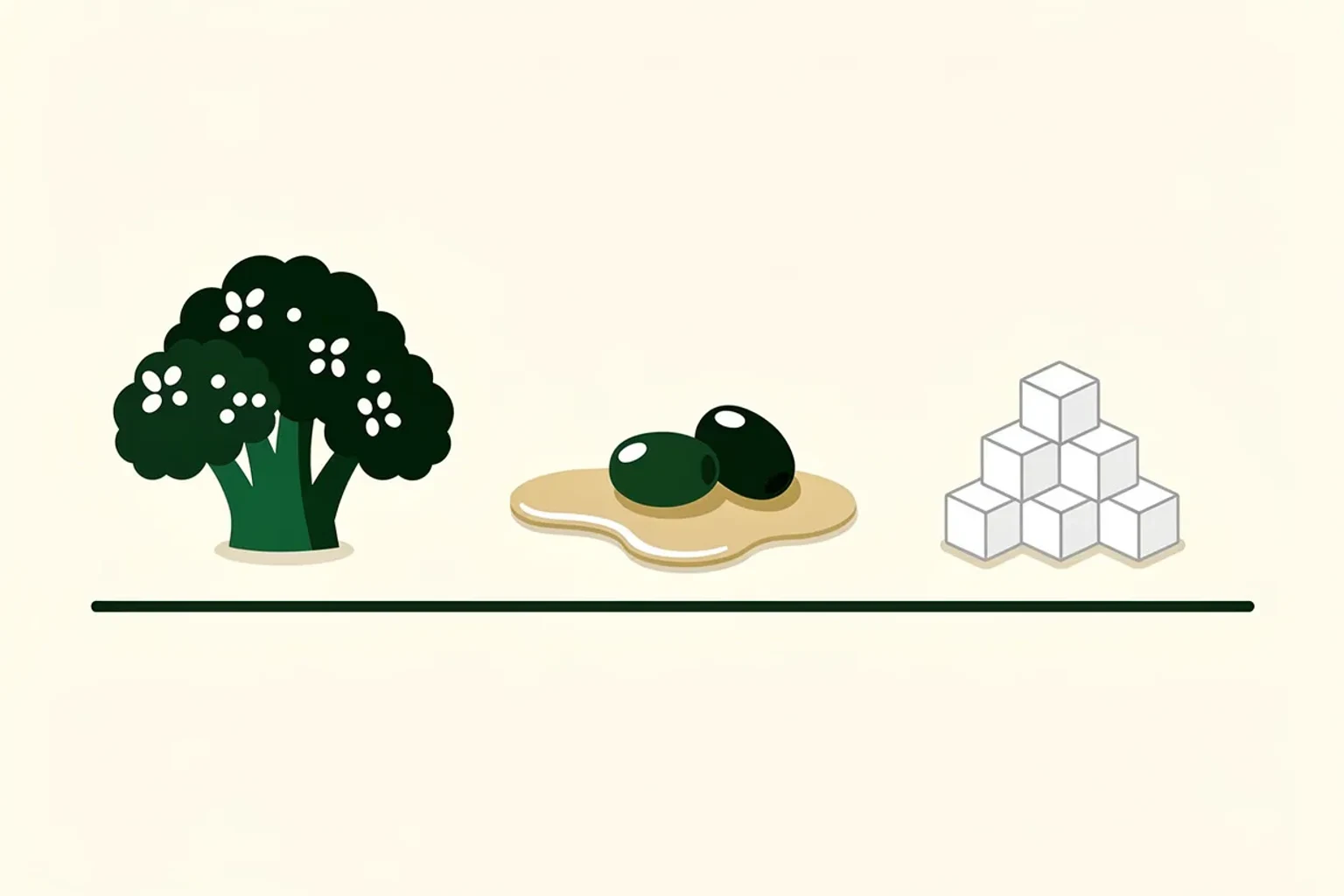
A calorie is a unit of energy. "220 kcal" on a label means the food carries enough energy to raise the temperature of 220 litres of water by 1 °C. Technical, but in practice for the body it just means "fuel". And 220 kcal from a bowl of oats and 220 kcal from a chocolate bar will fill you up differently, raise blood sugar differently, and end up in storage differently.
This guide is about the calorie as a unit: what it measures, how it ends up in a food, why "not all calories are equal", and how that shapes real food choices.
What is a calorie?
Strictly: the energy needed to raise 1 g of water by 1 °C. In nutrition, the "calorie" on labels is the large calorie — kilocalorie — 1000 small calories. Labels usually drop the "kilo" prefix but mean kcal.
In SI units, calories are joules: 1 kcal = 4.184 kJ. EU labels are required to show both.
Originally food energy was measured by a bomb calorimeter — burn the food in a sealed chamber, record how much the surrounding water warmed up. Today most label values are calculated from macronutrients using Atwater factors.
Where calories come from
Calories come from food. Specifically, from four classes of compound:
- Carbohydrate — 4 kcal/g
- Protein — 4 kcal/g
- Fat — 9 kcal/g
- Alcohol — 7 kcal/g
Plus:
- Fibre — 2 kcal/g (EU rules); 0–4 kcal/g (US rules, counted as part of carbs)
- Sugar alcohols (erythritol, xylitol) — 0.2–2.4 kcal/g depending on type
More on macros — see the macro vs micro breakdown.
Take 100 g of salmon: 20 g protein × 4 + 13 g fat × 9 ≈ 80 + 117 = 197 kcal. The label says 200. A 1–2 % discrepancy is normal.
Not all calories are equal: energy density
A calorie is a unit of energy, not volume or weight. 200 kcal lands in very different-sized portions.
| Food | Weight for 200 kcal |
|---|---|
| Broccoli (raw) | ~590 g |
| Apple | ~390 g |
| Greek yogurt (2 %) | ~330 g |
| Cooked chicken breast | ~125 g |
| Avocado | ~125 g |
| Rye bread | ~80 g |
| Dark chocolate (70 %) | ~35 g |
| Olive oil | ~22 g |
| Sugar | ~50 g |
| Butter | ~28 g |
This is energy density — kcal per gram of food. Barbara Rolls at Penn State built her Volumetrics approach around this number: at the same calorie count, low-density foods fill more stomach space and sustain satiety longer.
Rolls's bands:
- Very low density (< 0.6 kcal/g) — most raw vegetables and fruit, lean dairy, broths
- Low (0.6–1.5 kcal/g) — cooked grains, legumes, lean meat, lean fish
- Medium (1.5–4 kcal/g) — bread, pasta, mid-fat cheese, fatty fish
- High (> 4 kcal/g) — oils, nuts, chocolate, chips, dried fruit
All else equal, a diet leaning on low-density foods gives more eating volume per calorie.
Satiety: same calories, different fullness
In 1995 Susanna Holt ran 240-kcal portions of different foods past test subjects and tracked fullness two hours later. White bread was the baseline at 100. The result — the Satiety Index:
| Food | Satiety index |
|---|---|
| Boiled potato | 323 |
| Fish | 225 |
| Oatmeal | 209 |
| Orange | 202 |
| Apple | 197 |
| Beef | 176 |
| Black beans | 168 |
| Whole-grain bread | 157 |
| Cheese | 146 |
| White bread (baseline) | 100 |
| Ice cream | 96 |
| Cornflakes | 118 |
| Doughnuts | 68 |
| Chocolate bar | 70 |
The pattern is simple: high-protein, high-fibre, high-water foods with low energy density fill you up. Refined sugars and structureless fats sit at the bottom. See also the glycemic index, which explains part of the gap.
Food matrix: why absorption isn't always 100 %
The calorie on the label isn't always the calorie the body extracts. The reason is matrix — the food's physical structure.
- Whole almonds — label says 575 kcal/100 g, actual absorption ~440 kcal. Cell walls trap some of the fat. Almond butter delivers the full label value.
- Raw vs cooked carrots — cooking releases carotenoids ~30 % better, but the calorie count is the same.
- Resistant starch — cooled and reheated rice, potato, or pasta carry 10–15 % starch that digests poorly. It shifts to the large intestine and acts more like fibre.
- Bound fats in nuts and seeds — David Baer at USDA recalculated almond energy from 6.8 to 4.6 kcal/g in 2012. Standard tables haven't caught up.
So 100 kcal "from almonds" and 100 kcal "from almond butter" are different 100 kcal.
Thermic effect of food: the cost of digestion
Digesting food also costs energy — about 10 % of daily expenditure.
- Protein — 20–30 % of its energy goes to processing it
- Carbohydrate — 5–10 %
- Fat — 0–3 %
- Alcohol — ~22 %
So 200 kcal from chicken breast leaves about 140–160 kcal of net energy; 200 kcal from olive oil leaves nearly all 200. Over time, this is part of why high-protein diets give an edge in body composition.
How accurate are labels?
US and EU regulators allow ±20 % tolerance from declared calories. In practice, industrial-scale products typically deviate less than 10 %. Artisanal and small-producer foods vary more.
The smaller the declared count, the larger the percent error. A "60 kcal" snack at ±20 % spans 48–72.
The Vnutri catalog reports calories per 100 g, aggregated from 8 curated databases where values are lab-measured. That smooths out variation between manufacturers of the same food.
"Calorie in — calorie out": what the simple balance misses
The first law of thermodynamics holds: energy doesn't appear or vanish inside the body. But "100 kcal in = 100 kcal stored" papers over three effects.
- Satiety and behaviour. A high-protein, high-fibre diet keeps you fuller, and on average you eat less — not because of counting, but because you want less.
- Hormonal response. A 30 g bite of sugar and a 30 g bite of protein signal insulin, leptin, and ghrelin differently. That sets what happens to blood glucose and appetite three hours later.
- Cost of digestion. Thermic effect, above.
Real-world trials back this up. Kevin Hall's 2019 controlled crossover at NIH showed that on isocaloric diets, ultra-processed foods drove more weight gain than minimally processed ones — through eating speed, satiety, and inadvertent overconsumption.
How many calories you need
Resting expenditure (BMR) — energy at rest — for an adult is 1300–1700 kcal. Total expenditure (TDEE) — including activity — is usually 1800–2800 kcal. Exact figure depends on age, sex, weight, muscle mass, and activity.
Rough estimate:
- Sedentary adult: BMR × 1.2
- Light activity (1–3 workouts/wk): BMR × 1.375
- Moderate (3–5 workouts): BMR × 1.55
- High (6–7 workouts): BMR × 1.725
- Very high (manual labour + sport): BMR × 1.9
For weight loss — usually a 300–500 kcal/day deficit; for gain — a 200–400 kcal surplus. Aggressive deficits (> 750 kcal/day) risk muscle loss and adherence breakdown.
How Vnutri shows calories
The Vnutri catalog reports calories per 100 g for all 845+ foods — one standard, not "per serving". This matters for comparison: different brands of the same food list different serving sizes on the label, making direct comparison hard. Per 100 g gives a single scale.
Calories sit next to macros, glycemic index (where known), and 38 other nutrients. Filter by low carb, low fat, and other parameters.
Frequently asked questions
Are all calories equal?
In thermodynamics — yes: 100 kcal is 100 kcal. In metabolism — no: satiety, hormonal response, digestive cost, and actual absorption all vary. In the short term, energy balance wins. Over the long run, calorie quality matters too.
How many kcal in a gram of fat, protein, and carbohydrate?
Fat — 9 kcal/g, protein and carbs — 4 kcal/g, alcohol — 7 kcal/g, fibre — 2 kcal/g (EU). These are Atwater factors, used to calculate label calories.
Are "negative-calorie" foods real?
Myth. Celery, cucumber, and leafy greens have very low density (10–15 kcal/100 g), but digestion costs at most 20–30 % of that energy. The net balance is positive — just very small. Useful in a deficit, but not a way to "burn" fat.
Will my metabolism slow if I eat less?
Yes, partly. BMR drops 5–15 % in a deficit due to lower body mass and thyroid hormone adaptation. It blunts part of the deficit but doesn't make weight loss impossible. It does make plateaus expected.
What matters more — calories or macros?
Calories first — they set the direction of weight. Macros second, especially protein (preserves muscle). Hitting calories without enough protein gives worse body composition at the same scale weight.
Can vegetables make you gain weight?
In theory, yes, if you ate enormous quantities. In practice, almost never: at energy density below 0.5 kcal/g, food volume exceeds stomach capacity before calories exceed expenditure.
References
- US National Academies of Sciences. Dietary Reference Intakes for Energy. National Academies Press. 2023.
- Hall KD, et al. Ultra-processed diets cause excess calorie intake and weight gain: randomized controlled trial. Cell Metab. 2019;30(1):67–77.
- Rolls BJ. The Volumetrics Eating Plan. HarperCollins. 2007.
- Holt SH, et al. A satiety index of common foods. Eur J Clin Nutr. 1995;49(9):675–690.
- Novotny JA, Gebauer SK, Baer DJ. Discrepancy between the Atwater factor predicted and empirically measured energy values of almonds in human diets. Am J Clin Nutr. 2012;96(2):296–301.