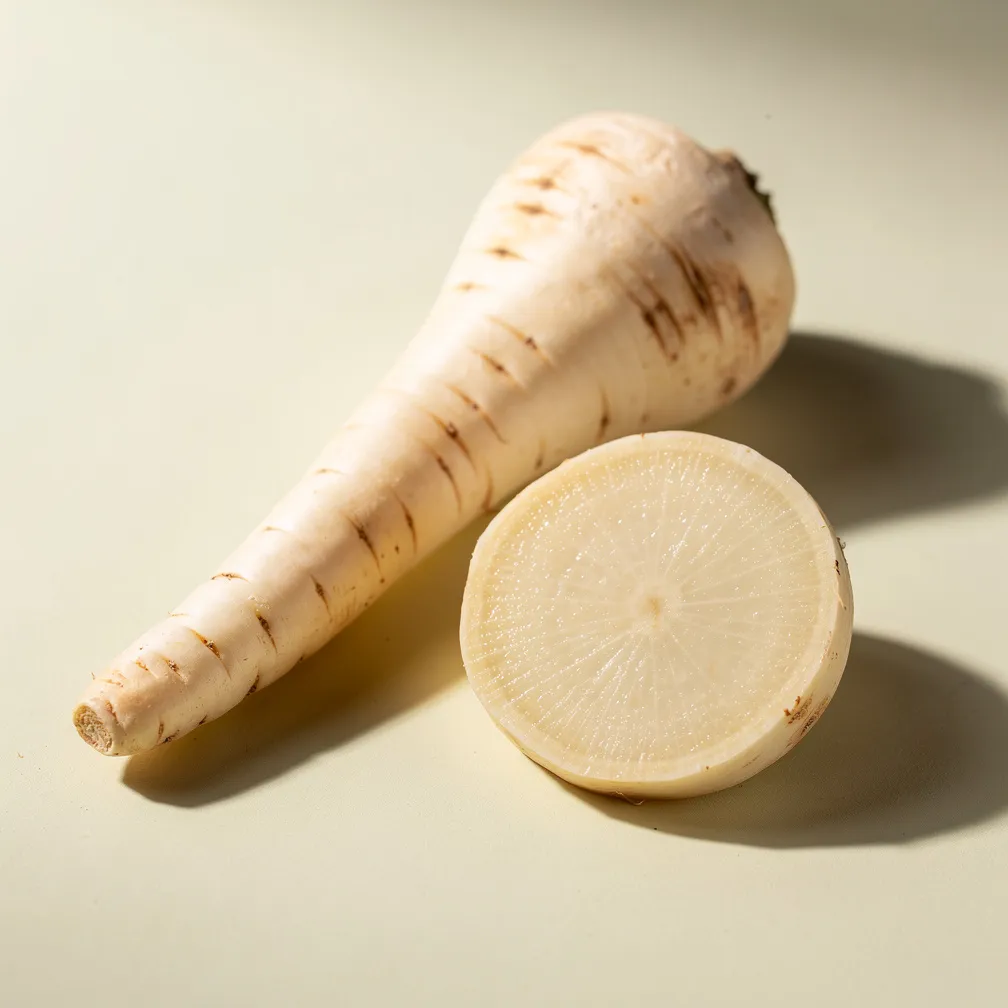
Parsnip
Categories
Cooking method
| Macros | per 100 g |
|---|---|
| Calories | 63 kcal |
| Protein | 1.5 g |
| Fat | 0.4 g |
| Carbs | 12.5 g |
Parsnip is a cream-coloured root vegetable closely related to carrot and parsley, typically eaten cooked — roasted, boiled, mashed or added to soups and stews — though it can also be eaten raw when young and tender. Per 100 g, raw parsnip provides 63 kcal, 1.5 g of protein, 0.4 g of fat, 12.5 g of carbohydrates and a notable 4.5 g of dietary fibre, with sugars accounting for 4.8 g of those carbohydrates. It is a good source of potassium at 450 mg per 100 g, and contributes 67 mcg of folate and 22.5 mcg of vitamin K per 100 g. No glycemic index value is available for raw parsnip. It fits a wide range of dietary patterns, including vegan, vegetarian, gluten-free, dairy-free, keto, paleo, mediterranean and low-FODMAP.
How many calories in a parsnip?
Raw parsnip contains 63 kcal per 100 g. A medium parsnip weighs around 130 g, putting it at approximately 82 kcal per vegetable before cooking.
How much potassium is in parsnip?
Parsnip contains 450 mg of potassium per 100 g, making it a relatively rich vegetable source of this mineral. That figure is notably higher than carrots, which typically provide around 320 mg per 100 g.
Is parsnip keto-friendly?
Parsnip appears on the keto diet list in this dataset, though at 12.5 g of carbohydrates per 100 g it sits at the higher end for a keto vegetable. Portion size matters — small amounts can fit within a daily carbohydrate limit, but larger servings may not.
Diets
Get Vnutri
Log meals, track daily totals, save favorites. Free on iOS and Android.
Glycemic Index
approximateMacros · per 100 g
| Macros | Amount |
|---|---|
| Calories | 63.0 kcal |
| Protein | 1.5 g |
| Fat | 0.40 g |
| Carbs | 12.5 g |
| Sugars | 4.8 g |
| Fiber | 4.5 g |
| Starch | 5.2 g |
| Fats breakdown | Amount |
|---|---|
| Saturated | 0.050 g |
| Monounsaturated | 0.070 g |
| Polyunsaturated | 0.047 g |
| Trans | 0 g |
| Omega-3 | 0.014 g |
| Omega-6 | 0.16 g |
| Cholesterol | 0 mg |
| Minerals | Amount |
|---|---|
| Calcium | 41.0 mg |
| Iron | 0.59 mg |
| Magnesium | 29.0 mg |
| Phosphorus | 71.0 mg |
| Potassium | 450 mg |
| Sodium | 10.0 mg |
| Zinc | 0.59 mg |
| Copper | 0.12 mg |
| Manganese | 0.48 mg |
| Selenium | 0.20 mcg |
| Iodine | 0.25 mcg |
| Vitamins | Amount |
|---|---|
| Vitamin A | 0 mcg |
| Retinol | 0 mcg |
| Vitamin C | 11.5 mg |
| Vitamin D | 0 mcg |
| Vitamin E | 1.5 mg |
| Vitamin K | 22.5 mcg |
| Thiamin (B1) | 0.090 mg |
| Riboflavin (B2) | 0.050 mg |
| Niacin (B3) | 1.0 mg |
| Pantothenic acid (B5) | 0.60 mg |
| Vitamin B6 | 0.10 mg |
| Folate (B9) | 67.0 mcg |
| Vitamin B12 | 0 mcg |
| Choline | 27.0 mg |
Other cooking states of Parsnip
Cooked parsnip (68 kcal).