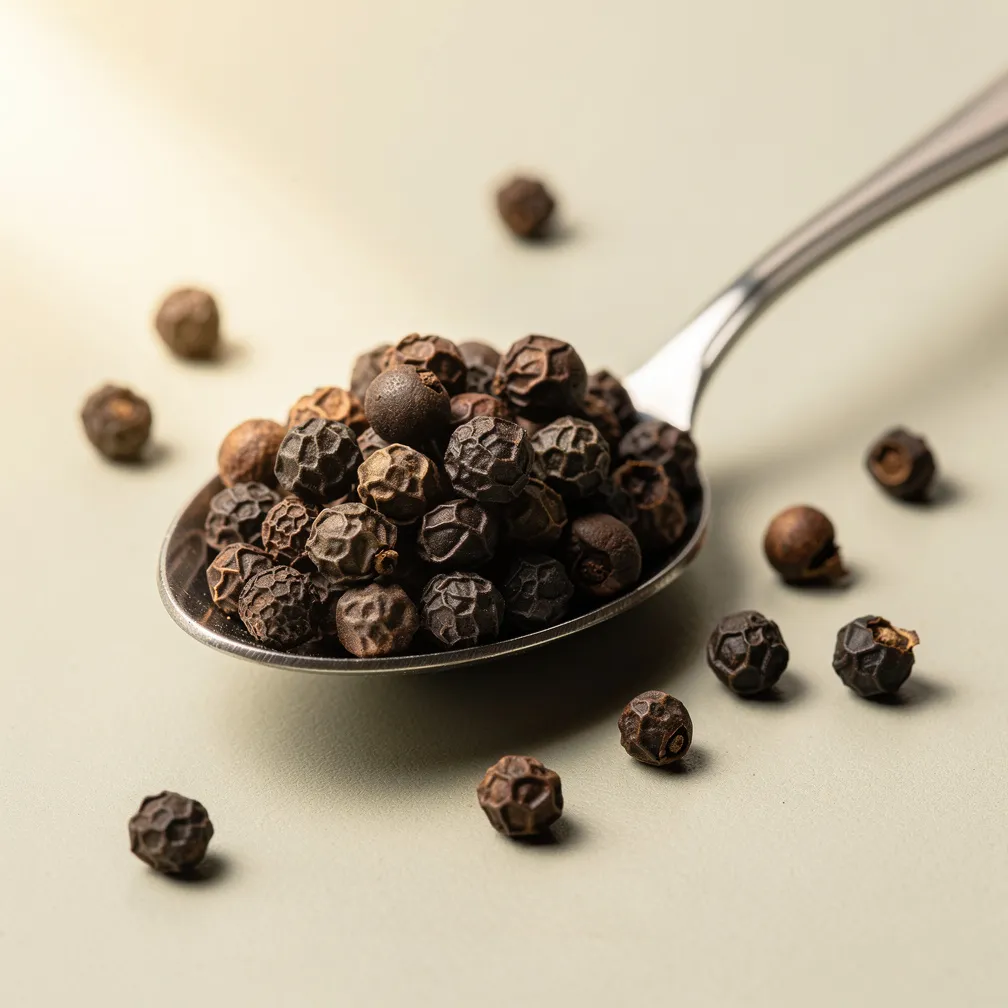
Black pepper
Categories
| Macros | per 100 g |
|---|---|
| Calories | 304 kcal |
| Protein | 11.0 g |
| Fat | 3.3 g |
| Carbs | 44.0 g |
Black pepper is a dried spice made from the ground or whole berries of Piper nigrum, used in virtually every cuisine worldwide as a seasoning for cooked dishes, sauces, marinades and table condiment. Because it is used in small quantities — typically under a gram per serving — the per-100g figures reflect a concentrated profile: 304 kcal, 11 g of protein, 3.3 g of fat, 44 g of carbohydrates and 13.9 g of dietary fibre. The mineral content is notably dense, with 870 mg of potassium, 173 mg of phosphorus and 171 mg of magnesium per 100 g. Folate comes in at 132 mcg per 100 g, though realistic intake from typical culinary use is modest. No glycemic index is available for black pepper. It fits vegan, vegetarian, gluten-free, dairy-free, paleo, Mediterranean and low-FODMAP dietary patterns.
How many calories in black pepper?
Black pepper contains 304 kcal per 100 g, but a typical pinch or single serving is around 0.5–1 g, contributing fewer than 3 kcal. The high calorie figure per 100 g reflects its concentrated, dried form rather than realistic portion sizes.
How much potassium is in black pepper?
Black pepper contains 870 mg of potassium per 100 g, which is a high concentration for a spice. In practice, a 1 g serving delivers around 8.7 mg of potassium, so it contributes minimally to daily intake at typical culinary amounts.
Is black pepper low-FODMAP friendly?
Yes, black pepper is included on the low-FODMAP diet list, making it a suitable seasoning for people managing digestive sensitivities. It is also compatible with vegan, vegetarian, gluten-free, dairy-free, paleo and Mediterranean dietary patterns.
Diets
Get Vnutri
Log meals, track daily totals, save favorites. Free on iOS and Android.
Macros · per 100 g
| Macros | Amount |
|---|---|
| Calories | 304 kcal |
| Protein | 11.0 g |
| Fat | 3.3 g |
| Carbs | 44.0 g |
| Sugars | 1.3 g |
| Fiber | 13.9 g |
| Starch | 39.3 g |
| Fats breakdown | Amount |
|---|---|
| Saturated | 1.4 g |
| Monounsaturated | 0.74 g |
| Polyunsaturated | 1.00 g |
| Trans | 0 g |
| Omega-3 | 0.22 g |
| Omega-6 | 1.4 g |
| Cholesterol | 0 mg |
| Minerals | Amount |
|---|---|
| Calcium | 110 mg |
| Iron | 6.3 mg |
| Magnesium | 171 mg |
| Phosphorus | 173 mg |
| Potassium | 870 mg |
| Sodium | 40.0 mg |
| Zinc | 1.4 mg |
| Copper | 0.72 mg |
| Manganese | 1.5 mg |
| Selenium | 4.9 mcg |
| Iodine | 4.5 mcg |
| Vitamins | Amount |
|---|---|
| Vitamin A | 6.0 mcg |
| Retinol | 0 mcg |
| Vitamin C | 0 mg |
| Vitamin D | 0 mcg |
| Vitamin E | 1.0 mg |
| Vitamin K | 5.0 mcg |
| Thiamin (B1) | 0.11 mg |
| Riboflavin (B2) | 0.18 mg |
| Niacin (B3) | 1.1 mg |
| Pantothenic acid (B5) | 1.4 mg |
| Vitamin B6 | 0.29 mg |
| Folate (B9) | 132 mcg |
| Vitamin B12 | 0 mcg |
| Choline | 11.3 mg |