Cream vs Greek Yogurt: Calories, Fat, Protein Compared
Cream vs Greek yogurt per 100 g: calories, fat, protein, calcium, lactose and when the yogurt swap works in cooking, baking, and dolloping.

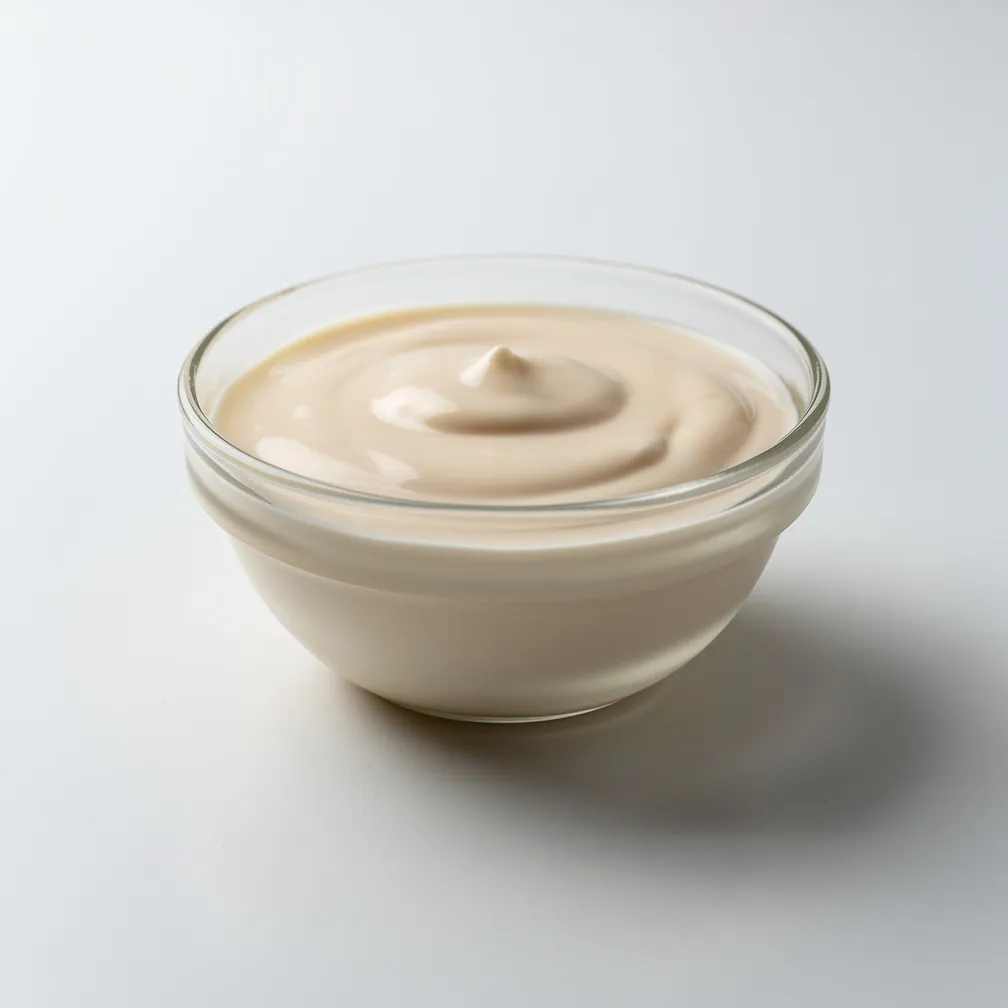
Cream and Greek yogurt both come from milk but take opposite paths through the dairy process. Cream is the fat fraction skimmed off the top; Greek yogurt is the protein-and-curd fraction strained from the bottom. The result is two ingredients with the same versatility in cooking and the same off-the-spoon mouthfeel, but very different macros: cream sits at 196 kcal per 100 g with 13 g of fat, Greek yogurt at 83 kcal with 8.6 g of protein.
This article compares them on macros, micronutrients, and culinary use — and shows where the yogurt swap saves calories without sacrificing the dish, and where cream's fat structure is doing real work.
Quick comparison
| Per 100 g | Cream | Greek yogurt (plain) |
|---|---|---|
| Calories | 196 kcal | 83 kcal |
| Protein | 3.0 g | 8.6 g |
| Fat | 13.0 g | 1.9 g |
| Saturated fat | 7.0 g | 0.1 g |
| Carbohydrate | 8.9 g | 9.5 g |
| Sugars | 4.5 g | 9.5 g (lactose) |
| Calcium | 88 mg | 100 mg |
| Potassium | 125 mg | 133 mg |
| Cholesterol | 27 mg | 5 mg |
| Vitamin A | 128 µg | 2 µg |
Numbers come from the Vnutri food catalog.
Macros and calories
The calorie gap — 196 vs 83 kcal per 100 g — is mostly fat. Cream is 13 g of fat per 100 g; Greek yogurt is 1.9 g. Roughly half of cream's fat is saturated (7 g), the highest saturated-fat density of any common dairy product short of butter. Greek yogurt's saturated fat is negligible (~0.1 g) because the strained whey carries most of the milk fat away.
Protein is where yogurt pulls ahead — 8.6 vs 3.0 g per 100 g, almost 3×. The straining process concentrates casein and removes water and lactose, leaving a protein-dense product. A half-cup dollop of Greek yogurt (~115 g) delivers about 10 g of protein, comparable to a small egg; the same dollop of cream gives ~3.5 g.
Carbohydrate is similar in count (8.9 vs 9.5 g) but different in composition. Cream's carbs are roughly half lactose, half added sugars in sweetened versions. Plain Greek yogurt's carbs are almost entirely lactose, the natural milk sugar that survives the straining.
Fat profile and saturated fat
Cream's 7 g of saturated fat per 100 g matters in context. A 4-tablespoon (~60 g) addition to a sauce or coffee gives you ~4.2 g of saturated fat — about 20 % of the daily limit recommended by most cardiovascular guidelines. The same volume of full-fat Greek yogurt adds ~0.06 g.
The 2020s evidence on saturated fat and cardiovascular risk is more nuanced than the older "all saturated fat is bad" framing — dairy fat specifically performs better in cohort studies than meat fat or industrial trans fat. Still, total dietary patterns that lean heavily on cream-based sauces, soups, and desserts trend toward higher LDL and higher caloric density. Yogurt swaps trim both without forcing a major flavour change.
Vitamins and minerals
Both deliver dairy's classic mineral profile: calcium, potassium, phosphorus, riboflavin, and vitamin B12. Greek yogurt has the slight edge on calcium (100 vs 88 mg) and potassium (133 vs 125 mg) per 100 g because straining concentrates these along with protein.
Cream wins on fat-soluble vitamins. Vitamin A (128 µg vs 2 µg) and vitamin D track with milk fat — cream concentrates them, low-fat yogurt strips them. For a daily fat-soluble vitamin contribution, this matters; for everyday use, both are minor sources compared to vegetables, eggs, or liver.
The B12 story is roughly even — both products are decent sources at ~0.3–0.5 µg per 100 g.
Glycemic index and blood sugar
Greek yogurt sits at GI 12, very low — the lactose is buffered by protein and fat, and the dose per portion is small. Cream isn't ranked because the carbohydrate content is below the GI testing threshold relative to a 50 g carb dose. Neither product produces a meaningful blood-sugar spike on its own.
In cooking, the swap matters less for blood sugar than for total calories. A pasta dish finished with 200 g of cream sauce has the same starch load as one finished with yogurt — but ~230 fewer calories. Background in glycemic index explained.
Diet compatibility
| Diet | Cream | Greek yogurt |
|---|---|---|
| Vegan | No (dairy) | No (dairy) |
| Vegetarian | Yes | Yes |
| Pescatarian | Yes | Yes |
| Gluten-free | Yes | Yes |
| Dairy-free | No | No |
| Keto | Yes (low-carb, high-fat) | Borderline (lactose) |
| Paleo | No (dairy) | No (dairy) |
| Mediterranean | Limited (used sparingly) | Yes |
| Low-FODMAP | Yes (small portions) | Yes (small portions, lactose-tolerant) |
For keto, cream is the cleaner pick — high fat, very low net carbs. For Mediterranean and high-protein patterns, Greek yogurt is the standard. Both are off-limits on a strict dairy-free or vegan diet; coconut cream and cashew cream are the usual substitutes for cream, and soy or coconut yogurt for Greek yogurt.
When to choose Greek yogurt
- 58 % fewer calories per 100 g — significant in any recipe that calls for cream by the cupful.
- 3× the protein — turns a sauce or topping into a small protein contribution.
- Almost no saturated fat — fits cardiovascular-conscious patterns without giving up dairy.
- Tangier flavour profile — works in curries, dips, marinades, breakfast bowls, baked-good toppings.
- Higher calcium per gram — a daily yogurt habit covers more of the calcium target than a cream habit.
When to choose cream
- Required for hot sauces and reductions — yogurt curdles when boiled, especially below 35 % fat content.
- Whipped applications — only fat above 30 % whips into stable peaks; full-fat Greek yogurt won't.
- Carrier for fat-soluble flavours and vitamins (vitamin A, E, K2) — useful in some applications.
- Keto, high-fat patterns where calorie density is the goal rather than the limit.
- Classical preparations where the fat structure is non-negotiable: crème brûlée, panna cotta, ganache.
How to use them in practice
For cold applications — fruit toppings, salad dressings, cold soups, dollops on baked potato — Greek yogurt swaps 1:1 with cream and saves roughly 110 kcal per 100 g. The texture is slightly tangier; sweeten lightly if the recipe calls for sweetness.
For hot sauces, stir Greek yogurt in off the heat to avoid curdling. Stabilising it with 1 tsp of cornstarch slurry per 200 g lets it tolerate a low simmer. For pasta sauces, a 50/50 cream-yogurt blend cuts about a quarter of the calories while keeping the cream's smoothness.
For baking, Greek yogurt substitutes for sour cream and crème fraîche 1:1 in muffins, scones, and quick breads. It doesn't substitute for whipping cream in mousses, pavlovas, or piped applications — the fat structure is missing.
How Vnutri shows both
The cream food page shows the full per-100g profile including the saturated-fat breakdown, while the Greek yogurt page does the same plus the protein density and calcium. Both appear in the dairy category; Greek yogurt also shows up in the high-protein filter.
Frequently asked questions
Is Greek yogurt healthier than cream?
For most uses, yes — it delivers 58 % fewer calories, 85 % less fat, and 3× the protein at the same volume. The exception is recipes where cream's fat structure is functional (whipping, hot sauces, classical desserts).
Can I substitute Greek yogurt for cream in pasta sauce?
Yes — with care. Add the yogurt off the heat or temper it first with a ladle of the hot pasta water, then stir gently. A 50/50 cream-yogurt blend is the easiest path to a sauce that looks and tastes like the cream version with about a quarter fewer calories.
Will Greek yogurt curdle when heated?
Standard Greek yogurt curdles around 75 °C. To prevent it: temper with hot liquid before adding, stabilise with cornstarch (1 tsp per 200 g), or remove from heat before stirring in. Full-fat Greek yogurt tolerates heat better than fat-free.
Which has more protein, cream or Greek yogurt?
Greek yogurt has nearly 3× the protein — 8.6 vs 3.0 g per 100 g. That's why it's a useful protein contribution and cream isn't.
Does Greek yogurt have less lactose than cream?
About the same proportion, but lower in absolute amount when strained. Greek yogurt is roughly 9.5 g lactose per 100 g; cream is ~4.5 g (cream is mostly water and fat). Greek yogurt's lactose is partially fermented to lactic acid during culturing, which some people tolerate better than fresh dairy lactose.
Is cream really 7 g saturated fat per 100 g?
Yes — standard 35 % fat whipping cream lands around 6.5–7.5 g of saturated fat per 100 g. Half-and-half (10–12 % fat) is closer to 2 g; double cream (48 % fat) closer to 10 g. Always check the label for the specific product.
References
- USDA FoodData Central — Cream, fluid, heavy whipping (FDC ID: 170859); Yogurt, Greek, plain, whole milk (FDC ID: 170887).
- Drouin-Chartier JP, Brassard D, Tessier-Grenier M, et al. Systematic review of the association between dairy product consumption and risk of cardiovascular disease. Adv Nutr. 2016;7(6):1026–1040.
- de Souza RJ, Mente A, Maroleanu A, et al. Intake of saturated and trans unsaturated fatty acids and risk of all cause mortality, cardiovascular disease, and type 2 diabetes. BMJ. 2015;351:h3978.
- Atkinson FS, Brand-Miller JC, Foster-Powell K. International tables of glycemic index and glycemic load values 2021. Am J Clin Nutr. 2021;114(5):1625–1632.