Beef Wellington vs Sunday Roast Beef: Calories, Fat, Protein
Beef Wellington vs Sunday roast beef per 100 g: 368 vs 185 kcal, 27.4 vs 8.5 g fat. Pastry-encased fillet vs traditional sliced roast — the calorie gap.
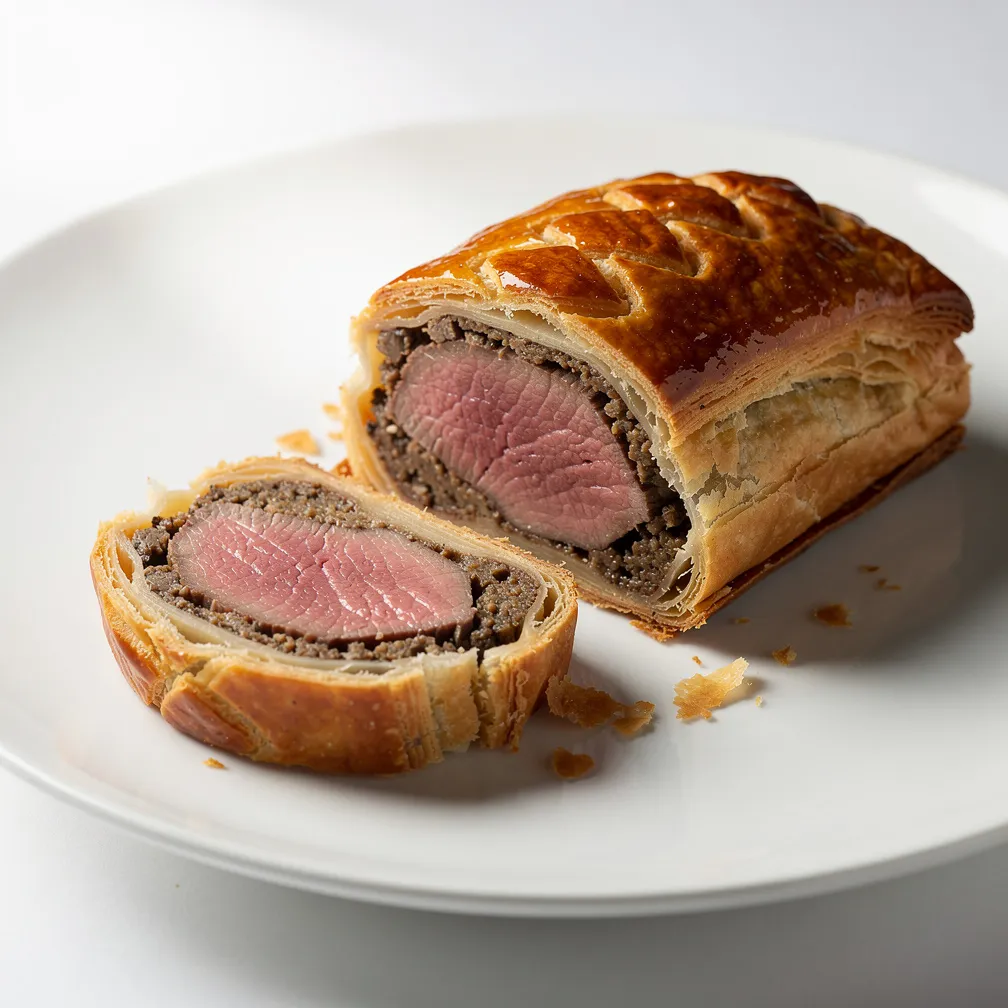
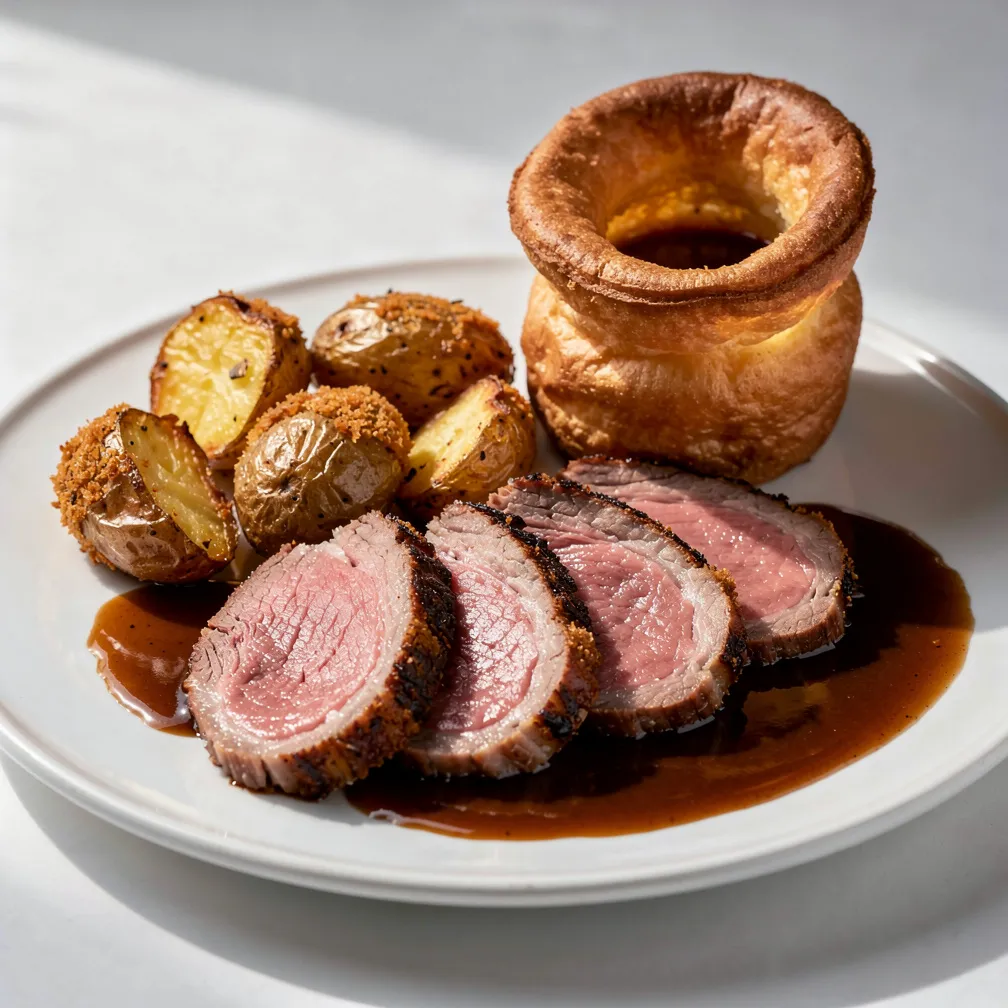
Beef Wellington and a traditional Sunday roast beef are the two pillars of British beef cuisine. They serve different occasions — Wellington is celebration food, the Sunday roast is weekly ritual — and that distinction shows up sharply in the nutrition. Per 100 g, beef Wellington lands at 368 kcal vs Sunday roast beef's 185 kcal. The Wellington is twice as calorie-dense, mostly because of the puff pastry wrapping and the duxelles-and-prosciutto layer between meat and crust.
Protein favors the Wellington (19.2 g vs 13 g per 100 g) because the fillet of beef is unusually lean, but the protein-per-calorie ratio reverses: Sunday roast delivers 7 g protein per 100 kcal vs Wellington's 5.2 g. The roast is the more protein-efficient calorie investment.
Quick comparison
| Per 100 g | Beef Wellington | Sunday roast beef |
|---|---|---|
| Calories | 368 kcal | 185 kcal |
| Protein | 19.2 g | 13.0 g |
| Fat | 27.4 g | 8.5 g |
| Saturated fat | 9.6 g | 3.2 g |
| Carbohydrate | 10.3 g | 15.0 g |
| Sugars | 0.1 g | 2.5 g |
| Fiber | 0.4 g | 2.0 g |
| Sodium | 182 mg | 320 mg |
| Potassium | 274 mg | 380 mg |
| Calcium | 9 mg | 35 mg |
| Iron | 3.4 mg | 2.2 mg |
| Vitamin C | 0.6 mg | 8.0 mg |
| Glycemic index | 45 | — |
Macros and calories
A 200 g portion of beef Wellington = 736 kcal — close to a full day's energy from a single course. A 200 g portion of Sunday roast beef (with Yorkshire pudding and gravy bundled into the dish weight) = 370 kcal. The Wellington is a fixed-portion dish where you cannot easily reduce the calorie density without abandoning the form; the roast scales naturally with slice thickness.
Fat is the headline gap: 27.4 g vs 8.5 g per 100 g. Most of the Wellington's fat is in the puff pastry — laminated butter dough is roughly 30 % fat by weight. Add the prosciutto layer and the duxelles bound with butter, and the dish's fat profile dwarfs even the richest cut of roast beef.
Saturated fat is 9.6 g vs 3.2 g per 100 g — a threefold gap. The Wellington's pastry pushes the saturated fat content past most other British meat dishes. WHO daily saturated fat allowance for a 2,000 kcal diet is 22 g; a 200 g serving of Wellington uses 87 % of that allowance.
Vitamins and minerals
Sunday roast beef delivers more across most micronutrients — and importantly, that's because the roast is typically served with carrots, broccoli, peas, gravy, and Yorkshire pudding all under one dish identity. Vitamin C at 8 mg per 100 g comes from the vegetables; fiber at 2 g per 100 g comes from the same source.
Iron is the one mineral where the Wellington wins (3.4 vs 2.2 mg per 100 g), because beef fillet is the highest-iron cut of beef and the Wellington's filling is pure meat without vegetable dilution. A 200 g Wellington portion delivers ~7 mg iron — roughly 40 % of an adult's daily target.
Sodium is the only place the Sunday roast runs higher (320 vs 182 mg per 100 g), because gravy and Yorkshire pudding contribute salt that the Wellington doesn't carry per se.
Saturated fat and meal architecture
The 9.6 g saturated fat per 100 g of Wellington is the single most flag-worthy nutrient number on this page. Cardiology guidance suggests keeping daily saturated fat under 10 % of total calories — about 22 g for a 2,000 kcal day. A 200 g Wellington serving uses 87 % of that allowance in one course.
The Sunday roast version, even with its Yorkshire pudding and gravy bundle, stays under 30 % of the daily sat-fat limit at the same portion size. For weekly British cooking, this is why the roast is the sustainable ritual and the Wellington is the once-or-twice-a-year occasion.
Diet compatibility
| Diet | Beef Wellington | Sunday roast beef |
|---|---|---|
| Vegan | No | No |
| Vegetarian | No | No |
| Gluten-free | No (puff pastry) | Borderline (gravy) |
| Dairy-free | No (butter pastry) | Borderline |
| Paleo | No (pastry) | Yes (no pudding) |
| Mediterranean | No | Yes (lean cuts) |
| Keto | Borderline | No (Yorkshire pud) |
| Low-FODMAP | Borderline | Yes |
The Sunday roast is the more diet-flexible dish: served without the Yorkshire pudding and with extra vegetables, it fits Paleo, Mediterranean, and low-FODMAP frameworks. The Wellington's pastry locks it out of every gluten-free or low-carb pattern.
When to choose beef Wellington
- Higher protein per 100 g (19.2 g) — fillet is among the leanest cuts.
- 55 % more iron — meaningful for women, vegetarians-leaning-into-meat, anemia recovery.
- Special-occasion centerpiece — birthdays, anniversaries, formal dinners.
- Lower sodium per 100 g (182 vs 320 mg) when served without gravy.
- GI of 45 (low-medium) — the protein-and-fat density slows glucose response.
When to choose Sunday roast beef
- Half the calories per 100 g — sustainable as a weekly ritual.
- One-third the saturated fat — friendlier on heart-health metrics.
- Five times the fiber from accompanying vegetables.
- 13× more vitamin C from carrots, peas, and other roast vegetables.
- Traditional and scalable — feeds 6–8 on one joint, leftover sandwiches all week.
Practical pairings
Beef Wellington is structurally complete — pastry + meat + duxelles already deliver three layers. The traditional pairing is a port jus, glazed root vegetables, and a green salad. Skip the potato gratin or boiled potato side — the pastry has the carbohydrate covered.
Sunday roast beef wants the full British array: roast potatoes, Yorkshire pudding, peas, carrots, gravy. The entire plate is the dish. A simpler version (roast beef + steamed vegetables + a thin gravy) cuts the calorie load by 30 % without losing identity.
For weekly British meals: Sunday roast every weekend, Wellington once a quarter. The Wellington's calorie cost requires occasion-level justification; the roast's calorie cost is built for repeat use.