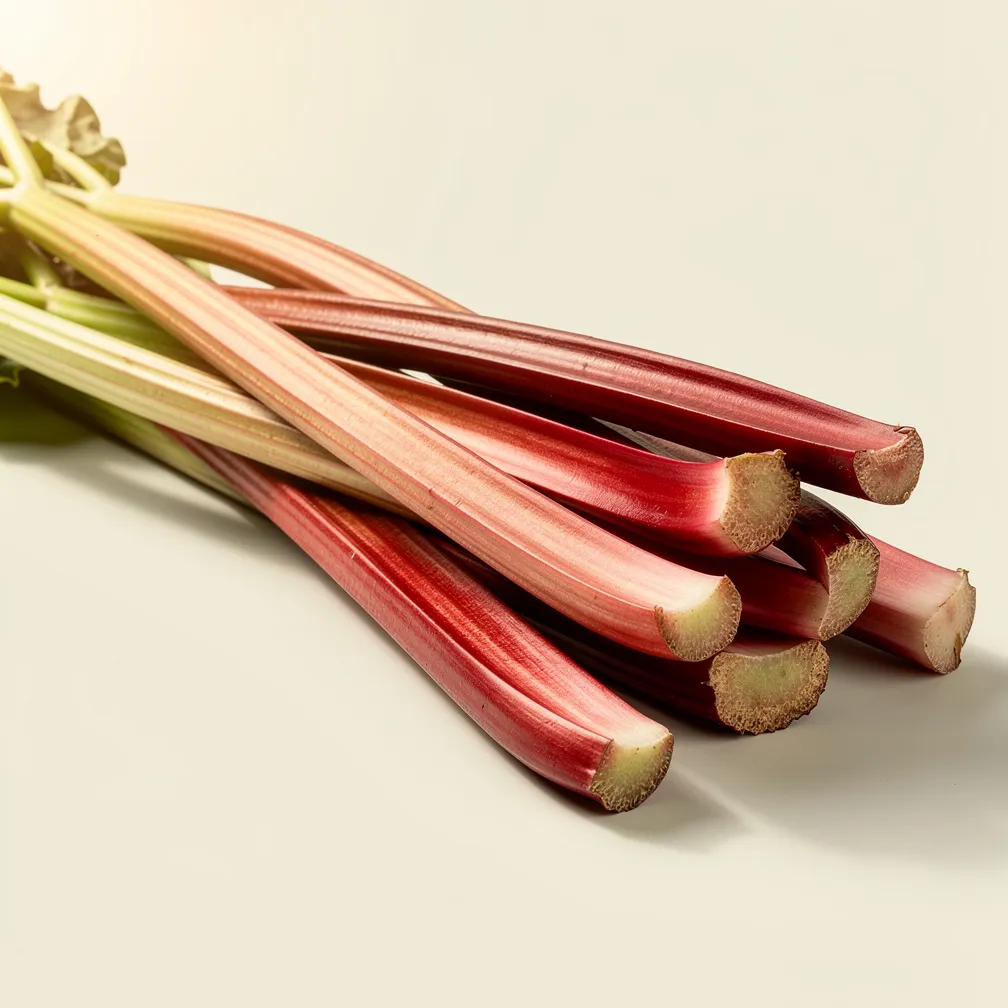
Rhubarb
Categories
| Macros | per 100 g |
|---|---|
| Calories | 21 kcal |
| Protein | 0.9 g |
| Fat | 0.2 g |
| Carbs | 5.1 g |
Rhubarb is a tart, stalky vegetable commonly treated as a fruit in the kitchen, typically cooked with sugar in pies, crumbles, jams and compotes rather than eaten raw. Per 100 g, raw rhubarb provides just 21 kcal, 0.9 g of protein, 0.2 g of fat, 5.1 g of carbohydrates and 2.2 g of dietary fibre, with very little natural sugar at only 1.1 g. It is a notable source of potassium at 280 mg per 100 g, calcium at 115 mg, and vitamin K at 29.3 mcg, alongside 8 mg of vitamin C. No glycemic index value is available for rhubarb. It fits a wide range of dietary patterns, including vegan, vegetarian, gluten-free, dairy-free, keto, paleo, mediterranean and low-FODMAP.
How many calories in rhubarb?
Raw rhubarb contains just 21 kcal per 100 g, making it one of the lower-calorie plant foods available. A typical stewed serving of around 150 g would contribute roughly 30–35 kcal before any added sugar is counted.
How much potassium is in rhubarb?
Rhubarb provides 280 mg of potassium per 100 g, which is a reasonably solid amount for such a low-calorie food. It also contains 115 mg of calcium per 100 g, which is relatively high compared to most fruits and vegetables.
Is rhubarb keto-friendly?
Yes, rhubarb is considered keto-compatible, with only 5.1 g of carbohydrates and 1.1 g of sugars per 100 g. The main consideration for keto use is the sugar typically added during cooking, which would need to be accounted for or substituted.
Diets
Get Vnutri
Log meals, track daily totals, save favorites. Free on iOS and Android.
Glycemic Index
approximateMacros · per 100 g
| Macros | Amount |
|---|---|
| Calories | 21.0 kcal |
| Protein | 0.90 g |
| Fat | 0.20 g |
| Carbs | 5.1 g |
| Sugars | 1.1 g |
| Fiber | 2.2 g |
| Starch | 0 g |
| Fats breakdown | Amount |
|---|---|
| Saturated | 0.029 g |
| Monounsaturated | 0.021 g |
| Polyunsaturated | 0.054 g |
| Trans | 0 g |
| Omega-3 | 0 g |
| Omega-6 | 0.12 g |
| Cholesterol | 0 mg |
| Minerals | Amount |
|---|---|
| Calcium | 115 mg |
| Iron | 0.29 mg |
| Magnesium | 12.0 mg |
| Phosphorus | 14.0 mg |
| Potassium | 280 mg |
| Sodium | 3.0 mg |
| Zinc | 0.10 mg |
| Copper | 0.023 mg |
| Manganese | 0.17 mg |
| Selenium | 1.1 mcg |
| Iodine | 0.30 mcg |
| Vitamins | Amount |
|---|---|
| Vitamin A | 5.0 mcg |
| Retinol | 0 mcg |
| Vitamin C | 8.0 mg |
| Vitamin D | 0 mcg |
| Vitamin E | 0.27 mg |
| Vitamin K | 29.3 mcg |
| Thiamin (B1) | 0.031 mg |
| Riboflavin (B2) | 0.030 mg |
| Niacin (B3) | 0.25 mg |
| Pantothenic acid (B5) | 0.085 mg |
| Vitamin B6 | 0.025 mg |
| Folate (B9) | 7.0 mcg |
| Vitamin B12 | 0 mcg |
| Choline | 6.1 mg |