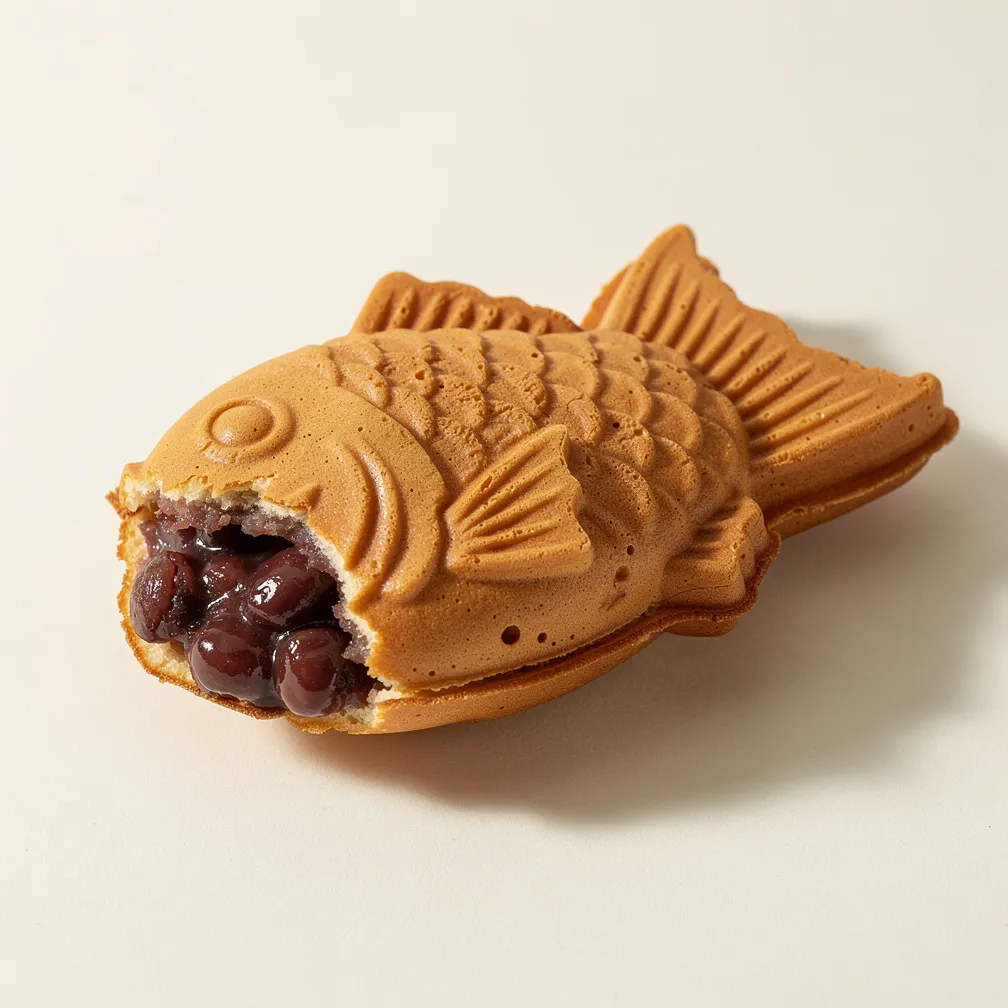
Taiyaki fish waffle
| Macros | per 100 g |
|---|---|
| Calories | 255 kcal |
| Protein | 6.0 g |
| Fat | 5.5 g |
| Carbs | 46.0 g |
Taiyaki is a Japanese fish-shaped waffle filled most commonly with sweet red bean paste, though custard, chocolate and cheese variants are also popular. Sold as a street food and at festivals, a single taiyaki typically weighs around 80–100 g and is eaten warm straight from the cast-iron mould. Per 100 g, it provides 255 kcal, 6 g of protein, 5.5 g of fat and 46 g of carbohydrates, of which 20 g are sugars and 2 g is dietary fibre — a profile that reflects its flour-and-filling base. Notable minerals include 190 mg of sodium, 120 mg of potassium and 40 mg of calcium per 100 g, alongside 25 mcg of vitamin A and 0.2 mcg of vitamin B12. No glycemic index data is available. Taiyaki is suitable for vegetarian dietary patterns.
How many calories in taiyaki?
Taiyaki contains 255 kcal per 100 g. A typical single piece weighing around 90 g would come to roughly 230 kcal.
How much sodium is in taiyaki?
Taiyaki contains 190 mg of sodium per 100 g, which comes from both the batter and the filling. A single piece at 90 g would contribute around 170 mg of sodium.
Is taiyaki vegetarian-friendly?
Yes, taiyaki is suitable for vegetarians. The standard recipe uses wheat flour, eggs, milk and sweet red bean paste, with no meat or fish despite the fish-shaped appearance.
Diets
Get Vnutri
Log meals, track daily totals, save favorites. Free on iOS and Android.
Glycemic Index
approximateMacros · per 100 g
| Macros | Amount |
|---|---|
| Calories | 255 kcal |
| Protein | 6.0 g |
| Fat | 5.5 g |
| Carbs | 46.0 g |
| Sugars | 20.0 g |
| Fiber | 2.0 g |
| Fats breakdown | Amount |
|---|---|
| Saturated | 1.8 g |
| Monounsaturated | 2.0 g |
| Polyunsaturated | 0.90 g |
| Cholesterol | 55.0 mg |
| Minerals | Amount |
|---|---|
| Calcium | 40.0 mg |
| Iron | 1.1 mg |
| Potassium | 120 mg |
| Sodium | 190 mg |
| Vitamins | Amount |
|---|---|
| Vitamin A | 25.0 mcg |
| Vitamin C | 0 mg |
| Vitamin B12 | 0.20 mcg |