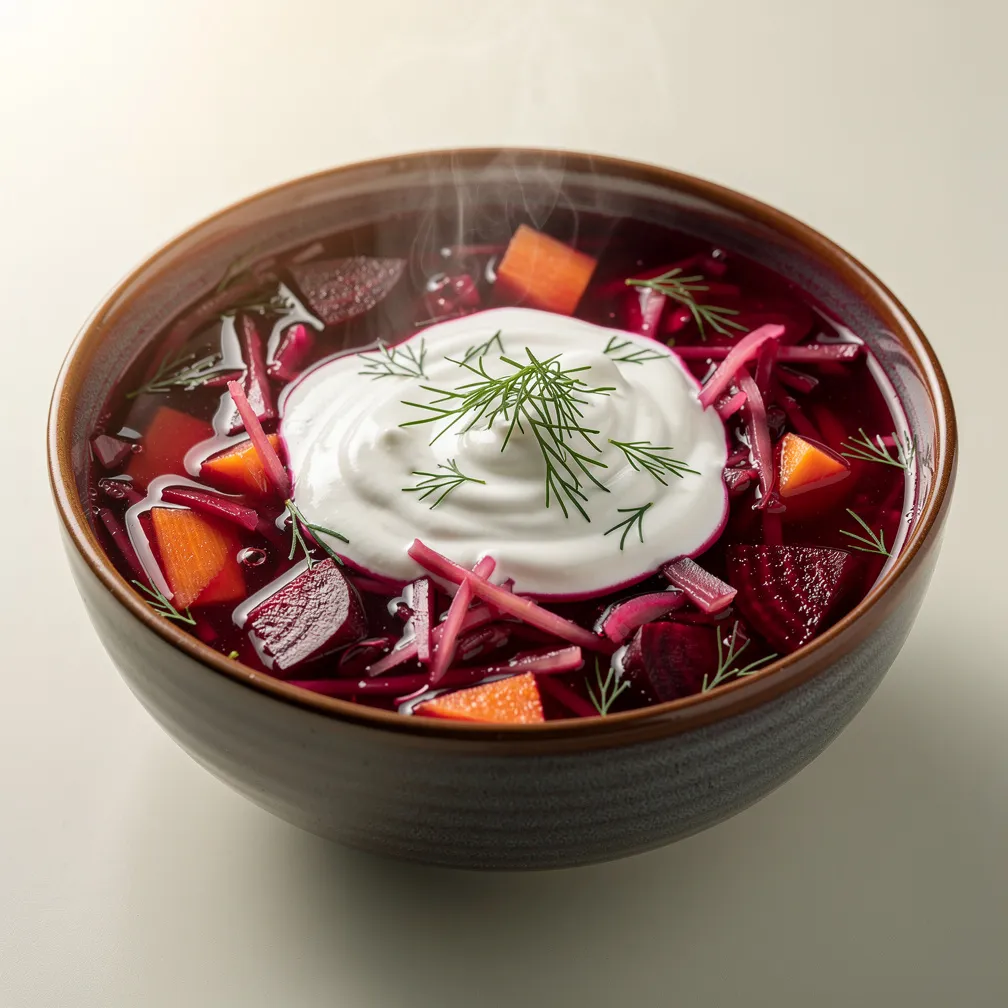
Russian borscht
| Macros | per 100 g |
|---|---|
| Calories | 49 kcal |
| Protein | 1.8 g |
| Fat | 1.2 g |
| Carbs | 8.4 g |
Russian borscht is a hearty vegetable soup built around beetroot, cabbage, carrots and potatoes, typically simmered with meat and served hot with a spoonful of sour cream. It is a staple of Eastern European cuisine, commonly eaten as a first course at lunch or dinner. Per 100 g, borscht provides 49 kcal, 1.8 g of protein, 1.2 g of fat, 8.4 g of carbohydrates and 1.8 g of dietary fibre, with 4.2 g coming from sugars. It contains 380 mg of sodium and 210 mg of potassium per 100 g, along with 12 mg of vitamin C and 42 mcg of vitamin A. No glycemic index value is available for this dish. As prepared here, borscht is listed as dairy-free.
How many calories in Russian borscht?
Russian borscht contains 49 kcal per 100 g. A typical serving of around 300 g would amount to roughly 147 kcal, making it a relatively light first course.
How much sodium is in Russian borscht?
Russian borscht contains 380 mg of sodium per 100 g, which is notable given that a standard serving can easily reach 300 g or more. Most of this sodium comes from added salt and broth used during cooking.
Is Russian borscht healthy?
Russian borscht has a modest calorie count of 49 kcal per 100 g and provides 1.8 g of fibre, 210 mg of potassium, 12 mg of vitamin C and 42 mcg of vitamin A. The main consideration is its sodium content at 380 mg per 100 g, which adds up quickly in a full bowl.
Diets
Get Vnutri
Log meals, track daily totals, save favorites. Free on iOS and Android.
Macros · per 100 g
| Macros | Amount |
|---|---|
| Calories | 49.0 kcal |
| Protein | 1.8 g |
| Fat | 1.2 g |
| Carbs | 8.4 g |
| Sugars | 4.2 g |
| Fiber | 1.8 g |
| Fats breakdown | Amount |
|---|---|
| Saturated | 0.40 g |
| Monounsaturated | 0.50 g |
| Polyunsaturated | 0.20 g |
| Cholesterol | 5.0 mg |
| Minerals | Amount |
|---|---|
| Calcium | 28.0 mg |
| Iron | 0.60 mg |
| Potassium | 210 mg |
| Sodium | 380 mg |
| Vitamins | Amount |
|---|---|
| Vitamin A | 42.0 mcg |
| Vitamin C | 12.0 mg |
| Vitamin B12 | 0.10 mcg |