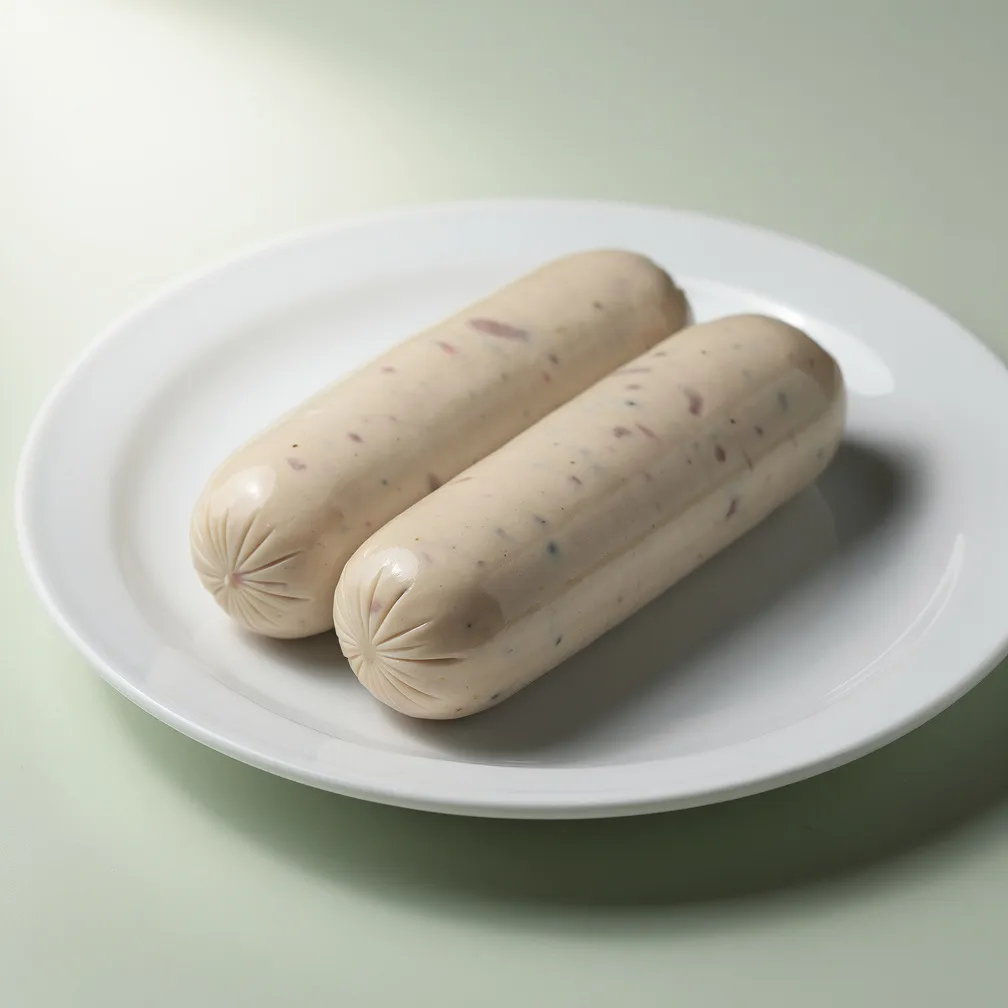
Munich Weißwurst
| Macros | per 100 g |
|---|---|
| Calories | 265 kcal |
| Protein | 13.0 g |
| Fat | 22.0 g |
| Carbs | 2.5 g |
Munich Weißwurst is a traditional Bavarian cooked sausage made from finely minced veal and pork back bacon, seasoned with parsley, lemon, onions and cardamom. It is a regional staple typically served in the morning or at brunch, poached in hot water and eaten by sucking the meat from the skin — traditionally accompanied by sweet mustard and a pretzel. Per 100 g, it provides 265 kcal, 13 g of protein, 22 g of fat and just 2.5 g of carbohydrates, making it a high-fat, low-carb food. Notable micronutrients include 850 mg of sodium, 210 mg of potassium and 1.5 mcg of vitamin B12 per 100 g. No glycemic index is available for this food. It is listed as compatible with dairy-free and gluten-free dietary patterns.
How many calories in Munich Weißwurst?
Munich Weißwurst contains 265 kcal per 100 g. A single sausage typically weighs around 80–90 g, putting one piece at roughly 210–240 kcal.
How much sodium is in Munich Weißwurst?
Munich Weißwurst contains 850 mg of sodium per 100 g, which is relatively high compared to many other protein foods. This is worth keeping in mind if you are tracking daily sodium intake.
Is Munich Weißwurst gluten-free?
Traditional Munich Weißwurst is listed as gluten-free, as the classic recipe does not include wheat-based fillers. However, formulations can vary by producer, so checking the label on packaged versions is always advisable.
Diets
Get Vnutri
Log meals, track daily totals, save favorites. Free on iOS and Android.
Macros · per 100 g
| Macros | Amount |
|---|---|
| Calories | 265 kcal |
| Protein | 13.0 g |
| Fat | 22.0 g |
| Carbs | 2.5 g |
| Sugars | 0.50 g |
| Fiber | 0.10 g |
| Fats breakdown | Amount |
|---|---|
| Saturated | 8.5 g |
| Monounsaturated | 10.0 g |
| Polyunsaturated | 2.0 g |
| Cholesterol | 80.0 mg |
| Minerals | Amount |
|---|---|
| Calcium | 18.0 mg |
| Iron | 1.0 mg |
| Potassium | 210 mg |
| Sodium | 850 mg |
| Vitamins | Amount |
|---|---|
| Vitamin A | 25.0 mcg |
| Vitamin C | 1.0 mg |
| Vitamin B12 | 1.5 mcg |