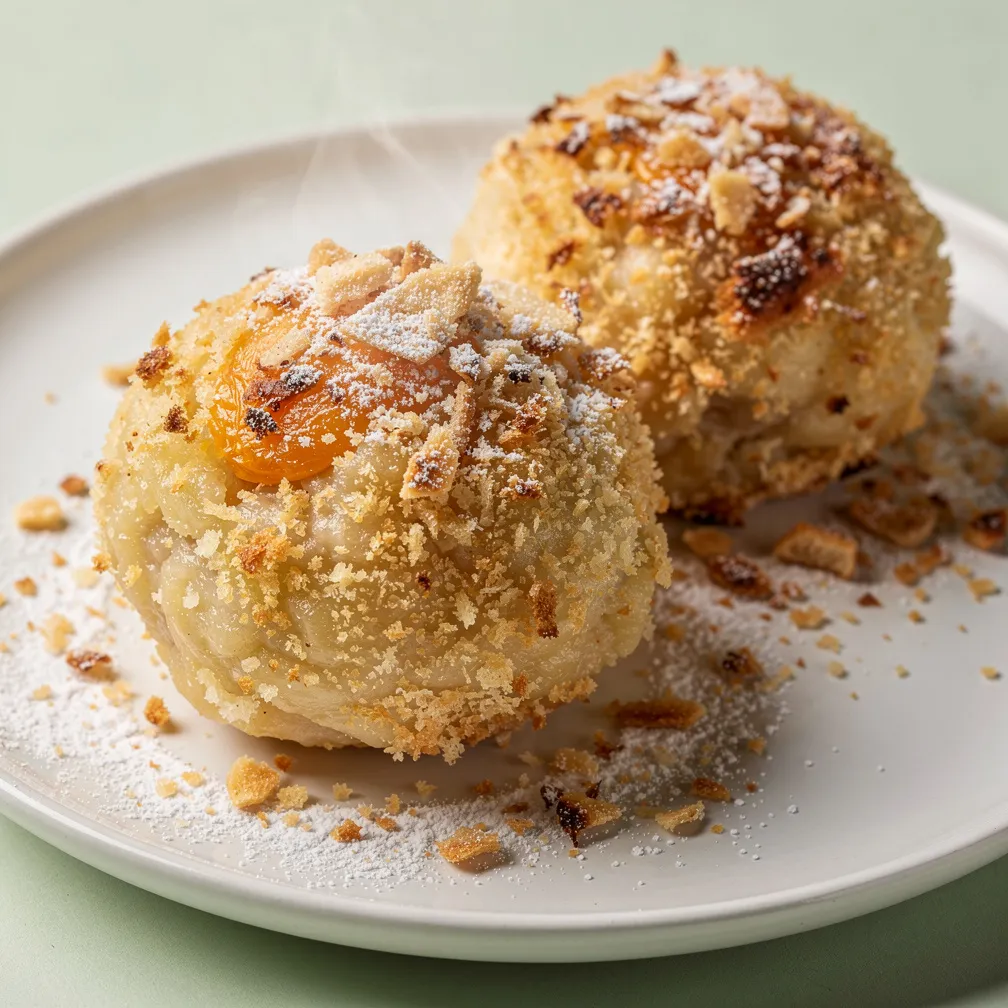
Marillenknödel
| Macros | per 100 g |
|---|---|
| Calories | 215 kcal |
| Protein | 4.0 g |
| Fat | 6.0 g |
| Carbs | 36.0 g |
Marillenknödel are Austrian apricot dumplings made from a soft dough — typically potato, quark or bread-based — wrapped around a whole apricot, boiled, and rolled in buttered breadcrumbs. They are a classic dessert or sweet main course in Austrian and Central European cuisine, most popular in summer when fresh apricots are in season. Per 100 g, Marillenknödel provide 215 kcal, 4 g of protein, 6 g of fat, 36 g of carbohydrates, and 1.5 g of dietary fibre, with 14 g coming from sugars. Notable micronutrients include 220 mg of potassium, 40 mg of calcium, 55 mcg of vitamin A, and 5 mg of vitamin C per 100 g. No glycemic index data is available for this dish. Marillenknödel are suitable for a vegetarian dietary pattern.
How many calories in Marillenknödel?
Marillenknödel contain 215 kcal per 100 g. A single dumpling typically weighs around 120–150 g, putting one piece at roughly 260–320 kcal depending on size and recipe.
Are Marillenknödel vegetarian?
Yes, Marillenknödel are suitable for a vegetarian diet. The dish is made from dough, apricots, butter and breadcrumbs, with no meat or fish involved.
How much potassium is in Marillenknödel?
Marillenknödel contain 220 mg of potassium per 100 g, contributed largely by the apricot filling and the potato or quark dough base. That is a moderate amount for a dessert-style dish.
Diets
Get Vnutri
Log meals, track daily totals, save favorites. Free on iOS and Android.
Macros · per 100 g
| Macros | Amount |
|---|---|
| Calories | 215 kcal |
| Protein | 4.0 g |
| Fat | 6.0 g |
| Carbs | 36.0 g |
| Sugars | 14.0 g |
| Fiber | 1.5 g |
| Fats breakdown | Amount |
|---|---|
| Saturated | 3.5 g |
| Monounsaturated | 1.8 g |
| Polyunsaturated | 0.40 g |
| Cholesterol | 45.0 mg |
| Minerals | Amount |
|---|---|
| Calcium | 40.0 mg |
| Iron | 0.90 mg |
| Potassium | 220 mg |
| Sodium | 95.0 mg |
| Vitamins | Amount |
|---|---|
| Vitamin A | 55.0 mcg |
| Vitamin C | 5.0 mg |
| Vitamin B12 | 0.10 mcg |