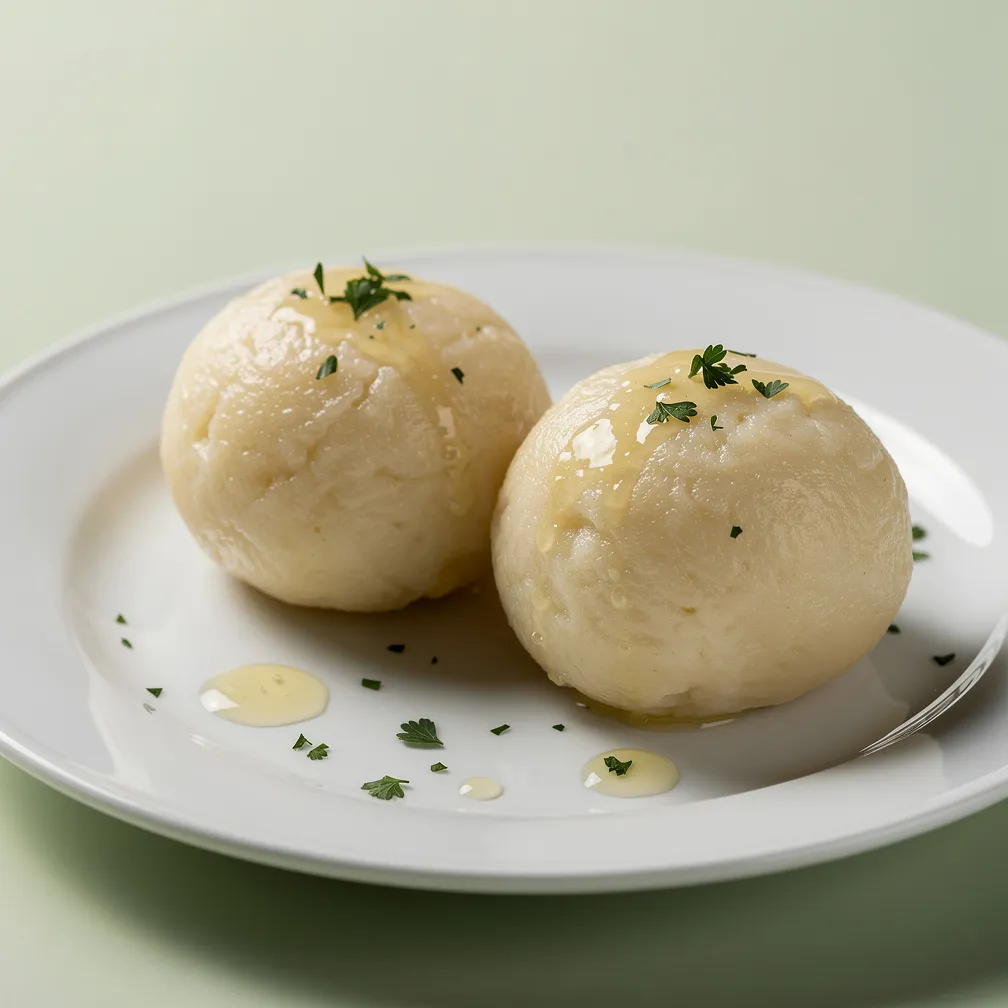
Kartoffelknödel
| Macros | per 100 g |
|---|---|
| Calories | 130 kcal |
| Protein | 2.8 g |
| Fat | 1.0 g |
| Carbs | 27.0 g |
Kartoffelknödel are traditional German potato dumplings, typically shaped by hand and simmered in salted water before serving alongside roast meats, gravies or braised dishes — a staple of Bavarian and central German cuisine. Per 100 g of raw dough, they provide 130 kcal, 2.8 g of protein, 1 g of fat, 27 g of carbohydrates and 2 g of dietary fibre, with very little sugar (0.8 g). Notable minerals include potassium at 320 mg and sodium at 280 mg per 100 g, alongside 8 mg of vitamin C. No glycemic index value is available for this food. Kartoffelknödel are suitable for vegetarian and dairy-free dietary patterns.
How many calories in Kartoffelknödel?
Raw Kartoffelknödel contain 130 kcal per 100 g. A single cooked dumpling typically weighs around 150–200 g, putting one serving at roughly 195–260 kcal depending on size.
How much potassium is in Kartoffelknödel?
Kartoffelknödel contain 320 mg of potassium per 100 g, which reflects their potato base. That is a meaningful amount for a starchy side dish, comparable to a modest serving of plain boiled potatoes.
Are Kartoffelknödel vegetarian-friendly?
Yes, Kartoffelknödel are suitable for a vegetarian diet. The base recipe relies on potato, starch and egg rather than meat, and this product is also dairy-free, though individual recipes can vary.
Diets
Get Vnutri
Log meals, track daily totals, save favorites. Free on iOS and Android.
Macros · per 100 g
| Macros | Amount |
|---|---|
| Calories | 130 kcal |
| Protein | 2.8 g |
| Fat | 1.0 g |
| Carbs | 27.0 g |
| Sugars | 0.80 g |
| Fiber | 2.0 g |
| Fats breakdown | Amount |
|---|---|
| Saturated | 0.30 g |
| Monounsaturated | 0.30 g |
| Polyunsaturated | 0.20 g |
| Cholesterol | 20.0 mg |
| Minerals | Amount |
|---|---|
| Calcium | 18.0 mg |
| Iron | 0.70 mg |
| Potassium | 320 mg |
| Sodium | 280 mg |
| Vitamins | Amount |
|---|---|
| Vitamin A | 5.0 mcg |
| Vitamin C | 8.0 mg |
| Vitamin B12 | 0.10 mcg |