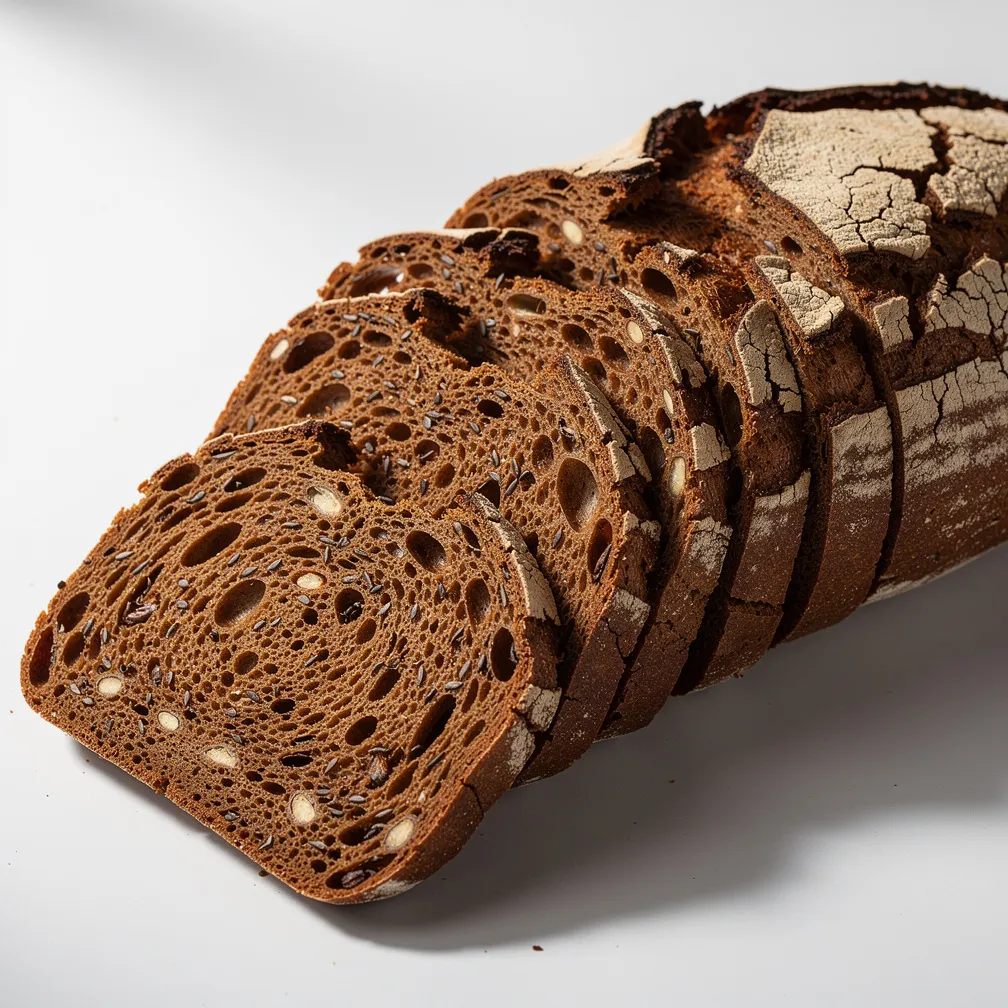
German rye bread
| Macros | per 100 g |
|---|---|
| Calories | 220 kcal |
| Protein | 7.0 g |
| Fat | 1.5 g |
| Carbs | 44.0 g |
German rye bread is a dense, dark loaf made predominantly from rye flour, typically sold pre-sliced and eaten as an everyday staple across Germany and Northern Europe. It is commonly served with butter, cheese, cold cuts or smoked fish, and forms the base of open-faced sandwiches. Per 100 g, it provides 220 kcal, 7 g of protein, 1.5 g of fat, 44 g of carbohydrates and a notable 6 g of dietary fibre, with only 2 g coming from sugars. In terms of minerals, it contains 520 mg of sodium, 280 mg of potassium and 30 mg of calcium per 100 g. No glycemic index value is available for this entry. German rye bread is suitable for vegan, vegetarian, pescatarian and dairy-free dietary patterns.
How many calories in German rye bread?
German rye bread contains 220 kcal per 100 g. A typical slice weighs around 30–40 g, which works out to roughly 66–88 kcal per slice.
How much sodium is in German rye bread?
German rye bread contains 520 mg of sodium per 100 g, which is relatively high compared to many other breads. This is worth keeping in mind if you are tracking daily sodium intake across multiple servings.
Is German rye bread vegan?
Yes, German rye bread is suitable for vegan and vegetarian diets, as it is typically made from rye flour, water, salt and a sourdough starter with no animal-derived ingredients. It is also dairy-free and pescatarian-compatible.
Diets
Get Vnutri
Log meals, track daily totals, save favorites. Free on iOS and Android.
Macros · per 100 g
| Macros | Amount |
|---|---|
| Calories | 220 kcal |
| Protein | 7.0 g |
| Fat | 1.5 g |
| Carbs | 44.0 g |
| Sugars | 2.0 g |
| Fiber | 6.0 g |
| Fats breakdown | Amount |
|---|---|
| Saturated | 0.20 g |
| Monounsaturated | 0.40 g |
| Polyunsaturated | 0.60 g |
| Cholesterol | 0 mg |
| Minerals | Amount |
|---|---|
| Calcium | 30.0 mg |
| Iron | 2.5 mg |
| Potassium | 280 mg |
| Sodium | 520 mg |
| Vitamins | Amount |
|---|---|
| Vitamin A | 0 mcg |
| Vitamin C | 0 mg |
| Vitamin B12 | 0 mcg |