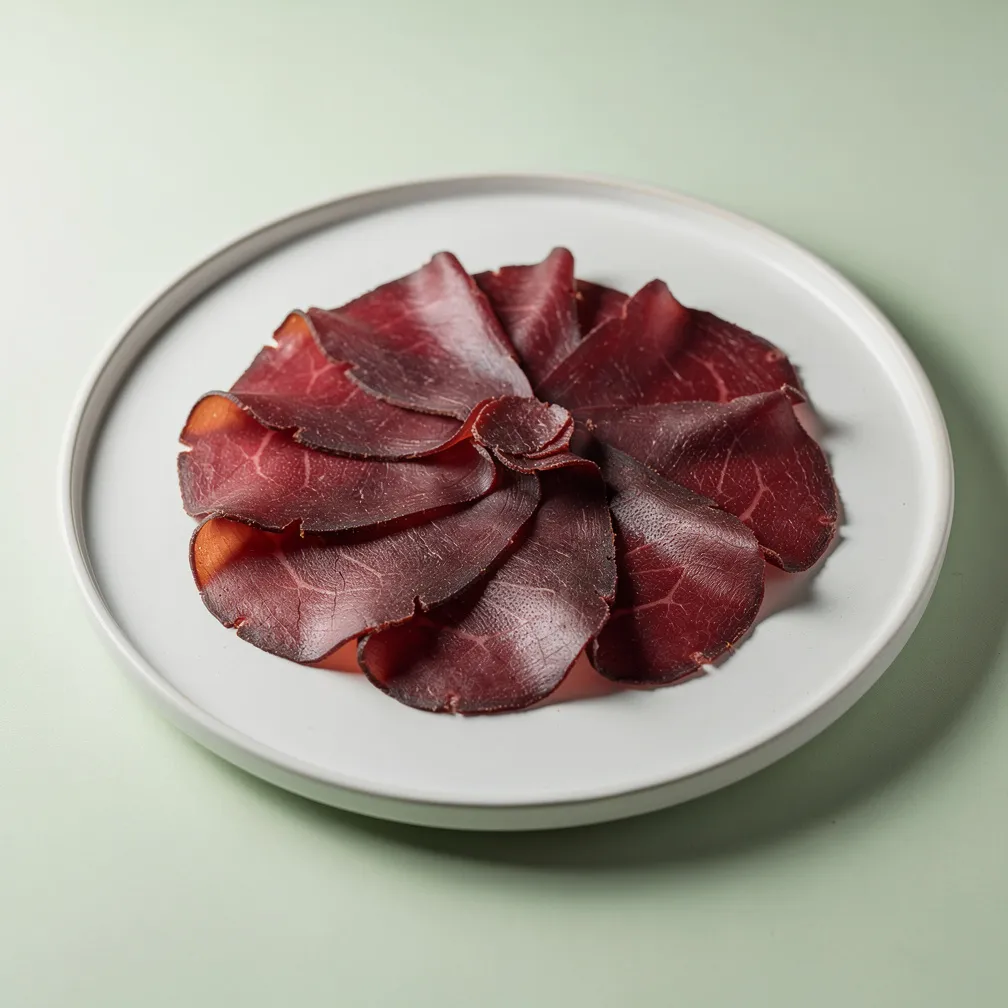
Bündnerfleisch
| Macros | per 100 g |
|---|---|
| Calories | 245 kcal |
| Protein | 38.0 g |
| Fat | 8.0 g |
| Carbs | 2.0 g |
Bündnerfleisch is a traditional Swiss air-dried beef originating from the canton of Graubünden, typically served in paper-thin slices as part of a charcuterie board or alongside bread and pickles. The drying and curing process concentrates both flavour and nutrients, resulting in a high-protein, low-carbohydrate product: per 100 g it provides 245 kcal, 38 g of protein, 8 g of fat and just 2 g of carbohydrates with no dietary fibre. It is notably high in sodium at 1,900 mg per 100 g, and also contributes 480 mg of potassium and 2.5 mcg of vitamin B12 per 100 g. No glycemic index is available for this product. Bündnerfleisch is compatible with gluten-free, dairy-free, keto and paleo dietary patterns.
How many calories in Bündnerfleisch?
Bündnerfleisch contains 245 kcal per 100 g. A typical serving of thinly sliced Bündnerfleisch is around 30–40 g, which works out to roughly 75–100 kcal per portion.
How much sodium is in Bündnerfleisch?
Bündnerfleisch contains 1,900 mg of sodium per 100 g, which is high relative to most foods and reflects the salt-curing process used in its production. Even a small 30 g serving delivers around 570 mg of sodium.
Is Bündnerfleisch keto-friendly?
Yes, Bündnerfleisch is well suited to a keto diet. With only 2 g of carbohydrates and 38 g of protein per 100 g, it fits comfortably within the low-carb macros that keto requires.
Diets
Get Vnutri
Log meals, track daily totals, save favorites. Free on iOS and Android.
Macros · per 100 g
| Macros | Amount |
|---|---|
| Calories | 245 kcal |
| Protein | 38.0 g |
| Fat | 8.0 g |
| Carbs | 2.0 g |
| Sugars | 0.50 g |
| Fiber | 0 g |
| Fats breakdown | Amount |
|---|---|
| Saturated | 2.8 g |
| Monounsaturated | 3.2 g |
| Polyunsaturated | 0.60 g |
| Cholesterol | 90.0 mg |
| Minerals | Amount |
|---|---|
| Calcium | 18.0 mg |
| Iron | 3.5 mg |
| Potassium | 480 mg |
| Sodium | 1900 mg |
| Vitamins | Amount |
|---|---|
| Vitamin A | 0 mcg |
| Vitamin C | 0 mg |
| Vitamin B12 | 2.5 mcg |