Paleo vs Keto: Overlaps, Differences, and Which Suits You
Paleo vs keto compared: macros, food lists, evidence on weight loss and cardiovascular markers, sustainability, and who each diet fits.
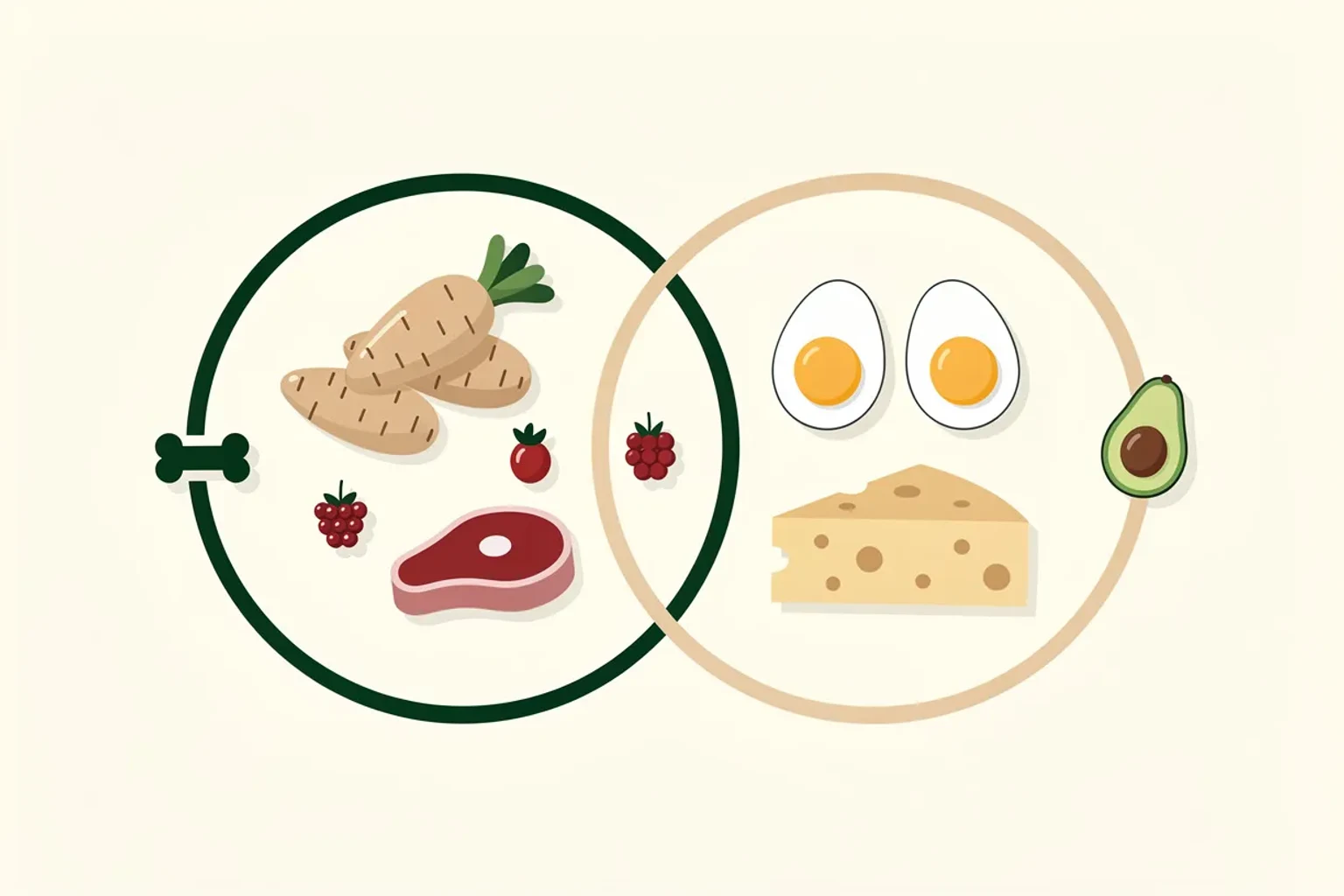
Paleo and keto get lumped together because both cut bread, pasta, sugar, and industrial seed oils. They aren't the same diet. Paleo is a food-quality rule (eat foods our ancestors could have eaten). Keto is a metabolic rule (eat few enough carbs to enter ketosis). One allows fruit, honey, and sweet potato. The other does not.
This article compares the two on macros, food lists, evidence, cardiovascular response, and sustainability — and shows which goals each fits.
Quick comparison
| Parameter | Paleo | Keto |
|---|---|---|
| Carbs | No hard limit (often 100–200 g/day) | Strict: 20–50 g net carbs/day |
| Fat | Moderate to high | 70–80 % of calories |
| Protein | Moderate to high (~25–35 %) | Moderate (20–25 %) |
| Fruit | Yes | Berries only, small portions |
| Tubers | Yes (potato, sweet potato, cassava) | No |
| Grains | No | No |
| Legumes | No | No |
| Dairy | No | Yes (fatty) |
| Honey, maple | Yes (in moderation) | No |
| Rationale | Foods available before agriculture | Trigger and maintain ketosis |
What paleo is
Paleo asks one question: could a pre-agricultural human have eaten this? If yes — it's in. If no (grains, legumes, dairy, refined sugar, industrial seed oils) — it's out.
Allowed:
- Meat, fish, seafood, eggs
- Vegetables, including starchy ones — potato, sweet potato, cassava, taro
- Fruit and berries
- Nuts and seeds (peanuts excluded — a legume)
- Honey, maple syrup (in moderation)
- Cold-pressed oils — olive, avocado, coconut
Excluded:
- Grains — wheat, rice, oats, corn, all flours
- Legumes — beans, lentils, chickpeas, peanuts, soy
- Dairy — milk, cheese, yogurt, butter (some "primal" variants allow butter and ghee)
- Refined sugar, refined seed oils (sunflower, soybean, corn)
- Anything ultra-processed
No carb limit. Someone eating paleo can land at 150 g of carbs a day from fruit and tubers.
What keto is
Keto cuts carbs hard enough to switch the body from glucose to ketones. The threshold is 20–50 g of net carbs per day; below it, in 2–4 days, the liver starts producing β-hydroxybutyrate and acetoacetate from fat. That state is ketosis.
To stay there, calories come mostly from fat (70–80 %), some from protein (20–25 %), and very little from carbs (< 10 %). Food choices follow the math, not an ancestral story: butter, cheese, fatty cuts of pork, soybean oil — all fine on keto, none allowed on paleo.
Full mechanics and food list in the keto diet basics guide.
What they share
- No grains
- No refined sugar
- No legumes (paleo excludes them entirely; keto rules them out for the carb count)
- Heavy reliance on meat, fish, eggs, vegetables, nuts
- Strong push away from ultra-processed foods
- Similar tolerance for moderate-to-high fat
A paleo plate and a low-carb keto plate often look almost identical: salmon, broccoli, olive oil, a handful of walnuts. The split appears when fruit, honey, or sweet potato show up.
Where they diverge
Carbs. Paleo has no number to hit. Keto has a strict one (20–50 g net).
Fruit, honey, tubers. Paleo eats them. Keto can't fit them without exceeding the carb budget.
Dairy. Paleo excludes it as post-agricultural. Standard keto leans on cheese, cream, and butter.
Goal of the rule. Paleo aims for food quality and an anti-inflammatory pattern. Keto aims for a metabolic state.
This last point matters. A "dirty keto" diet of bacon, processed cheese, and sugar-free soda hits the macros but ignores food quality. A paleo diet of grass-fed meat, vegetables, and fruit looks healthier on a label but is not in ketosis.
Evidence
Paleo. The Manheimer 2015 meta-analysis (four RCTs, ~159 participants) found short-term improvements in waist circumference, triglycerides, fasting glucose, and HDL versus standard guideline diets, over 2–24 weeks. The Mellberg 2014 two-year RCT in postmenopausal women showed paleo beat a Nordic-guideline diet on fat mass and triglycerides at 6 months, but the difference shrank by 24 months as adherence dropped. Long-term data is thin and adherence drives most of the gap.
Keto. The Bueno 2013 meta-analysis (13 RCTs, ~1577 participants) found very-low-carb ketogenic diets produced greater weight loss at 12 months than low-fat diets (~0.9 kg difference) with lower triglycerides and higher HDL — but also higher LDL. Hall 2021 (NIH, n=20) found people on a ketogenic diet ate ~700 kcal fewer per day than on a plant-based low-fat diet, but lost less body fat. For epilepsy, keto remains a clinical gold standard with decades of pediatric data.
Neither diet has strong long-term mortality or cardiovascular outcome trials. Most data is intermediate markers, not endpoints.
Cardiovascular response
Both diets can raise or lower LDL depending on fat quality. Paleo built on grass-fed meat, fish, olive oil, and avocado is broadly neutral to favorable. Keto built on bacon, lard, and butter often raises LDL 10–30 %. Keto built on olive oil, fatty fish, and nuts looks closer to a Mediterranean profile.
Triglycerides drop on both, more sharply on keto. HDL rises on both. The cholesterol response is individual — about 25–30 % of people on strict keto show large LDL rises (hyper-responders); routine lipid panels at 3 and 6 months are standard practice.
Sustainability
Paleo is easier to stick to. No carb counting, no ketosis to maintain, fruit and tubers keep meals varied. Eating out is feasible — grilled fish with vegetables works almost anywhere.
Keto demands a daily carb tally and reacts badly to small slips. A piece of bread or a single banana can knock someone out of ketosis for a day. Adherence beyond 12 months is low in most trials (often below 30 %).
In practice, many people use keto as a 3–6 month intervention for weight loss or metabolic reset, then move to paleo, low-carb Mediterranean, or a mixed diet for maintenance.
Who suits each
Paleo fits:
- An anti-inflammatory eating pattern without strict carb counting
- An autoimmune elimination trial (AIP variant)
- Anyone moving off ultra-processed foods who wants variety
- Athletes who need carbs for performance
Keto fits:
- Rapid short-term weight loss (3–6 months)
- Type 2 diabetes and insulin resistance (with medical supervision)
- Epilepsy as a medical protocol
- People whose appetite is strongly driven by carbs and who respond well to ketosis
Neither is mandatory. A Mediterranean diet does most of the same things with less restriction.
Combining them
"Ketogenic paleo" or "paleo-keto" exists: paleo food rules plus a keto carb count. No grains, no legumes, no dairy, plus < 50 g net carbs. Food choices narrow to fatty meat, fish, eggs, leafy greens, low-carb cruciferous vegetables, nuts, avocado, olive and coconut oil. It works, but the restriction is heavy and sustainability drops further.
How Vnutri shows both
The Vnutri catalog tags every food for diet compatibility. The keto diet page lists foods that fit a 20–50 g net-carb day. The paleo diet page lists foods without grains, legumes, dairy, or refined ingredients. The low-carb filter (< 10 g per 100 g) gives a quick keto-friendly subset.
The food list page also shows the glycemic index, which matters for both diets — high-GI foods spike glucose regardless of whether they fit the rules.
Frequently asked questions
Which loses weight faster?
In the first 1–3 months, keto usually wins by 1–3 kg, mostly water and faster appetite suppression. By 12 months the gap narrows to under a kilogram in most trials.
Can you do paleo with lots of carbs?
Yes. Paleo has no carb cap. A paleo athlete might eat 200–300 g of carbs a day from sweet potato, fruit, and squash.
Is keto sustainable long-term?
For most people, no — adherence drops sharply after 6–12 months. It works as a short-term intervention. Strict long-term keto suits epilepsy patients and a minority who tolerate it well.
Do both raise cholesterol?
Both can raise LDL if built on saturated fat. Both improve triglycerides and HDL. Fat quality matters more than the diet label. Check lipids at 3 and 6 months on either.
Vegan paleo or vegan keto?
Vegan paleo is mostly contradictory — paleo leans heavily on animal protein. Vegan keto is technically possible (tofu, coconut oil, avocado, nuts) but nutritionally tight; B12, iron, and amino acid balance need attention.
Pick one for life?
Probably not. Most people land on a mixed pattern — paleo principles for food quality, occasional carb cuts for weight control, Mediterranean staples for sustainability. Diets are tools for specific goals, not identities.
References
- Manheimer EW, et al. Paleolithic nutrition for metabolic syndrome: systematic review and meta-analysis. Am J Clin Nutr. 2015;102(4):922–932.
- Bueno NB, et al. Very-low-carbohydrate ketogenic diet v. low-fat diet for long-term weight loss: a meta-analysis. Br J Nutr. 2013;110(7):1178–1187.
- Mellberg C, et al. Long-term effects of a Palaeolithic-type diet in obese postmenopausal women: 2-year randomized trial. Eur J Clin Nutr. 2014;68(3):350–357.
- Hall KD, et al. Effect of a plant-based, low-fat diet versus an animal-based, ketogenic diet on ad libitum energy intake. Nat Med. 2021;27(2):344–353.
- Estruch R, et al. Primary prevention of cardiovascular disease with a Mediterranean diet supplemented with extra-virgin olive oil or nuts (PREDIMED). N Engl J Med. 2018;378(25):e34.