Keto Diet Basics: What to Eat, What to Avoid, and Common Mistakes
Keto principles: 70/25/5 macros, what's allowed and what isn't, how to make it through the first week. Food lists, keto flu, myths, and FAQ.
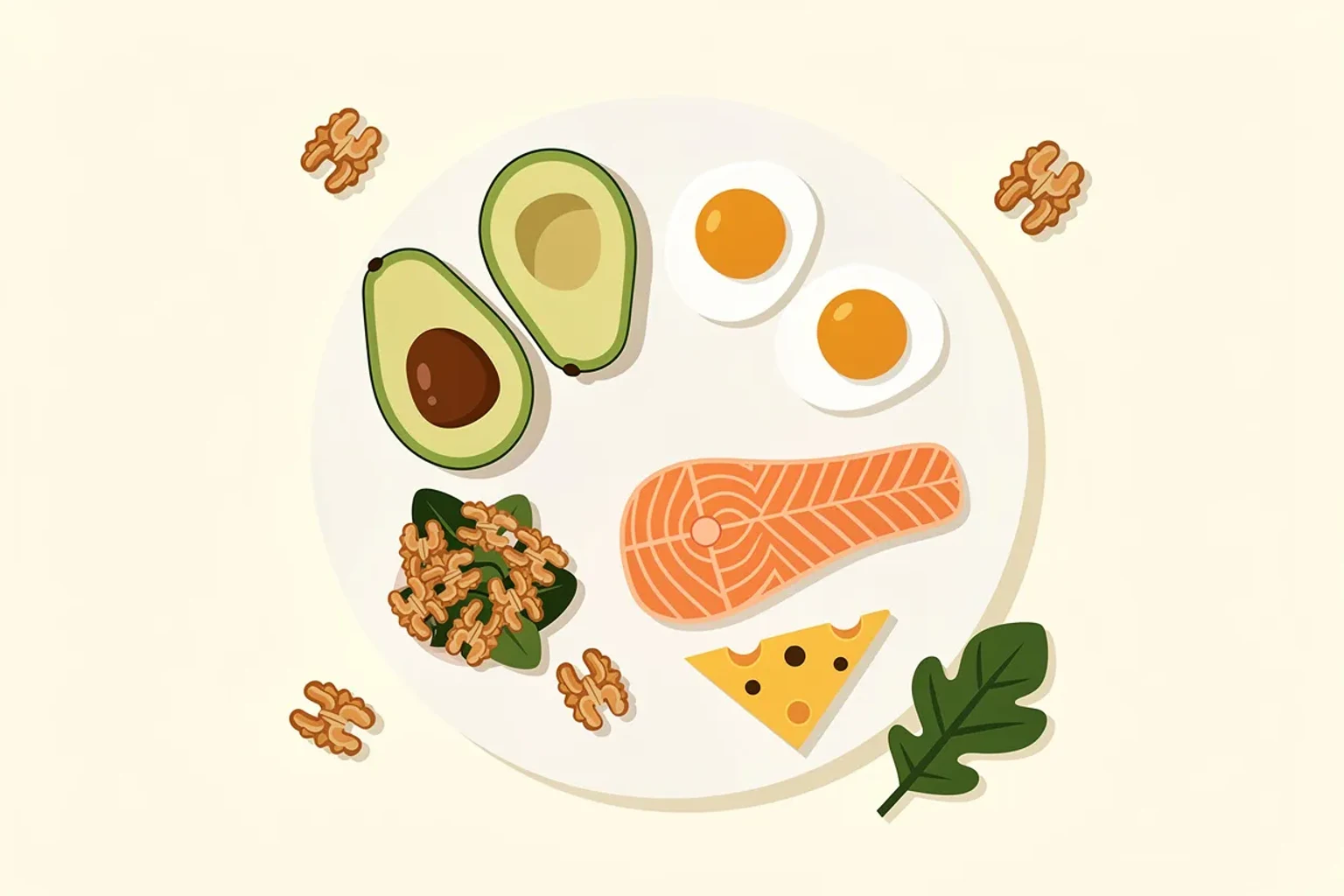
Keto is a low-carbohydrate diet where the body switches from glucose to ketone bodies as its main fuel. On paper it looks simple: 70–80 % of calories from fat, 20–25 % from protein, < 5–10 % from carbohydrates. In practice the first two weeks are a sharp metabolic shift, and most people quit before keto starts working.
This guide is for anyone who wants to understand how keto works, what to eat, what to avoid, and how to survive the first week without a crash.
What keto is
The body prefers glucose as fuel. When carbs are available (>50–100 g/day), all energy comes from them. When carbs drop below ~50 g/day, after 2–4 days the liver starts making ketone bodies (β-hydroxybutyrate, acetoacetate) from fat. That's ketosis.
Ketosis is a normal physiological state, not a pathology. The body can run on it for years (but not on it alone — some protein and a little glucose are still needed).
Don't confuse it with diabetic ketoacidosis — a pathological state in type 1 diabetes where ketones build to toxic levels (>20 mmol/L). On keto, ketones sit at 0.5–3 mmol/L, which is safe.
Parameters
| Macro | Standard keto | Targeted keto (TKD) | Cyclical (CKD) |
|---|---|---|---|
| Fat | 70–80 % | 65–75 % | 70 % |
| Protein | 20–25 % | 20 % | 25 % |
| Carbs | < 10 % (≤ 50 g) | < 15 % (≤ 75 g) | < 5 % (≤ 30 g) |
Standard keto suits most. TKD and CKD are for athletes.
Net carbs vs total carbs is a common source of confusion. Net carbs = total carbs − fiber. Fiber doesn't raise glucose, so it's subtracted. On keto, you count net carbs: 100 g of broccoli (7 g total, 4 g fiber → 3 g net) counts as "3 g of carbs" in keto math.
What's allowed
Fats (the base):
- Olive, coconut, avocado oil
- Butter, ghee
- Fatty meats, fish, eggs
- Cheese, cream, Greek yogurt
- Nuts and seeds (not all — peanuts and cashews need care because of carbs)
Protein:
- Meat (no breading)
- Fish and seafood
- Eggs
- Cheese
- Tofu, tempeh
Low-carb vegetables:
- Leafy greens — spinach, arugula, lettuce, chard
- Brassicas — broccoli, cauliflower, cabbage, kale
- Avocado
- Peppers, tomatoes, cucumbers, zucchini
- Asparagus, mushrooms, leeks (in moderation)
- Garlic, onion (in moderation — 3–5 g per dish)
Berries (in moderate amounts):
- Raspberries, blackberries — 5–6 g net carbs / 100 g
- Strawberries — 5.5 g net carbs / 100 g
- Blueberries — 12 g / 100 g, watch the portion
Full list of keto-compatible foods in the Vnutri catalog.
What to avoid
Carbs:
- Bread, pasta, rice, any grain
- Potato, sweet potato, corn
- Legumes — beans, lentils, chickpeas
- Sugar in any form — honey, syrup, maple syrup
- Most fruit — banana, grapes, apples, oranges, mango
Sweeteners:
- Stevia, erythritol, monk fruit — fine
- Xylitol — fine (but toxic to dogs)
- Aspartame, sucralose — controversial (no glucose effect, but microbiota concerns)
- Maltitol — NO (it raises glucose)
Marketing traps:
- "Keto bars" with maltitol — raise glucose
- "Keto bread" with sugar alcohols — sometimes more net carbs than claimed
- Low-carb "fruit yogurts" — often contain hidden sugar
Keto flu
The first 3–7 days off carbs are a transition period. Symptoms:
- Fatigue, headache
- Irritability, brain fog
- Muscle cramps
- Nausea
- Insomnia
- Frequent urination
It's not a virus. The cause is sodium and water loss. When you cut carbs, insulin drops, kidneys excrete sodium, and water leaves with it. Sodium deficit creates all the symptoms.
Fix:
- Sodium — an extra 3–5 g of salt per day on top of meals. A cup of broth, salt food freely.
- Magnesium — 300–500 mg (magnesium citrate, not oxide).
- Potassium — avocado, spinach, salmon. Or 99 mg potassium supplement.
- Water — 2–3 litres.
This clears most symptoms in 2–3 days. Without electrolytes, the first week is torture.
How to start
Three approaches.
- Cold turkey. Day one — cut carbs to 30 g, start counting. Tough, but you're in ketosis within a week. Suits the motivated.
- Gradual. Drop 30 g of carbs per week. In ketosis after 4 weeks. Less shock, slower path.
- Cyclical. 5 days keto, 2 days normal. Doesn't work for most people — the weekend kicks you out of ketosis and Monday brings the flu back.
Standard advice: cold turkey with strong electrolyte support.
In the first 7 days — weigh everything. "By feel" carb estimates are usually 2–3× too low. See how to read a nutrition label.
What to measure
- Blood ketones — the most accurate method. A ketone meter (Keto-Mojo, FreeStyle Optium). Ketosis range: 0.5–3 mmol/L.
- Urine ketones — strips (Ketostix). Cheap, but only accurate at the start. After 2–3 weeks the body adapts and fewer ketones reach urine.
- Breath ketones — acetone meters (Ketonix). Convenient but pricier.
- No measurement — symptoms work for most: hunger drops, steady energy appears, mental clarity. A reasonable indicator.
Measurements are for adjustment, not obsession. Pushing ketones above 3 mmol/L doesn't mean "better".
Who it suits and who it doesn't
Works well:
- Type 2 diabetes, insulin resistance (with medical supervision — meds need adjustment)
- Epilepsy (a medical protocol, not a lifestyle)
- Metabolic syndrome
- Fast short-term weight loss
- Appetite control for people reactive to carbs
Doesn't work or is harmful:
- Pregnancy and breastfeeding
- A history of eating disorders
- Athletes with high aerobic load (performance can drop; see CKD)
- Liver, gallbladder, pancreas disease — keto stresses these organs
- Carnitine deficiency or fatty-acid metabolism disorders
- Type 1 diabetes — only under close medical supervision
Before starting, talk to a doctor if you have chronic conditions.
Common mistakes
- Too much protein. Gluconeogenesis converts excess protein to glucose. 25 % of calories is fine; 40 % will knock you out of ketosis.
- Hidden carbs. Sauces, marinades, "sugar-free" with maltitol, nuts in large amounts.
- Ignoring electrolytes. Keto flu.
- Counting total carbs instead of net. Cuts out vegetables.
- Daily "keto desserts". Technically keto, but they keep sugar cravings alive.
- Low-calorie keto. Keto doesn't override calories. 1500 kcal with no carbs is still a deficit, but burnout is inevitable.
- Tempting food at home. Bread and sweets in the cupboard is a recipe for relapse. Clear the house before starting.
Long-term evidence
Short term (3–6 months): convincing data on weight loss, lower HbA1c in type 2 diabetics, lower triglycerides.
Long term (>2 years): thin. Adherence drops — most people return to mixed eating by month 12. One of the largest RCTs (Hall 2021 NIH) showed weight recovers ~60 % after returning to a mixed diet.
Cardiovascular risk depends on fat quality. Keto on lard, bacon, and butter raises LDL. Keto on olive oil, avocado, nuts, fatty fish is neutral or improves the profile.
See 9 diets and paleo vs keto.
Keto + other diets
- Keto + low-FODMAP — for IBS patients with insulin resistance. Rare, but works.
- Keto + vegetarian — tough but possible. Built on eggs, dairy, nut butters.
- Keto + vegan — very hard. Tofu, tempeh, nuts, avocado, coconut oil. Vitamin tracking is critical.
- Keto + Mediterranean — incompatible in the strict sense (Mediterranean includes grains and legumes). But a "low-carb Mediterranean" is possible — fish, olive oil, vegetables.
How Vnutri helps
The Vnutri catalog shows net carbs (carbohydrate − fiber) for every food. The low-carb filter uses a < 10 g per 100 g threshold, covering all keto-friendly options. The keto diet page lists every food tagged as keto-compatible.
On the detail page, each food shows a net carbs badge — you can see at a glance whether it fits the daily limit.
Frequently asked questions
How many carbs on keto?
20–50 g of net carbs per day. The exact number depends on insulin sensitivity and activity level. Athletes can sometimes go to 70–100 g; for most, 30 g.
When does ketosis start?
With a full carb cut — within 2–4 days. Some people see first signs on day 2, others on day 5.
Can you drink alcohol on keto?
Pure alcohol (vodka, whiskey, rum) — 0 carbs but 7 kcal/g, and it temporarily blocks fat burning. Dry wine — 2–4 g carbs per glass. Beer and sweet drinks — no. Alcohol tolerance drops on keto — go gently.
How long can you stay on keto?
There's no evidence-based upper limit, but data beyond 2 years is thin. Most people cycle: 3–6 months on keto, then mixed eating, back to keto if needed. "Forever" works only for epilepsy and a few medical cases.
What is targeted keto (TKD)?
Carbs (15–30 g) before training for athletes. They fuel high-intensity work without knocking you out of ketosis for long.
Does keto raise cholesterol?
LDL — often yes (10–30 % up). But LDL particles shift toward larger, less atherogenic ones. Triglycerides drop. HDL rises. The overall picture is usually favorable, but people with familial hypercholesterolemia need monitoring on keto.
Can you exercise on keto?
Low-intensity (running, swimming, walking) — yes, after adaptation (2–4 weeks). High-intensity (HIIT, sprints, heavy lifting) — performance drops in the first weeks. Long term, you can adapt or use TKD.
References
- Hall KD, et al. Effect of a plant-based, low-fat diet versus an animal-based, ketogenic diet on ad libitum energy intake. Nat Med. 2021;27(2):344–353.
- Bueno NB, et al. Very-low-carbohydrate ketogenic diet v. low-fat diet for long-term weight loss: a meta-analysis. Br J Nutr. 2013;110(7):1178–1187.
- Volek JS, Phinney SD. The Art and Science of Low Carbohydrate Living. Beyond Obesity LLC. 2011.
- Athinarayanan SJ, et al. Long-term effects of a novel continuous remote care intervention including nutritional ketosis. Front Endocrinol. 2019;10:348.
- Kossoff EH, et al. Optimal clinical management of children receiving dietary therapies for epilepsy. Epilepsia Open. 2018;3(2):175–192.