Dairy-Free Without a Calcium Deficit: Practical Food Guide
Non-dairy calcium sources, ranked by mg per 100 g and absorption rate. Tables, a sample day for 1000 mg, common mistakes, and FAQ.
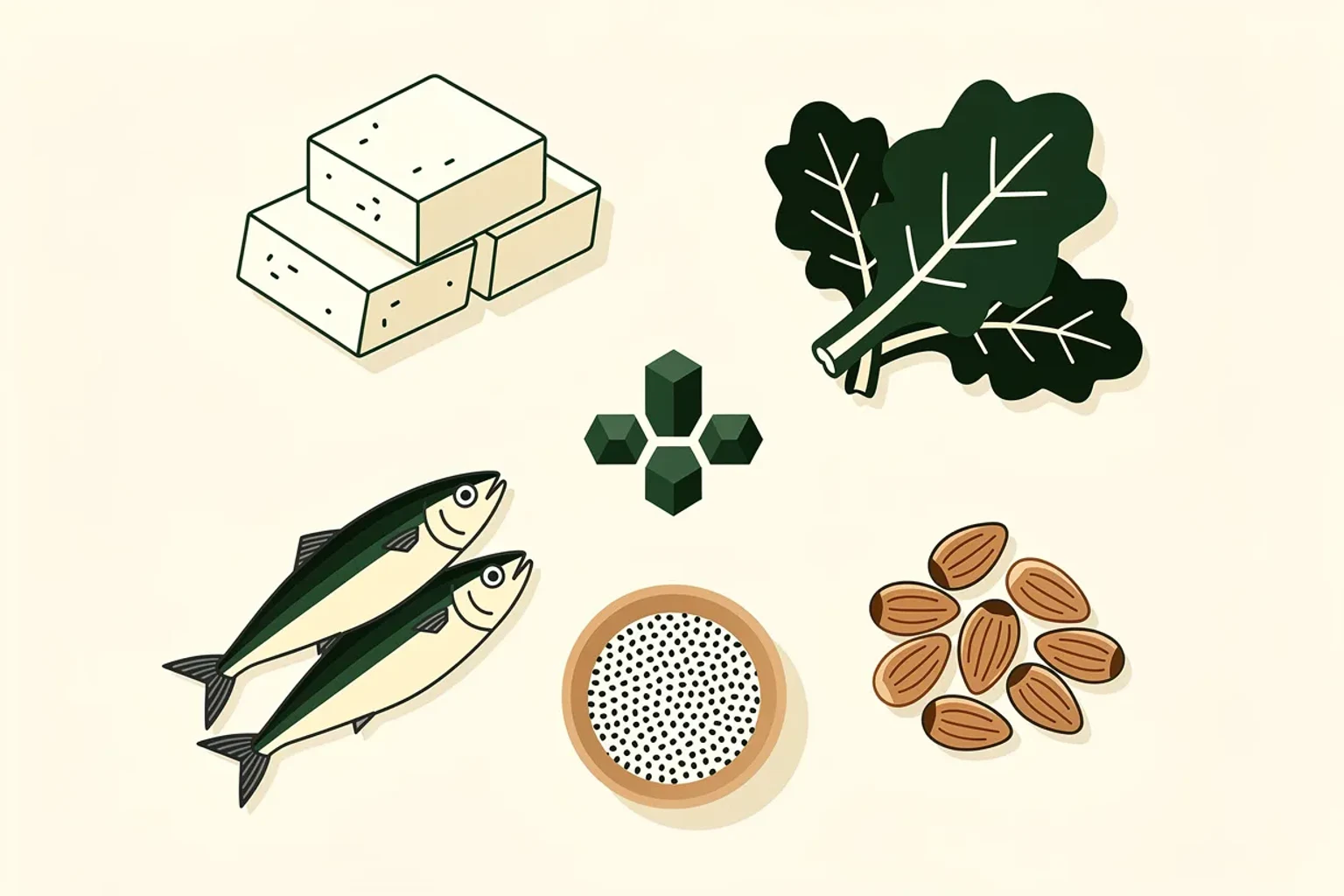
Dairy is the single largest calcium source in most Western diets — about 50 % of total intake. Pull dairy out without a plan and a gap opens fast. The fix isn't complicated, but it has to be deliberate: a few high-density plant sources, calcium-set tofu, fortified plant milks, and small fish with bones if you eat them.
This guide ranks the realistic alternatives by calcium per 100 g, adjusts for absorption (the number that actually matters), and shows a sample day that hits 1000 mg without dairy.
How much calcium you need
Official targets for adults:
| Source | Daily target |
|---|---|
| EFSA (Europe) | 950 mg |
| US National Academies | 1000–1200 mg |
| UK SACN | 700 mg |
| WHO | 1000 mg |
Pregnant and breastfeeding women, adolescents, and adults over 50 sit at the upper end (1200–1300 mg). Children need 800–1100 mg depending on age. Real average intake in adults who avoid dairy: 500–700 mg — well below target.
Why dairy dominates
Per 100 g, dairy is dense and absorbable:
| Food | Calcium |
|---|---|
| Hard cheese (parmesan, cheddar) | 700–900 mg |
| Yogurt | 150 mg |
| Milk | 120 mg |
| Cottage cheese | 80 mg |
Absorption is ~30 %. A glass of milk plus a piece of cheese covers most of a day. That's the bar to clear without dairy.
Top non-dairy sources
Ranked by calcium per 100 g of food.
| Food | Calcium |
|---|---|
| Sesame seeds, whole (with shell) | 975 mg |
| Tahini | 425 mg |
| Sardines, with bones (canned) | 380 mg |
| Tofu, calcium-set (firm) | 350 mg |
| Almonds | 264 mg |
| Kale, raw | 254 mg |
| Dried figs | 162 mg |
| Fortified plant milk (oat, almond, soy) | 120 mg / 100 ml |
| Mustard greens | 115 mg |
| Tempeh | 110 mg |
| White beans, canned | 100 mg |
| Bok choy | 100 mg |
| Spinach, raw | 99 mg |
| Chickpeas, cooked | 90 mg |
| Fortified orange juice | varies |
A few caveats. Sesame seeds: the high number applies to whole seeds with the hull — hulled (white) sesame drops to about 60 mg. Tofu: only if the coagulant is calcium sulfate — read the label. Spinach: see the next section.
Bioavailability matters more than the number
Calcium content per 100 g is half the story. How much you actually absorb depends on what's bound to it — mainly oxalates and phytates.
| Food | Absorption |
|---|---|
| Dairy (milk, yogurt, cheese) | ~30 % |
| Tofu, calcium-set | ~30 % |
| Sesame seeds (whole) | ~30 % |
| Fortified plant milk | ~24 % |
| Kale, bok choy, broccoli | ~50 % |
| Almonds, chickpeas, white beans | ~20 % |
| Spinach, swiss chard, beet greens | ~5 % |
Kale and bok choy punch above their weight: lower mg per 100 g than spinach, but ten times the absorption. Spinach has 99 mg of calcium per 100 g and you absorb about 5 mg of it — effectively zero. The same is true for swiss chard, beet greens, and rhubarb. Treat them as iron and folate, not calcium.
Fortified plant milks (oat, almond, soy) are formulated to match dairy at 120 mg per 100 ml. Absorption is 80 % of dairy's — shake the carton before pouring, the calcium settles.
A sample day for 1000 mg
| Meal | Food | Calcium |
|---|---|---|
| Breakfast | 240 ml fortified plant milk + oats | ~290 mg |
| Snack | 15 g tahini on toast | ~65 mg |
| Lunch | Tofu salad with kale and chickpeas | ~250 mg |
| Dinner | Salmon with sautéed kale | ~150 mg |
| Total | ~755 mg |
That covers three-quarters of the target. Closing the last 250 mg: a tablespoon of whole sesame seeds (~145 mg), an extra glass of fortified plant milk (~120 mg), or a small handful of almonds. If none fits, a supplement of 200–300 mg with a meal works.
The vitamin D and magnesium triangle
Calcium doesn't move alone.
- Vitamin D is required to absorb calcium from the gut. Without enough D, you can eat 1500 mg of calcium and absorb 200. See vitamin D from food.
- Magnesium activates vitamin D in the liver and kidneys. Low magnesium means D stays inactive, which means calcium stays unabsorbed.
- Vitamin K2 directs absorbed calcium into bone instead of arteries.
A dairy-free plan that fixes calcium but ignores D usually fails. Sun exposure, fatty fish, fortified foods, and — for most people in winter — a supplement of 800–2000 IU/day cover D. Magnesium comes from nuts, seeds, dark chocolate, leafy greens, whole grains.
Common mistakes
- Relying on spinach. High mg, almost no absorption. Same for swiss chard and beet greens.
- Ignoring vitamin D. Without D, the calcium just passes through.
- Trusting "fortified" without reading the label. Some plant milks aren't fortified. Some are fortified with 60 mg per 100 ml instead of 120. Check.
- Calcium supplements without food. Absorbed worse on an empty stomach. The Bolland 2010 meta-analysis also flagged a small increase in cardiovascular events at high doses (>1000 mg/day from supplements) — food-first is the safer route.
- Counting hulled sesame as whole. Almost all the calcium is in the hull. Tahini made from hulled seeds carries five to ten times less calcium than tahini from whole seeds.
Who especially needs to plan
- Pregnant or breastfeeding women — 1200–1300 mg/day, plus the fetus or infant pulls calcium from bone reserves if intake falls short.
- Children and adolescents — peak bone mass is built by age 25 and depends on calcium intake in those years.
- Postmenopausal women — estrogen drop accelerates bone loss; calcium plus D plus weight-bearing exercise slows it.
- Adults over 50 — absorption efficiency falls, target rises to 1200 mg.
- Strict vegans without sardines — no dairy, no small fish with bones, so plant sources and fortified products carry the whole load.
For everyone else, dairy-free calcium is fully achievable on a normal diet — it just needs counting once until the new habits stick.
How Vnutri helps
The Vnutri catalog shows calcium per 100 g for every food. The high-calcium filter ranks foods by density (from 100 mg per 100 g). The dairy-free diet filter shows only foods compatible with a dairy-free plan, and you can stack the two to find dairy-free, high-calcium options in one screen.
For the absorption story, see also macros vs micros and the nine diets explained overview.
Frequently asked questions
Can you really get enough calcium without dairy?
Yes — but only with a plan. Average intake in adults who drop dairy without replacing it sits at 500–700 mg, well below the 950–1200 mg target. A daily glass of fortified plant milk, a serving of calcium-set tofu or sardines with bones, and one source of leafy greens (kale, bok choy) closes the gap.
Are fortified plant milks as good as dairy?
Close enough. Calcium content matches dairy (120 mg per 100 ml). Absorption is about 80 % of dairy's — 24 % vs 30 %. Shake the carton; the calcium settles at the bottom.
Why is spinach not a good calcium source?
Spinach carries 99 mg of calcium per 100 g but also high oxalates that bind it before absorption. Net absorption is about 5 %, so 100 g of spinach delivers 5 mg of calcium. Kale, bok choy, and broccoli are low-oxalate and absorbed at 50 % — the right leafy greens for calcium.
Should I take a calcium supplement?
Cover the target from food first. If a real gap remains, 200–500 mg with a meal works. Avoid doses above 1000 mg/day from supplements — the Bolland 2010 meta-analysis flagged a small increase in cardiovascular events at that level. Single doses above 500 mg also absorb poorly; split them.
Lactose-free milk vs plant milk?
Lactose-free milk is regular milk with the lactose broken down. It keeps dairy's 120 mg per 100 ml and 30 % absorption, just no lactose. Works for lactose intolerance but not for a dairy allergy or a vegan plan. Fortified plant milks match the calcium content and are the right choice for both cases.
References
- Weaver CM, Plawecki KL. Dietary calcium: adequacy of a vegetarian diet. Am J Clin Nutr. 1994;59(5 Suppl):1238S–1241S.
- Weaver CM, Proulx WR, Heaney R. Choices for achieving adequate dietary calcium with a vegetarian diet. Am J Clin Nutr. 1999;70(3 Suppl):543S–548S.
- Heaney RP. Calcium, dairy products and osteoporosis. J Am Coll Nutr. 2000;19(2 Suppl):83S–99S.
- Bolland MJ, Avenell A, Baron JA, et al. Effect of calcium supplements on risk of myocardial infarction and cardiovascular events: meta-analysis. BMJ. 2010;341:c3691.
- European Food Safety Authority. Scientific opinion on dietary reference values for calcium. EFSA J. 2015;13(5):4101.
- Tang BMP, Eslick GD, Nowson C, et al. Use of calcium or calcium in combination with vitamin D supplementation to prevent fractures and bone loss in people aged 50 years and older. Lancet. 2007;370(9588):657–666.